India is so excited by the idea of becoming a major power that our new found confidence is changing into arrogance long before it happens. If it does…
‘If you’ve done it, it ain’t braggin,’ is an old Texan saying.
But if you attend a business conference abroad on India, like I did recently, you’d think it’s an old one out of New Delhi.
For almost 6 hours, it was a non-stop gush of staggering numbers and the possibilities for profit in India – a view we’re hearing a lot of nowadays in the media, at seminars and from the government of course. And thanks to an expanding economy Indians are fast shedding their diffidence about themselves and their country. My fear though is that confidence is changing too quickly into arrogance in some quarters - arrogance, that neither has any basis in reality nor advances the interests of ‘Brand India’ in any way. Our image of ourselves is somewhat distorted by this chorus of hallelujahs for India, producing a brash, new nationalism that comes from growing wealth. Fareed Zakaria writes in his new book, ‘The Post-American World’ about this phenomenon in India and China and says that it can morph into something uglier.
It’s already happening in two ways – an intolerance towards anyone who strikes a more skeptical note about rising India and a propaganda-style message about India that is disconnected from reality. Both need to change because we are creating a brand that is bigger than the product.
For instance, if you challenge the idea of a rising India with the dogged optimists by pointing out the Gujarat genocide, you are immediately reminded that Gujarat is also one of the most industrially advanced and administratively efficient states in India. If you point to the fact that most of our engineering graduates are not employable you are immediately reminded that India still produces the highest number of engineering graduates in the world. If you suggest that Indian democracy is so criminalized that it has killed good governance you are told that no other country sends a billion people to the ballot box. This is the new half-full approach to life but it tends to gloss over anything that points in the other direction and brands anyone who says so as a skeptic and a kill-joy. We are in love with the idea of rising India so much that we can immediately marshal the relevant facts to prove it. Remember the ‘India Shining’ campaign? No one knew it would be the lead zeppelin of 2004.
So, just as facts and numbers on India can be spun in a positive way, they can also break down just as easily. For example, India’s growing importance in the world is measured by the fact that we have nuclear weapons, a 9.4% GDP growth rate, the second largest army in the world, a massive geographical territory, a billion people, a politically stable climate and the current flavour of the season internationally, a democratic form of government. This is what the world sees and acknowledges as powerful and this is what fuels India’s aspirations. But a great power is fundamentally supposed to be able to positively influence events, something we can’t do even in our own backyard at the moment. Afghanistan is a mess, Pakistan is losing control over itself, Bangladesh can’t decide when to have elections, Nepal is in transition and Sri Lanka in civil war. India has little or no control over events in its own neighbourhood, let alone projecting its power around the world. Besides even when the chance arose India could not take a bold stand. It refused to condemn China on its actions in Tibet and it did business with the Burmese junta at the height of the crackdown on pro-democracy protests.
On the economy, I can’t interpret the numbers because I am not an economist. But I do know this. A vast majority, 700 million Indians are still on two dollars a day or less. Logically that can’t make us a powerful country in the near future even if more and more Indian billionaires are populating lists of the wealthiest people on the planet.
I’m sure I don’t have to expand on the law and order situation. Most of us have had our share of let-downs and shock defeats with the police. And externally, our nukes might deter China and Pakistan but our government can’t guarantee that bombs won’t kill our people in a bazaar.
My point here is not to say that we shouldn’t be optimistic about India or that India isn’t a rising power. Looking at where we came from, of course it is. But we need to see where we have to go before we acquire the bragging rights. Let’s get rid of the arrogance, and listen to the skeptics. The aspirations of a billion people demand it.
This is the first in a series of columns also available on the NDTV website.
Monday, May 26, 2008


Friday, May 23, 2008
A YOUNG AFGHAN 'GLOBAL LEADER'

Violence begets violence and Afghans know that better than anyone else. One whole generation has seen nothing but guns and war where the sight of a Kalashnikov is as common as that of a kite.
In that generation, just four years before the Soviet invasion in 1979, was born Ahmad Nader Nadery. Despite the lawless, “failed state” that Afghanistan has become through his lifetime, he has soldiered on in his mission to protect human rights. And that’s why he was recognized this year as a “Young Global Leader” by the World Economic Forum for his role as commissioner of the Afghanistan Independent Human Rights Commission (AIHRC).
Addressing human rights in a war zone sounds like an overwhelming task. And it is. Where does it begin? And is it a tiny clean drop in a surging dirty ocean of violations? What good has the U.S. invasion done - people are still dying and an insurgency rages in the south? But just as the mind starts to boggle at these questions, Nader presents a simple analysis to the outsider. “The fact that we are even talking about human rights today is a huge step forward,” he says. And as beginnings go, that is a good one.
Nadery’s ambition for a peaceful Afghanistan was sparked off during his days at the Kabul University where he studied law. “Students represent every section of society and Afghans trust them. So I thought that students should take over the role of maintaining security as the different militias and warlords fight.” He and a friend presented this idea to the UN’s special envoy in Pakistan. It didn’t work. The UN didn’t want to sponsor another armed group. Having tried and failed Nadery went back to Afghanistan to finish his law degree. But by then he had made a staunch enemy in the Taliban for being a meddlesome troublemaker who had the audacity to challenge them. He says, “I was jailed, beaten and tortured for three months by the Taliban but my family managed to bail me out. It was 1999 and I couldn’t go back to Kabul. My siblings had all left for Europe so I decided to join my parents in Pakistan.”
But Peshawar, far from feeling safe, only felt lonely and depressing. The future looked bleak and Nadery remembers that time as a metaphor. There was booming construction in Peshawar with the arrival of Afghan refugees. But back home in Kabul, there was only destruction. Peshawar was being built while Kabul was being destroyed. He couldn’t bear to sit there and do nothing. So while many Afghans were resigned to their fate, waiting for money from relatives abroad and waiting for peace, Nadery decided to do something crazy.
He decided to journey through dangerous Taliban controlled Afghanistan to ask people what they wanted and record their problems – a first step in deciding the future course of the country. He and a friend traveled from Nimroz in the south near the Iranian border ending their journey two months later in Jalalabad between Kabul and the Khyber Pass. They met two other friends to discuss what they had seen and heard from ordinary Afghans about the conflicts and their problems. “We discovered that there was a major ‘legitimacy of power’ crisis. People didn’t trust the government at all because there had been no democratic process after 1978 to legitimize power.” The Taliban had successfully turned Afghanistan into a dark, barren, lawless corner of the world where learning and freedom were completely wiped out. Nadery recalls, “You couldn’t tell whether you were looking at an old man or a young one.” The thick beards and the depression made everyone look old and sad. “There was not a single woman on the street. The Taliban were hated by ordinary people not just for their violence and barbaric forms of justice but also because they abused elders – a grave violation of Afghan culture. But even through this there was a narrow window of hope and I started working for the International Human Rights Law Group gathering information on human rights abuses.” Despite these efforts, under the Taliban the total state of suppression continued.
“So when 9/11 happened and the U.S bombing in Afghanistan began a month later ordinary Afghans welcomed foreign troops,” he says. He himself felt a new surge of hope. The Taliban would be gone and the aspirations of 32 million Afghans would finally be realized.
Nadery became a prominent voice when President Hamid Karzai appointed him the Human Rights Commissioner in the AIHRC in 2002. But six years on Nadery’s job is as tough as it was when he began. “Reconstruction efforts didn’t create job opportunities and people were frustrated.” The Taliban tapped into these frustrations and made their comeback. Renewed pledges on security, rule of law and human rights in London in 2006 have also largely remained unfulfilled. “The Afghan national Army has the confidence of the people but the police are a source of fear and insecurity,” says Nadery. Meanwhile the Taliban has evolved. “They use the media in a very sophisticated way and try to dominate public opinion. They’ve learnt a lot from Iraq, especially suicide bombing.”
The biggest violation of rights is evident in civilian casualties something for which the international forces are equally culpable. Nadery says, “More than 8000 civilians have been killed in the last two years during operations, air-strikes and Taliban suicide bombings. The international forces shoot indiscriminately and torture and abuse detainees.”
Today in Afghanistan the metaphor of his Peshawar experience is evident. Where reconstruction has failed the Taliban is strong or as Nadery says, “Where the road ends the Taliban begins.” Ahmad Nader Nadery is a “Young Global Leader” because he is steadfast in his commitment to push them back.
In that generation, just four years before the Soviet invasion in 1979, was born Ahmad Nader Nadery. Despite the lawless, “failed state” that Afghanistan has become through his lifetime, he has soldiered on in his mission to protect human rights. And that’s why he was recognized this year as a “Young Global Leader” by the World Economic Forum for his role as commissioner of the Afghanistan Independent Human Rights Commission (AIHRC).
Addressing human rights in a war zone sounds like an overwhelming task. And it is. Where does it begin? And is it a tiny clean drop in a surging dirty ocean of violations? What good has the U.S. invasion done - people are still dying and an insurgency rages in the south? But just as the mind starts to boggle at these questions, Nader presents a simple analysis to the outsider. “The fact that we are even talking about human rights today is a huge step forward,” he says. And as beginnings go, that is a good one.
Nadery’s ambition for a peaceful Afghanistan was sparked off during his days at the Kabul University where he studied law. “Students represent every section of society and Afghans trust them. So I thought that students should take over the role of maintaining security as the different militias and warlords fight.” He and a friend presented this idea to the UN’s special envoy in Pakistan. It didn’t work. The UN didn’t want to sponsor another armed group. Having tried and failed Nadery went back to Afghanistan to finish his law degree. But by then he had made a staunch enemy in the Taliban for being a meddlesome troublemaker who had the audacity to challenge them. He says, “I was jailed, beaten and tortured for three months by the Taliban but my family managed to bail me out. It was 1999 and I couldn’t go back to Kabul. My siblings had all left for Europe so I decided to join my parents in Pakistan.”
But Peshawar, far from feeling safe, only felt lonely and depressing. The future looked bleak and Nadery remembers that time as a metaphor. There was booming construction in Peshawar with the arrival of Afghan refugees. But back home in Kabul, there was only destruction. Peshawar was being built while Kabul was being destroyed. He couldn’t bear to sit there and do nothing. So while many Afghans were resigned to their fate, waiting for money from relatives abroad and waiting for peace, Nadery decided to do something crazy.
He decided to journey through dangerous Taliban controlled Afghanistan to ask people what they wanted and record their problems – a first step in deciding the future course of the country. He and a friend traveled from Nimroz in the south near the Iranian border ending their journey two months later in Jalalabad between Kabul and the Khyber Pass. They met two other friends to discuss what they had seen and heard from ordinary Afghans about the conflicts and their problems. “We discovered that there was a major ‘legitimacy of power’ crisis. People didn’t trust the government at all because there had been no democratic process after 1978 to legitimize power.” The Taliban had successfully turned Afghanistan into a dark, barren, lawless corner of the world where learning and freedom were completely wiped out. Nadery recalls, “You couldn’t tell whether you were looking at an old man or a young one.” The thick beards and the depression made everyone look old and sad. “There was not a single woman on the street. The Taliban were hated by ordinary people not just for their violence and barbaric forms of justice but also because they abused elders – a grave violation of Afghan culture. But even through this there was a narrow window of hope and I started working for the International Human Rights Law Group gathering information on human rights abuses.” Despite these efforts, under the Taliban the total state of suppression continued.
“So when 9/11 happened and the U.S bombing in Afghanistan began a month later ordinary Afghans welcomed foreign troops,” he says. He himself felt a new surge of hope. The Taliban would be gone and the aspirations of 32 million Afghans would finally be realized.
Nadery became a prominent voice when President Hamid Karzai appointed him the Human Rights Commissioner in the AIHRC in 2002. But six years on Nadery’s job is as tough as it was when he began. “Reconstruction efforts didn’t create job opportunities and people were frustrated.” The Taliban tapped into these frustrations and made their comeback. Renewed pledges on security, rule of law and human rights in London in 2006 have also largely remained unfulfilled. “The Afghan national Army has the confidence of the people but the police are a source of fear and insecurity,” says Nadery. Meanwhile the Taliban has evolved. “They use the media in a very sophisticated way and try to dominate public opinion. They’ve learnt a lot from Iraq, especially suicide bombing.”
The biggest violation of rights is evident in civilian casualties something for which the international forces are equally culpable. Nadery says, “More than 8000 civilians have been killed in the last two years during operations, air-strikes and Taliban suicide bombings. The international forces shoot indiscriminately and torture and abuse detainees.”
Today in Afghanistan the metaphor of his Peshawar experience is evident. Where reconstruction has failed the Taliban is strong or as Nadery says, “Where the road ends the Taliban begins.” Ahmad Nader Nadery is a “Young Global Leader” because he is steadfast in his commitment to push them back.
Published in The Hindu BusinessLine on May 23rd 2008.
Monday, May 19, 2008
RAJ THACKERAY'S SHORT-TERM THUGGERY

It was with a degree of consternation that most people watched Raj Thackeray’s young army of party-workers attacking Indian citizens from Bihar and UP inside Maharashtra. Was regionalism surfacing again as a new centrifugal force in India? How much traction would it find amongst Maharashtrians? Why have these tendencies not blunted with time? And, is this the start of more violent identity politics?
I discussed these questions with Professor Suhas Palshikar, a political scientist and professor at the Pune University and an expert on Maharashtrian politics. He says, “This is a very short-term strategy by Raj Thackeray because the Maharashtra elections are around the corner. Three years from now you may not hear him saying these things.” He adds, “This is part of the majoritarian brand of politics that does find traction even amongst moderate people.” Raj Thackeray keeps his message conveniently vague invoking a sense of hurt inflicted upon Maharashtrian culture and sentiments and towards the economic status of Maharashtrians. Professor Palshikar says, “He does not want to tie his hands and so his position is ambiguous. The message seems to be that outsiders will have to remain within bounds.” “Regional majoritarianism has good appeal and it is the easiest policy to adopt while entering politics. He wants to gain ground away from the Shiv Sena and there is a space for this kind of regional, identity politics. His strategy will be to be a spoiler in the coming elections.”
Founded only in 2006, Raj Thackeray’s Maharashtra Navnirman Sena will contest its first assembly elections next year.
I discussed these questions with Professor Suhas Palshikar, a political scientist and professor at the Pune University and an expert on Maharashtrian politics. He says, “This is a very short-term strategy by Raj Thackeray because the Maharashtra elections are around the corner. Three years from now you may not hear him saying these things.” He adds, “This is part of the majoritarian brand of politics that does find traction even amongst moderate people.” Raj Thackeray keeps his message conveniently vague invoking a sense of hurt inflicted upon Maharashtrian culture and sentiments and towards the economic status of Maharashtrians. Professor Palshikar says, “He does not want to tie his hands and so his position is ambiguous. The message seems to be that outsiders will have to remain within bounds.” “Regional majoritarianism has good appeal and it is the easiest policy to adopt while entering politics. He wants to gain ground away from the Shiv Sena and there is a space for this kind of regional, identity politics. His strategy will be to be a spoiler in the coming elections.”
Founded only in 2006, Raj Thackeray’s Maharashtra Navnirman Sena will contest its first assembly elections next year.
PS: How can a political party have the very militant word ‘Army’ in it? How can Maharashtra Navnirman Sena or Shiv Sena be allowed? (And just incidentally, both uncle and nephew, Raj and Bal Thackeray are admirers of Adolf Hitler.)
Thursday, May 08, 2008
A TSUNAMI MEMORY FROM CYCLONE NARGIS
 Every day the numbers rise.
Cyclone Nargis has extracted a deadly price in isolated Burma killing nearly 22,500 people as of May 7th with another 41,000 reported missing. But to the witless military junta this appears inconsequential as they are looking to go ahead with a referendum on a new constitution likely to cement their rule.
I’m not about to discuss the merits (of which there are few) and demerits of the Burmese rulers. Instead, their response, or lack of it, reminded me of India’s response to the Indian Ocean tsunami in December 2004.
I was at the Marina Beach in those early hours after the tsunami struck trying to make sense of what was happening because I was covering it for NDTV. I could only confirm 6 deaths in my first live phone interview at 10 am. By 5 pm the figure had jumped to 200 and across south east Asia the toll was 200,000 - quite like the situation in Burma which began with a toll of 351 and has risen alarmingly in the last 3 days.
The world is begging the Burmese junta to accept foreign aid because they need it. It will make the difference between survival and death for its citizens. India had also refused tsunami aid but for entirely different reasons. Keen to prove its dominance in the region and equally eager to keep the US out of its zone of influence, India said “thanks but no thanks.” We wanted to prove that not only could we manage our own affairs, we could help our neighbours too.
And in those early days after the tsunami, I’ll say we sure did. On the Indian mainland in worst hit Tamil Nadu, Jayalalithaa’s government did an outstanding job clearing bodies, cordoning off the beach, shifting people into temporary shelters, providing food and sanitizing the disaster zone. This doesn’t mean that things were working like clockwork, falling into place like a well-rehearsed drill. Quite the contrary because there was a fair degree of confusion and overlap in duties. The effort was outstanding because of the sudden injection of energy, commitment and creativity into the government machinery and its visible presence everywhere. No one could complain that the government didn’t care about them or wasn’t working for them. For someone whose default position is to be anti-establishment this was a refreshing revelation – when push comes to shove the government can deliver. Some of the smartest bureaucrats in Tamil Nadu were on the job leaving the western press a little incredulous that India remained disease free and the situation hadn’t descended into anarchy.
Of course there is an exception here too. Government response in the Andaman and Nicobar islands came late. This had as much to do with inefficiency as it had to do with the fact that island infrastructure was very badly battered. Ayesha Majid, a tribal leader gave an angry TV interview saying if the government didn’t want to help them that was fine but that it should stop lying to the world that everything was under control because her community was shattered and marooned.
But soon the exception became the norm. As people started sensing the opportunities in the midst of grief things changed. The zeal with which government officers had worked was later channeled towards siphoning off aid. The nationalist commitment slowly receded and the old demons of corruption and deceit surfaced once again. And I returned squarely to my default position.
However, it was wonderful, in those brief first few days, to see an Indian government that is capable of so much but alas, does so little.
Monday, May 05, 2008
IS THIS HISTORY?
Guilty until proven innocent. That seems to be the approach of law enforcement agencies towards a lot of Muslims in the lower socio-economic class in India. As the Sachar Committee Report of the Indian government points out, Muslims bear the twin burden of accusations of being “anti-national” and “appeased” at the same time.
What is often under-examined thanks to some of the noise the Hindutva brigade drums up about Muslim appeasement is that Muslims in fact face a lot of structural violence in India; something that has gone up in the Islamophobic environment created after 9/11.
A recent question that appeared in a history exam of the Ranchi University is of a piece with this structural violence. Apart from reflecting an utter and complete lack of academic rigour, it reflects the hardening stereotypes of Islam and Muslims, all happily fueled by the media, a distorted teaching of Indian history and of course the propaganda of the saffron agency.
The question in the university exam was, “Prophet Mohammed started his career as a trader and ended as a raider. Comment.”
There are so many prejudices and assumptions built into that statement that it is worrisome that the person who framed it was teaching. He or she has since been debarred.
What is often under-examined thanks to some of the noise the Hindutva brigade drums up about Muslim appeasement is that Muslims in fact face a lot of structural violence in India; something that has gone up in the Islamophobic environment created after 9/11.
A recent question that appeared in a history exam of the Ranchi University is of a piece with this structural violence. Apart from reflecting an utter and complete lack of academic rigour, it reflects the hardening stereotypes of Islam and Muslims, all happily fueled by the media, a distorted teaching of Indian history and of course the propaganda of the saffron agency.
The question in the university exam was, “Prophet Mohammed started his career as a trader and ended as a raider. Comment.”
There are so many prejudices and assumptions built into that statement that it is worrisome that the person who framed it was teaching. He or she has since been debarred.
Sunday, April 20, 2008
SAFER INDIA
This is some incredibly useful information that was forwarded to me on email. That most honourable of police officers, Kiran Bedi, has started an NGO called Safer India. You can visit the site http://www.saferindia.com/ to log a complaint about any crime if the police in your area does not record your complaint. The NGO will then mail your complaint to the DGP of your state.
That mail can be used as a legal document if you choose to go to court.
I've never used it so I can't vouch for it but if you do and find that it works do tell more people about it.
That mail can be used as a legal document if you choose to go to court.
I've never used it so I can't vouch for it but if you do and find that it works do tell more people about it.
Monday, April 14, 2008
THE SCARLETT CASE...
just got murkier. Small wonder that the Chief Minister of Goa wanted to deflect attention by investigating the mother for carelessness.
Thursday, April 03, 2008
WATCH BASRA CLOSELY
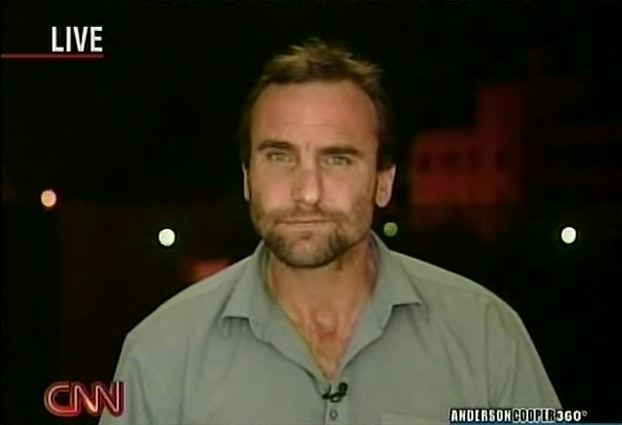 It’s always a great pleasure to attend a talk by a bold journalist like Michael Ware. Ware, in his wonderful unvarnished Australian accent, calls it like it is. In the fog of propaganda, lies and spin, his is the voice of pessimistic reason. He relocated to Iraq when plans of the invasion were underway and has therefore seen the entire gory war drama enfold from start to..... well what is not in sight... the finish. Although, Ware left Iraq on the day the Iraqi Army went into Basra, he told a small audience at the Middle East Institute in DC that Basra is not part of the regular violence that we have grown accustomed to hearing about from Iraq. This latest violence is a window to the world of Iraq if and when America leaves. According to Ware, the proxy battles between Iraq’s neighboring states and the battle for oil and territory will unfold with the ferocity that is being witnessed in Basra now. So all those who advocate troop withdrawal need to watch Basra closely.
Friday, March 14, 2008
STALIN, 'SHAKOTIS' AND SALSA IN LITHUANIA
 The Amber Museum in the seaside town of Palanga. The Museum is in a 19th century Palace set amidst these beautifully manicured gardens.
A view of the village of Neringa on the Curonian Spit.

(Photos by Kannan Narayanaswamy)
Suddenly in 1991, when the Berlin wall fell and the Iron Curtain parted, for the curious traveller all the roads less travelled were finally open. It’s precisely what makes a visit to Lithuania so rewarding. It lies on that road in East Europe that’s buzzing with new freedom and new money, but retains a distinctive stamp of the old communist era and teases the curious visitor to discover where the twain meet.
Landing in the capital Vilnius at midday in late-October, I was excited by the grey streets, the graffiti on bare walls next to Baroque churches, the steel and glass buildings, the old grim faces, the young, trendy girls and the modern cars. In every eyeful there was a slice of all the changes Lithuania has experienced since becoming independent of former USSR. Finally, I said to myself, some good old-fashioned history — not in boring, gigantic, disinfected museums but out in the streets and in peoples’ conversations. Lithuania was going to be exciting and edifying.
A week is a good time in this tiny country of 3.4 million people because it’s easy to crisscross by road if you’ve decided what you want to see (or haven’t). My ten-day agenda however was dictated entirely by my Lithuanian hosts which was fine with me because I couldn’t have planned it better myself. All I really wanted was to get a glimpse of the old, communist Lithuania and the new capitalist EU member. I got a lot more and wondered why this beautiful country was so under-reported.
But the good thing about not knowing anything about a place is that everything holds a surprise. And in the controversial Grutas Park, I walked around with my jaw open. Located 130 km from the Capital, this place is also referred to by the slightly ominous ‘Stalin’s world.’ You walk through the park under the cold gaze of the gigantic statues of Stalin, Lenin and several lesser-known leaders of Lithuania’s brutal 20th-century experience under Soviet rule. After Lithuania became independent it pulled down their statues of all these reviled men and dumped them in storehouses. Later, a Lithuanian millionaire bought them up to set up the park. Walking through it is an Orwellian experience as loudspeakers blare out commands from old wooden watchtowers and old train compartments remind you of the thousands of Lithuanians sent to their deaths in Siberia.
Walking around its many hectares can make you hungry and a local café completes the experience by offering a “nostalgia menu”, which of course goes with vodka shots. However, one guest at our table went too far when he raised a toast to Russia. Our Lithuanian hosts almost choked on their drinks.
The faux pas however was soon forgotten and we continued to drive around the country, stopping off at towns like Alytus, the impossibly named spa resort of Druskininkai, and the cities of Kaunas and Klaipeda. Walking tours with a local guide are the best way to discover these places because they’re very small, afford wonderful views and the local guide can narrate interesting stories of local resistance against the Soviets.
Sometimes, though, the nicest part of the day would be spent sitting around in the living room in the evening with my hosts, drinking coffee and eating the strange-looking, great-tasting Lithuanian cake called shakotis.
Regardless of what draws you to Lithuania, a visit to the ecological wonder called the Curonian Spit is an absolute must. It’s a challenge of nature kept habitable by human effort. The spit is a 98-km-long island of sand separated from the Lithuanian mainland by a lagoon.
We boarded our car onto a ferry to reach this UNESCO World Heritage Site and drove through its charming villages of cottages between pencil-straight lanes. But what makes the Curonian Spit so special is that half its landscape looks like the desert of Arabia while the other looks like the Black Forest of Germany. So, it is dull brown sand and dark green forest surrounded by deep blue sea. This erstwhile western edge of the communist empire is a place where you can get away from it all. Just don’t wander off too far on your Lithuanian visa though — half the island is still with Russia!
As the trip was winding down I was casting about for souvenirs, and one of the nicest things about shopping in Lithuania is that you don’t have to buy cheesy ‘I love Lithuania’ T-shirts and mugs. You should make the only sensible choice there is — amber. In the seaside town of Palanga we spent an afternoon gazing at the exhibits in the Amber museum, which was housed in a 19th-century palace set amidst vast botanical gardens. Of course, treat the amber in the museum store as an exhibit also because you’ll get it outside for half the price.
I headed back from the coast with lots of memories, a little amber and some litas (Lithuanian currency) to spare. My vacation was coming to an end and to stall the impending sorrow we headed out for a last evening on the town.
Vilnius nightlife was a fantastic surprise — it’s alive, it’s raucous and it’s wild. The people in the nightclub were from everywhere… it could’ve been a club in New York, Melbourne or Mumbai. But lovely Lithuania is special — where else will you get Stalin, shakotis and salsa on the same trip?
Published in 'The Hindu BusinessLine' on 14th March 2008.
Wednesday, March 12, 2008
SEXISM AND CORRUPTION IN THE KEELING CASE
 When the Indian police conducts an investigation under the glare of the media, it is only a matter of time before the cracks and the corruption are laid bare. To that extent, their probe into the rape and murder of a 15-year old British tourist is following a familiar script. The police's ineptitude and insensitivity were on full display when Scarlett Keeling’s dead body turned up on a beach in Goa. It was quickly dismissed as a case of drowning. Only when Scarlett’s mother Fiona MacKeown insisted on a second autopsy did the Goa police suddenly regain their vision to see that her body was actually covered all over with nearly 50 cuts and bruises. And incidentally, there was not enough salt water in her lungs either to corroborate the drowning story.
In the sordid history of failures of the Indian police, this is only the latest chapter.
But throwing an element of lunacy into the bungled probe is the Chief Minister of Goa Digamber Kamat. He wants to investigate the teenager’s mother for negligence!
In the days leading up to her murder, Scarlett was not with her family and was staying with 25-year old tour guide, Julio Lobo. The story gets a little strange here because Scarlett was allegedly in a sexual relationship with this man whom her mother describes as “very caring” as an uncle would be. You could argue that it was foolish of her mother to leave her teenage daughter alone but it was certainly not illegal if she thought the person she was leaving her with was responsible! In fact, this notion of charging the mother for negligence can be turned on its head because assuming Julio Lobo had had sex with Scarlett Keeling it would still be rape under Indian law because it involved a minor. Then Samson D'Souza, the current suspect under police custody could either be the wrong guy as the Keeling family alleges or is simply one of the suspects.
Someone needs to point that out to Digamber Kamat.
I also think this is typical of the sexist insinuations that fly in rape investigations. By wanting to investigate the mother, the Chief Minister is placing the onus on the victim’s family to prove that the girl wasn’t asking to be raped, insinuating, in other words, that it was but natural that she was raped because she was alone.
Shame on you Digamber Kamat.
If Fiona MacKeown intends to fight to the finish and teach Kamat and the police a few lessons she will have the support of millions of Indian women like me.
Friday, February 22, 2008
PUTIN'S ACID TONGUE

At a recent press conference on Valentine’s Day, Russian President Vladimir Putin was asked to react to a remark by Hillary Clinton who said that as a former K.G.B. officer, Putin “has no soul.”
His reponse?
“As a minimum, a state official must at least have a head.”
Mr. Putin was also asked about complaints from the Organization for Security and Cooperation in Europe (OSCE) which says that elections are routinely rigged in post-Soviet autocracies. They complained that Russia was making it impossible to assess the current campaign and election fully because of it’s various restrictions.
Putin seemed to have dipped his tongue in vinegar before the presser. His response again was that the OSCE needs to be overhauled and suggested that the monitors intended to teach Russia how to become democratic.
“Let them teach their wives to make shchi,” he said. Shchi is a popular Russian cabbage soup.
His reponse?
“As a minimum, a state official must at least have a head.”
Mr. Putin was also asked about complaints from the Organization for Security and Cooperation in Europe (OSCE) which says that elections are routinely rigged in post-Soviet autocracies. They complained that Russia was making it impossible to assess the current campaign and election fully because of it’s various restrictions.
Putin seemed to have dipped his tongue in vinegar before the presser. His response again was that the OSCE needs to be overhauled and suggested that the monitors intended to teach Russia how to become democratic.
“Let them teach their wives to make shchi,” he said. Shchi is a popular Russian cabbage soup.
(Quotes from Putin’s press conference as reported by the New York Times.)
Friday, February 15, 2008
BENAZIR BHUTTO'S STATEMENT

This is a reproduction of Benazir Bhutto’s hand-written will. As she left Dubai last year, she certainly seemed to know that her end was near. In this statement written two days before the first bomb attack on her convoy, she passes on the baton of the PPP and seems to be saying goodbye and good-luck. Full text below:
Pakistan Peoples Party
To the officials and members of Pakistan Peoples Party I say that I was honoured to lead you. No leader could be as proud of their party, their dedication, devotion and discipline to the mission of Quaid E Azam Zulfikar Ali Bhutto for a Federal, Democratic and Egalitarian Pakistan as I have been proud of you. I salute your courage and your sense of honour. I salute you for standing by your sister through two military dictatorships.
I fear for the future of Pakistan. Please continue the fight against extremism, dictatorship, poverty and ignorance.
I would like my husband Asif Ali Zardari to lead you in this interim period until you and he decide what is best. I say this because he is a man of courage and honour. He spent eleven-and-a-half years in prison without bending despite torture. He has the political stature to keep our party united.
I wish all of you success in fulfilling the manifesto of our party and in serving the downtrodden, discriminated and oppressed people of Pakistan. Dedicate yourself to freeing them from poverty and backwardness as you have done in the past.
Benazir Bhutto
October 16, 2007.
Pakistan Peoples Party
To the officials and members of Pakistan Peoples Party I say that I was honoured to lead you. No leader could be as proud of their party, their dedication, devotion and discipline to the mission of Quaid E Azam Zulfikar Ali Bhutto for a Federal, Democratic and Egalitarian Pakistan as I have been proud of you. I salute your courage and your sense of honour. I salute you for standing by your sister through two military dictatorships.
I fear for the future of Pakistan. Please continue the fight against extremism, dictatorship, poverty and ignorance.
I would like my husband Asif Ali Zardari to lead you in this interim period until you and he decide what is best. I say this because he is a man of courage and honour. He spent eleven-and-a-half years in prison without bending despite torture. He has the political stature to keep our party united.
I wish all of you success in fulfilling the manifesto of our party and in serving the downtrodden, discriminated and oppressed people of Pakistan. Dedicate yourself to freeing them from poverty and backwardness as you have done in the past.
Benazir Bhutto
October 16, 2007.
Thursday, January 31, 2008
SMILE PLEASE, IT'S DIPLOMATESE

Government propaganda isn’t as sophisticated in India as it is in the United States. Obfuscation has been elevated to art. But here are some less-than-intelligent and bizarre samples of American euphemisms.
The U.S. invasion of Grenada in 1983 began at five am with the descent of thousands of U.S Army Rangers in parachutes. It was codenamed Operation Urgent Fury. But quite contrary to the sound and fury of that codename, the U.S. described it as the “pre-dawn vertical insertion of personnel.”
Several instances of diplomatese can be found in the tomes produced by the State Department. In a Human Rights report on Zaire in the 1970s, when the U.S was friends with Mobutu, the language was kept soft enough to be palatable to him and yet not so diluted as to be a complete lie. Here is an example. “Generally speaking, non-political prisoners are not subject to repeated beating.”
That’s not an under-statement. It's an un-statement.
A similarly inspired U.S spokesman said last year on Iraq, “There are some parts of the Sunni Triangle where the security situation right now, quite frankly, is not that bad. In parts of the Diyala Province, some parts of the Salahuddin Province and some parts of Nineveh Province the situation is not all blood and fire and destruction in all places every day.”
So wait, what is it everyday? Come again?
Closer home, President Musharraf bowled a googly in 2002. In a referendum on his presidency, voters were asked the following question: ‘For the survival of the local government system, establishment of democracy, continuity of reforms, end to sectarianism and extremism, and to fulfill the vision of our nation’s glorious founder, would you like to elect President General Pervez Musharraf as President of Pakistan for five years?”
YesNo.
Sunday, December 09, 2007
COALITION OF THE UNWILLING?
The Washington Post today carried a story about the U.S’ shrinking ‘coalition of the willing’ in Iraq. As the war has dragged on since the invasion in mid-2003, six countries have left while the ranks of the remaining coalition soldiers have thinned. But I almost fell off my chair in disbelief this morning when I read the numbers contributed by some. Five countries have less than 10 people in Iraq. According to the Post, Latvia has three soldiers in Iraq, Slovakia two, and Singapore one! To borrow a joke from one of my professors, this definitely looks more like the coalition of the unwilling.
A FRIGHTENING SCENARIO IN SIDHPUR, GUJARAT
This is a piece written by my dad who has been researching the heritage and architecture of the Dawoodi Bohra community in Sidhpur in Gujarat. The beautiful family homes there are today in a perilous state of disrepair - victims of cultural disrespect and neglect and now perhaps even falling prey to the ill wind of communalism blowing through Gujarat.
If you'd like more information please leave a comment with your contact email address and we'll get back to you.
A frightening scenario emerging in Sidhpur
Any observant visitor to Sidhpur cannot but help noticing that a very massive tract of land abutting the railway station and the Inter-city bus stand belongs to the minority Dawoodi Bohra Community. Part of this land is occupied by Community facilities like Roza/Kabrasthan (mausoleum); Masjid (mosque); Musafar Khana (guest house) and Jamaat Khana (dining hall) and the bulk of it by the heritage houses of Najampura and Harariya. The general residential areas of other communities begin nearly 1.5 kms away from the station (on its eastern side).,
For a very long time there have been soft, benign murmurs among the majority community that one day all these fine heritage houses will belong to them.
Perhaps with the intention of moving closer to the station; perhaps due to a rising demand for space, the majority community had begun buying property in predominantly Bohra areas at reasonable and market prices. There was no force, no intimidation and no coercion. The trend was starting to assume torrential proportions when the local Jamaat decided that enough was enough. This encroachment needed to be stopped. An arzee (petition) was sent to Aqa Maula (spiritual head of the Dawoodi Bohra community) and a farmaan (decree) was received aiming to plug this glaring violation. "No Bohra house was to be sold to anybody outside the community, no matter what the offer."
For a brief period matters appeared to be under control. Then a new virulent equation cropped up. Selling a house – and there are many reasons for selling -at reasonable, market price had become difficult owing to a very limited demand. So the house owners (mostly with large family trees and little stake in the property) began seeking recourse in demolishing the building; recovering a fair bit of the value and retaining a nuisance-free vacant site. Here was a classic case of "having your cake and eating it too". At least 15 houses were pulled down in an indirect response to a well meant farmaan. The disease having run its course, all the weak players have dropped off one by one. And now a frightening pattern is emerging. Over the last one year there have been umpteen cases of impertinent and in-your-face burglaries; of breaking into locked houses; damaging and stealing at random and often staying within for a week. At times the thieves have left notes threatening action against anyone who dares to inform or retaliate. The police on the other hand wave a lethargic arm and make only token efforts to apprehend the culprits. Something fishy is in the air. Clearly the intention is to intimidate. The initial sleepy response from the victim was a myopic belief that lightning never strikes any spot twice. The thieves having done with their house would now leave them alone. Passive resignation was followed by a forced amnesia.
Here is a useful insight. A few years ago a Chennai Jamaat group had been on a mission to prepare estimates for hosting Aqa Maula's Ashara Vaaz (10 days of Moharram) at Sidhpur. A constant refrain that came up then, among the shopkeepers, was – "if only all these closed houses were to open up, how much more would the local economy benefit". But alas! That was not to be. But the events on the night of Sunday 1 Dec. 2007 have thrown a blinding light on a frightening pattern. After a gap of nearly eight hundred years, Sidhpur has witnessed an act of deliberate sacrilege.
Riots have come and gone; Tempers have flared and cooled; Animosity has ebbed and flowed. But never has a sacrosanct place been violated or its keepers assaulted.
The highly venerated Kazikhan Maula's Roza Mubarak (mausoleum) – the beacon of Sidhpuri Dawoodi Bohras – has come under the malfeasant glare of a bizarre and conspiratorial mind, throwing open a wide ranging set of questions.
Who are these people? What is their motive? Have we stirred up a hornet's nest by conducting an economic survey? Is the game plan about land and space? Is it a communal problem? Are the chickens coming home to roost?
The Dawoodi Bohras of Sidhpur need to do a lot of introspection.
If you'd like more information please leave a comment with your contact email address and we'll get back to you.
A frightening scenario emerging in Sidhpur
Any observant visitor to Sidhpur cannot but help noticing that a very massive tract of land abutting the railway station and the Inter-city bus stand belongs to the minority Dawoodi Bohra Community. Part of this land is occupied by Community facilities like Roza/Kabrasthan (mausoleum); Masjid (mosque); Musafar Khana (guest house) and Jamaat Khana (dining hall) and the bulk of it by the heritage houses of Najampura and Harariya. The general residential areas of other communities begin nearly 1.5 kms away from the station (on its eastern side).,
For a very long time there have been soft, benign murmurs among the majority community that one day all these fine heritage houses will belong to them.
Perhaps with the intention of moving closer to the station; perhaps due to a rising demand for space, the majority community had begun buying property in predominantly Bohra areas at reasonable and market prices. There was no force, no intimidation and no coercion. The trend was starting to assume torrential proportions when the local Jamaat decided that enough was enough. This encroachment needed to be stopped. An arzee (petition) was sent to Aqa Maula (spiritual head of the Dawoodi Bohra community) and a farmaan (decree) was received aiming to plug this glaring violation. "No Bohra house was to be sold to anybody outside the community, no matter what the offer."
For a brief period matters appeared to be under control. Then a new virulent equation cropped up. Selling a house – and there are many reasons for selling -at reasonable, market price had become difficult owing to a very limited demand. So the house owners (mostly with large family trees and little stake in the property) began seeking recourse in demolishing the building; recovering a fair bit of the value and retaining a nuisance-free vacant site. Here was a classic case of "having your cake and eating it too". At least 15 houses were pulled down in an indirect response to a well meant farmaan. The disease having run its course, all the weak players have dropped off one by one. And now a frightening pattern is emerging. Over the last one year there have been umpteen cases of impertinent and in-your-face burglaries; of breaking into locked houses; damaging and stealing at random and often staying within for a week. At times the thieves have left notes threatening action against anyone who dares to inform or retaliate. The police on the other hand wave a lethargic arm and make only token efforts to apprehend the culprits. Something fishy is in the air. Clearly the intention is to intimidate. The initial sleepy response from the victim was a myopic belief that lightning never strikes any spot twice. The thieves having done with their house would now leave them alone. Passive resignation was followed by a forced amnesia.
Here is a useful insight. A few years ago a Chennai Jamaat group had been on a mission to prepare estimates for hosting Aqa Maula's Ashara Vaaz (10 days of Moharram) at Sidhpur. A constant refrain that came up then, among the shopkeepers, was – "if only all these closed houses were to open up, how much more would the local economy benefit". But alas! That was not to be. But the events on the night of Sunday 1 Dec. 2007 have thrown a blinding light on a frightening pattern. After a gap of nearly eight hundred years, Sidhpur has witnessed an act of deliberate sacrilege.
Riots have come and gone; Tempers have flared and cooled; Animosity has ebbed and flowed. But never has a sacrosanct place been violated or its keepers assaulted.
The highly venerated Kazikhan Maula's Roza Mubarak (mausoleum) – the beacon of Sidhpuri Dawoodi Bohras – has come under the malfeasant glare of a bizarre and conspiratorial mind, throwing open a wide ranging set of questions.
Who are these people? What is their motive? Have we stirred up a hornet's nest by conducting an economic survey? Is the game plan about land and space? Is it a communal problem? Are the chickens coming home to roost?
The Dawoodi Bohras of Sidhpur need to do a lot of introspection.
Saturday, December 01, 2007
Thursday, November 29, 2007
I'm just learning how to fool around on Facebook and am frankly a bit stunned by two things.
First. It's so public! You can glean so much information about people you love, hate, love-to-hate, want-to-forget and every other variety in between.
And second. So many people have so much personal information on it! Aren't you scared?
First. It's so public! You can glean so much information about people you love, hate, love-to-hate, want-to-forget and every other variety in between.
And second. So many people have so much personal information on it! Aren't you scared?
Friday, October 19, 2007
FOOLING AROUND WITH BUSH
Last weekend, we smushed George Bush. In fact, we smushed him so badly, his head came off.
So what were we up to exactly?
I think we were celebrating freedom of speech and expression while playing with a rubber doll. I doubt there are too many countries in the world that sell little caricature rubber pieces of their President or Prime Minister at the national airport. And since they do in America, they went the whole hog and added the words ‘No Brainer’ at the back of his head.
I bought one and introduced him to my three year old niece. I told her he was ‘George Bush’ and that she could go ahead and ‘smush him.’ She did it in right earnest. In fact once when she dropped him she prophetically said, “George Bush went down.”
Of course, honey. He’s definitely headed that way.
By Sunday night she had been kneading little rubber Bush with such gusto that his head came off. We put it back on because we won’t be denied the joy of smushing Bush.
So what were we up to exactly?
I think we were celebrating freedom of speech and expression while playing with a rubber doll. I doubt there are too many countries in the world that sell little caricature rubber pieces of their President or Prime Minister at the national airport. And since they do in America, they went the whole hog and added the words ‘No Brainer’ at the back of his head.
I bought one and introduced him to my three year old niece. I told her he was ‘George Bush’ and that she could go ahead and ‘smush him.’ She did it in right earnest. In fact once when she dropped him she prophetically said, “George Bush went down.”
Of course, honey. He’s definitely headed that way.
By Sunday night she had been kneading little rubber Bush with such gusto that his head came off. We put it back on because we won’t be denied the joy of smushing Bush.
Monday, October 08, 2007
THE WORLD’S LARGEST DEMOCRACY – SHOULD STAND UP FOR IT

‘Don’t go for gas, go for democracy.’
As India’s petroleum minister drove to the New Delhi airport on his way to Burma (Myanmar), pro-democracy protesters lined the streets with this message. But even as blood flowed on the streets of Rangoon, India went with blinders on, just for the oil.
Last week in mysterious, isolated Burma, democracy was crushed once again. Buddhist monks spearheading a new pro-democracy struggle were rounded up, beaten, jailed, and even killed when they rose up against the repression of their military rulers. The desperate Burmese looked to India for help and moral support because none was forthcoming from China. But India’s response was frustratingly typical. Like an ostrich sensing trouble – India buried its head in the sand, calling the protests Burma’s “internal matter.”
The world’s largest democracy, India, must shed this timidity, and mark its presence on the international stage by wielding more influence in the region. This fence-sitting is terrible for its image.
Boasting an annual growth rate of more than 9%, India has significant energy interests that have overtaken principled foreign policy issues. But the return on investment thus far in Burma is so below par that even the two main issues of the politics of realism or realpolitik do not justify India’s silence.
First, energy hungry China and India are competing for Burma’s natural gas and oil reserves. To achieve this, India started wooing the military junta in 1994. But in the last 13 years India has received no gas from Burma. Indeed, a few weeks ago, two contracts were awarded to PetroChina.
Second, Burma shares a border with India’s volatile north-east, plagued by tribal insurgency. India believes it needs the Burmese military’s help to flush out insurgents setting up training camps on the Burmese side. But, of the many groups that operate there, the Burmese army has taken action against only one, with whom India had a ceasefire anyway. Burma even receives arms and ammunition from India for these so-called counter-insurgency operations.
It seems then that tiny, dictatorial Burma benefits more from this relationship with India than the other way around. That’s pathetic for a country that likes the title of ‘superpower’. Now is the time to enhance that reputation because India has gained little from Burma anyway.
Besides, India can’t wish away Burma’s struggle for democracy. Economists warn that the uprisings will keep returning to political centre-stage in Burma because of the fragile nature of its economy. The Army has made most Burmese hopelessly poor. This latest struggle began on August 15th when the junta recklessly withdrew fuel subsidies. The price of gas went through the roof, rising almost 500%. Most Burmese could not even afford a bus ride. The Generals are handling the economy so poorly, that unrest might become a permanent feature in Burma. Given this situation, India will have to deal with its eastern neighbour sooner or later. It simply can’t afford to look away every time.
India must support democracy in Burma. As the only stable democracy in the region, it has the moral authority to preach it. It can’t justify supporting the dictators because it has gained nothing yet from the relationship economically either.
The Burmese have faced grave injustice for more than four decades. They want democracy but it’s been snatched from them with guns and violence every time.
Ironically on 15th August, when unrest began, India was celebrating its 60th year of independence. It’s time then for the world’s largest democracy to speak up boldly and stand up for freedom in its own backyard.
Tuesday, October 02, 2007
FOR AMERICA - TIME TO RETURN SOME FAVOURS

On the empty street outside the U.S. Embassy in Baghdad, Ahmed would often find himself alone with his massive shadow. He feared the militias were waiting to kill him for working as an interpreter for the Americans.
When Ahmed requested his American bosses turn off the floodlights as he left, he was assured that somewhere in a watchtower American snipers were watching his back.
Months later, Ahmed went up there to thank them. The snipers didn’t know what he was talking about and then could only laugh. Ahmed felt betrayed. He realized no one was looking out for him. He had just been lucky. The Iraqis were on their own. As they are today.
Hundreds of loyal Iraqis are on the run from militias for helping America. They want asylum in the U.S. But America has yawned in their faces. Iraqis are dying while America’s refugee program remains riddled with red-tape.
America has a moral obligation in Iraq, and it should do more to help law-abiding Iraqis who supported its war efforts to get out of there.
Ahmed is part of the massive humanitarian crisis unfolding in Iraq. According to the U.N. High Commission for Refugees (UNHCR) 4.2 million people have been displaced. Jordan and Syria have each taken in more than a million Iraqis.
America had promised to provide refuge to 7000 Iraqis by the end of September. Only 829 have been admitted. Ryan Crocker, U.S. Ambassador in Iraq, says that at this rate Iraqis will have to wait anywhere between 10 months to two years to get a visa, if at all. Crocker articulated the asylum seekers desperation when he sent two damning cables to Washington. One was bluntly titled, ‘Iraqi Refugee Processing: Can We Speed it Up?’
There are legitimate security concerns for America. Could the U.S. be letting in disgruntled Iraqis who could turn against the country? It’s possible and that’s why the security screening should not be lenient. What Washington should do however is respond with the sense of urgency that Crocker is demanding.
When Ahmed requested his American bosses turn off the floodlights as he left, he was assured that somewhere in a watchtower American snipers were watching his back.
Months later, Ahmed went up there to thank them. The snipers didn’t know what he was talking about and then could only laugh. Ahmed felt betrayed. He realized no one was looking out for him. He had just been lucky. The Iraqis were on their own. As they are today.
Hundreds of loyal Iraqis are on the run from militias for helping America. They want asylum in the U.S. But America has yawned in their faces. Iraqis are dying while America’s refugee program remains riddled with red-tape.
America has a moral obligation in Iraq, and it should do more to help law-abiding Iraqis who supported its war efforts to get out of there.
Ahmed is part of the massive humanitarian crisis unfolding in Iraq. According to the U.N. High Commission for Refugees (UNHCR) 4.2 million people have been displaced. Jordan and Syria have each taken in more than a million Iraqis.
America had promised to provide refuge to 7000 Iraqis by the end of September. Only 829 have been admitted. Ryan Crocker, U.S. Ambassador in Iraq, says that at this rate Iraqis will have to wait anywhere between 10 months to two years to get a visa, if at all. Crocker articulated the asylum seekers desperation when he sent two damning cables to Washington. One was bluntly titled, ‘Iraqi Refugee Processing: Can We Speed it Up?’
There are legitimate security concerns for America. Could the U.S. be letting in disgruntled Iraqis who could turn against the country? It’s possible and that’s why the security screening should not be lenient. What Washington should do however is respond with the sense of urgency that Crocker is demanding.
America can begin by implementing a few of Crocker’s suggestions immediately - Put more people on the job at the embassy in Amman, allow at least Iraqi employees like Ahmed to apply for visas in Baghdad, and try interviewing Iraqis through video conferencing.
The whole process of for refugee status needs to be simpler. Iraqis can’t even apply for refugee status within their own country. The U.S. considers it too unsafe to let so many people into the Green Zone in Baghdad. So, Iraqis have to undertake a perilous journey to the U.S. Embassy in Amman to apply. The understaffed embassy there begins processing their papers while the Iraqis return to the minefield of home, to wait. But, as Crocker has pointed out, the much awaited call could come up to two years later. In Iraq’s tumultuous conditions, that is far too long.
Acknowledging Crocker’s missive however is at odds with the noises the Bush administration makes about the war. If we are told that the situation on the streets of Baghdad is improving, then how come there is a mass exodus of people fleeing to Jordan, Syria, Sweden, Norway, Germany and Denmark, and now clamoring to enter America?
The propaganda about this war lies at the heart of the problem plaguing America’s response to this massive displacement of people. Instead of responding to the refugee problem highlighted by its own ambassador in Baghdad, the Bush administration has started its usual round of finger-pointing. While the Department of Homeland Security and the State Department engage in the blame game, this crisis is costing lives in Iraq.
The refugee problem needs to go right on top of the Iraq agenda. Every humanitarian agency working in Iraq recognizes its explosive nature except America. The UNHCR has said that relocating within Iraq is not an option for asylum seekers from Southern and Central Iraq - they simply have to get out of there or they’ll get killed. It has also doubled its budget to $123 million to tackle the crisis.
America needs to help the refugees now to save the lives of loyal Iraqis like Ahmed. By speeding up the refugee intake, the U.S has a real opportunity to do something it hasn’t done in a long time – regain some moral support in the world by restoring the faith of old friends.
Friday, June 15, 2007
FIRST LADY, FIRST FAUX PAS
 The post of President is largely a ceremonial one. Fine suits, or sarees as might be the case soon, hosting, toasting, wining, dining and the right words in the right place are the demands of the job. But the potential first lady President of India, Pratibha Patil, has already committed her first faux pas. In her first press meeting after her candidature was announced, she said she was concerned about the disparities in wealth distribution in our country. She felt however that schemes like the NREGS (National Rural EMPLOYMENT guarantee Scheme) attempted to create more opportunities for the rural poor and congratulated the other first lady Sonia Gandhi for it. But what she really called it, before TV cameras, was Sonia Gandhi's "unemployment guarantee scheme!"
Monday, June 04, 2007
THE BUDDHA SAYS...
A wonderful quote borrowed from Neodawn's blog.
"Do not believe in anything simply because you have heard it. Do not believe in anything simply because it is spoken and rumored by many. Do not believe in anything simply because it is found written in your religious books. Do not believe in anything merely on the authority of your teachers and elders. Do not believe in traditions because they have been handed down for many generations. But after observation and analysis, when you find that anything agrees with reason and is conducive to the good and benefit of one and all, then accept it and live up to it."
The Buddha
"Do not believe in anything simply because you have heard it. Do not believe in anything simply because it is spoken and rumored by many. Do not believe in anything simply because it is found written in your religious books. Do not believe in anything merely on the authority of your teachers and elders. Do not believe in traditions because they have been handed down for many generations. But after observation and analysis, when you find that anything agrees with reason and is conducive to the good and benefit of one and all, then accept it and live up to it."
The Buddha
Sunday, June 03, 2007
PARTY POOPER'S MESSAGE
 For me driving around in Chennai over the last few weeks has been a nauseating experience. I just can’t understand how people can be such sycophants and plaster the city with unlicensed, illegal hoardings of one man and his family and treat him above God Almighty and surrender their conscience and soul to him.
M.Karunanidhi has done nothing publicly to rein in his delinquent son M.K.Azhagiri for the murderous violence his supporters perpetrated on the employees of the ‘Dinakaran’ newspaper. I have little sympathy, mind you, for the Maran brothers who have thus far ridden happily on the back of a political empire to become all-powerful in this state. But to return to the earlier point, the DMK rank and file, far from mourning the behaviour of their colleagues in Madurai, far from hanging their heads in shame for belonging to a party responsible for the death of three people, are instead going berserk displaying their 'love' and loyalty. From laser shows and talking images of Periyar and Anna singing MK’s praises to people turning up from all corners of the state to wish their leader on his birthday, this celebration smacks of vulgarity that has become too commonplace to make news.
Why is a private function so public? Why must we be subjected to having our already ugly cityscape made worse by pictures of corrupt, duplicitous politicians?
Why isn’t there any outrage?
What can we do?
Saturday, May 05, 2007
FINALLY, THE TIDE TURNS
I was delighted to open the papers this morning. The headlines in 'The Hindu' - 'Geetha Johri report speaks of "collusion of State government" and next to that 'Rasheed names MPs, ex-Minister'. Occasionally the tide turns against the people who govern this country and its deeply satisfying to find that somebody can put the fear of God in them.
What is fantastic is that people within the system exposed the dangerous and delinquent officers. First a damning report by Geetha Johri, IGP where she says the entire episode of killing Sohrabuddin, his wife Kauserbi and a key witness Prajapati, "makes a complete mockery of the rule of law and is perhaps an example of the involvement of the state government in a major crime."
But Geetha Johri was removed and Rajneesh Rai took over. The officer shocked his superiors by actually arresting the notorious trio and killer-in-chief, D G Vanzara. He has now been removed and reports suggest its because he was pushing for a narco-analysis test on the three arrested cops. But Geetha Johri is back and the state government has to submit its report on May 15th. Based on that the Supreme Court will decide whether to order a CBI probe or not, something Johri herself had recommended. This is certainly a story to follow till the very end if we are interested in promoting the efforts of officers with integrity like Geeta Johri and making sure that such rogues are exposed - rogues who have no respect for the citizens of this country.
What is fantastic is that people within the system exposed the dangerous and delinquent officers. First a damning report by Geetha Johri, IGP where she says the entire episode of killing Sohrabuddin, his wife Kauserbi and a key witness Prajapati, "makes a complete mockery of the rule of law and is perhaps an example of the involvement of the state government in a major crime."
But Geetha Johri was removed and Rajneesh Rai took over. The officer shocked his superiors by actually arresting the notorious trio and killer-in-chief, D G Vanzara. He has now been removed and reports suggest its because he was pushing for a narco-analysis test on the three arrested cops. But Geetha Johri is back and the state government has to submit its report on May 15th. Based on that the Supreme Court will decide whether to order a CBI probe or not, something Johri herself had recommended. This is certainly a story to follow till the very end if we are interested in promoting the efforts of officers with integrity like Geeta Johri and making sure that such rogues are exposed - rogues who have no respect for the citizens of this country.
Thursday, April 19, 2007
MORE ON THE BLACK BUCK
I was presented with a request by a reader to delete the photographs of dead deer and black buck on the IIT Madras campus from my blog. The person who supplied the photographs to this reader, wants them taken off because he or she does not agree with me.
The dilemma was - this is my blog and I am entitled to write what I want and was given the photographs. Yet that does not make the photographs mine and now the person who gave them wants 'their' photographs removed.
So what I have decided to do this time is to remove them because I did not take them in the first place.
The people at IIT who introduced me to whats happening to the deer and black buck inside are disappointed that I am swayed by Ranjit Daniels argument of cutting down 30 hectares of trees. But I think I would go with a scientist with 30 years experience than a layperson.
Ranjith Daniels says, "My methods are not based on a whim. A lot of effort has gone into this. Let people be assured of that. Whats destroyed the IIT campus is the Prosopis Juliflora tree. Now we are trying to clear two or three hectares on an experimental basis. World over, loss of habitat is the biggest problem faced by conservationists."
Its no different with the black buck and thats why they are dealing with that threat first.
But people have argued that why not deal with the solvable problems first - like controlling traffic and construction activity? Ranjith acknowledges that traffic is a problem and signs will be put up to request people to drive slowly. But he says that these fears of traffic and construction are not the biggest threat and steps are being taken to ensure that the black buck isn't allowed to go extinct.
As far as the birds and other life in the trees that he plans to cut is concerned, he says, "The Juliflora has not allowed anything else to grow. Birds nests are not just in trees but in bushes also and these trees have destroyed the biodiversity on the campus."
The dilemma was - this is my blog and I am entitled to write what I want and was given the photographs. Yet that does not make the photographs mine and now the person who gave them wants 'their' photographs removed.
So what I have decided to do this time is to remove them because I did not take them in the first place.
The people at IIT who introduced me to whats happening to the deer and black buck inside are disappointed that I am swayed by Ranjit Daniels argument of cutting down 30 hectares of trees. But I think I would go with a scientist with 30 years experience than a layperson.
Ranjith Daniels says, "My methods are not based on a whim. A lot of effort has gone into this. Let people be assured of that. Whats destroyed the IIT campus is the Prosopis Juliflora tree. Now we are trying to clear two or three hectares on an experimental basis. World over, loss of habitat is the biggest problem faced by conservationists."
Its no different with the black buck and thats why they are dealing with that threat first.
But people have argued that why not deal with the solvable problems first - like controlling traffic and construction activity? Ranjith acknowledges that traffic is a problem and signs will be put up to request people to drive slowly. But he says that these fears of traffic and construction are not the biggest threat and steps are being taken to ensure that the black buck isn't allowed to go extinct.
As far as the birds and other life in the trees that he plans to cut is concerned, he says, "The Juliflora has not allowed anything else to grow. Birds nests are not just in trees but in bushes also and these trees have destroyed the biodiversity on the campus."
Monday, April 09, 2007
THE OTHER HORROR OF NITHARI
Take twenty minutes, don't take calls and read this horrific, chilling expose on how the cops in Uttar Pradesh were in cahoots with the wealthy Moninder Singh Pandher.
Sunday, April 08, 2007
VERY MUCH SHOCKED LETTER
Mildly funny letter written by Thiru M.Karunanidhi to the External Affairs Minister Pranab Mukherji wishing the latter a speedy recovery after his accident.
Dear Mukherjijee,
I am very much shocked (just shocked should do or perhaps very shocked if he insists) to hear the sudden news of the accident and I was a little relieved to know that you have escaped with head injuries (theres something wrong about being a little relieved when someone has just had their head bumped in many places. What he may have wanted to say was that he was relieved he had escaped with only ...only head injuries. Anyway...) At this age of yours, you should take all precautions while travelling. Your good and sincere services are very much needed for the country. While I wish you speedy recovery, I kindly request you to take complete rest before you resume your work. (Of course...of course)
Yours sincerely,
M.K.
Dear Mukherjijee,
I am very much shocked (just shocked should do or perhaps very shocked if he insists) to hear the sudden news of the accident and I was a little relieved to know that you have escaped with head injuries (theres something wrong about being a little relieved when someone has just had their head bumped in many places. What he may have wanted to say was that he was relieved he had escaped with only ...only head injuries. Anyway...) At this age of yours, you should take all precautions while travelling. Your good and sincere services are very much needed for the country. While I wish you speedy recovery, I kindly request you to take complete rest before you resume your work. (Of course...of course)
Yours sincerely,
M.K.
Wednesday, April 04, 2007
APRIL WEIRDO
Johnny Deep's inspiration Keith Richards of the Rolling Stones snorts some really weird stuff. Scary!
Now a regular reader has found that Richards was apparently kidding.
Now a regular reader has found that Richards was apparently kidding.
Monday, March 26, 2007
MISTAKES AND INDIANISMS
Some awful Indianisms have made their way into the newspaper. It’s so disorienting to see it in print…. Quite, like an itch in the middle of your back. I remember meeting a farmer in Thanjavur recently, who said that he spent his evenings at the local library reading ‘The Hindu’ to learn English. If he’s read the following, we know which way his English is headed.
After India’s shock defeat by Bangladesh ‘The Hindu’ carried a front-page photograph of some delinquents destroying Dhoni’s house. The caption read, ‘People breaking M.S.Dhoni’s under-construction house.’
Then there was another story on the inside pages about education and ended with ‘students going to abroad.’
The New Indian Express splashed the story on Bob Woolmer’s death on the front page. But it was littered with mistakes. It said, Bob Woolmer was planning to ‘part company with’ the Pakistanis. Then the paper informed us that it was a ‘high pressurized job.’ It ended by saying that the stresses of coaching the Pakistani side might have taken their ‘tol’.
On the second page of that days paper was a puzzling headline which read, ‘Middlemen play on the poor.’ What ...like step on them and use them as a playground? What?
And if anybody from a newspaper office is reading this, could you please stop saying, ‘Very much thankful’. It’s wrong.
Have you seen the totally bland quotes that make headlines in ‘The Hindu’? For instance, ‘Parents advised to guide students during exams.’ I always look forward to reading the headline on the Governor’s insipid speeches. For example, ‘Governor advises youth to work hard.’ Such illuminating stuff!
I’ll end with this hilarious headline from ‘The Hindu’ once again, the morning after the Ganesh Chaturthi festival. ‘Idols immersed, Three feared drowned.’
After India’s shock defeat by Bangladesh ‘The Hindu’ carried a front-page photograph of some delinquents destroying Dhoni’s house. The caption read, ‘People breaking M.S.Dhoni’s under-construction house.’
Then there was another story on the inside pages about education and ended with ‘students going to abroad.’
The New Indian Express splashed the story on Bob Woolmer’s death on the front page. But it was littered with mistakes. It said, Bob Woolmer was planning to ‘part company with’ the Pakistanis. Then the paper informed us that it was a ‘high pressurized job.’ It ended by saying that the stresses of coaching the Pakistani side might have taken their ‘tol’.
On the second page of that days paper was a puzzling headline which read, ‘Middlemen play on the poor.’ What ...like step on them and use them as a playground? What?
And if anybody from a newspaper office is reading this, could you please stop saying, ‘Very much thankful’. It’s wrong.
Have you seen the totally bland quotes that make headlines in ‘The Hindu’? For instance, ‘Parents advised to guide students during exams.’ I always look forward to reading the headline on the Governor’s insipid speeches. For example, ‘Governor advises youth to work hard.’ Such illuminating stuff!
I’ll end with this hilarious headline from ‘The Hindu’ once again, the morning after the Ganesh Chaturthi festival. ‘Idols immersed, Three feared drowned.’
Wednesday, March 21, 2007
WOMEN AND THE MEDIA
The following piece is the text of a talk given by my friend S. R. Madhu on 'Women and the Media.' I thought this would be a good place to reproduce it.
Friends,
Before I plunge into the subject of "Women and the media," let me conduct a little quiz on the subject.
Who is the first journalist to earn a salary of a million dollars a year? (Barbara Walters)
Who is the lady journalist from Kerala who covered several wars for CNN and Time magazine? (Anita Pratap)
Who is the editor of the best-known Indian magazine for women’s empowerment? (Madhu Kishwar, editor of Manushi)
Who is the only woman editor today of a major Indian daily newspaper? (Mrinal Pande, editor of Hindustan).
Why should we study women and the media? Because this subject is a mirror of women’s empowerment, according to Gloria Steinem herself. There’s a strong connection between women’s media and women’s empowerment.
What are the strengths of women as media specialists? They are more observant than men, they are more sensitive to unfairness and injustice than men, they often speak and write better than men.
Further, women are more effective than men in drawing people out, getting them to speak. They are more effective interviewers than men, particularly when the subject is a celebrity. One reason is that women have easy access to the celebrity’s wife, daughter, sister or mother – who are often the best sources of rare nuggets of information.
In my talk today, I’ll compare the status of women in the media about 50 years ago and now. I’ll discuss some issues concerning women in the media, then give you a few snapshots of some outstanding or exciting women achievers in the media today.
The status of women in the Indian media has undergone a tectonic shift. In the 1960s, most newspapers did not even have a single woman. Rami Chhabra was 19 when she met Prem Bhatia for a job in the Statesman of Calcutta. She was well qualified, she had just won an award from the BBC, and she was passionate about working in a newpaper.
Prem Bhatia looked up from his desk and said "Young lady, if you want to work in a daily, wipe off that lipstick and remove those ear-rings. Pretty girls shouldn’t be in newspaper offices. They distract the men." Prem Bhatia went back to his work, and Rami Chhabra stood dismissed. She approached other newspapers, but they said: "We know you write well. But why don’t you just sit at home and give us articles? We’ll both be happy."
In fact, some of the most legendary editors in India uttered similar sentiments. Girirlal Jain of the Times of India said a daily newspaper was no place for a woman. Later his own daughter joined a daily newspaper. Pran Chopra, another great editor, denied Razia Ismail a job saying "I’m sure you’ll refuse to do night shifts." Razia Ismail later had a distinguished career in the United Nations.
Difficult working conditions
But gradually, the prejudice against women in newspapers weakened. Newspapers in India started hiring women as reporters and subeditors. But they faced difficult working conditions.
-- There was no separate toilet for them, and a girl reporter often had to go down three floors or go up four floors to find a ladies’ toilet.
-- Usha Rai of the Times of India, wife of famous photographer Raghu Rai, says that when she got pregnant, she was shocked to discover that there was no provision for maternity leave! She had to fight for it before she got it! Some newspapers peremptorily divided three months of maternity leave into six weeks before the baby, six weeks after the baby. If the lady said, "I want only one week before the baby and seen weeks after the baby," managements didn’t agree.
-- Women had complaints about unequal pay and work conditions. Women were often given low-fee contracts, not absorbed on the staff. And women were always assigned soft stories – flower shows, gallery shows, fashion shows, beauty contests, book launches, film and drama reviews. They were thrown crumbs from the reporting beat, while men covered Parliament, the Prime Minister’s office, the Home Ministry, Finance Ministry and so on.
There was sexual harassment. In Mumbai, a news bureau chief assigned a girl to do a story on pornographic literature on the pavements, and passed on to her on his collection of pornographic limericks as "research material".
Ammu Joseph who lives in Bangalore, has written a book titled Making News: Women in Journalism. It is based on interviews with 200 women journalists from different parts of India. The book contains many interesting stories and anecdotes, many of them unpleasant.
In a newspaper office the night shift is the most important. Meena Menon of the UNI says when she volunteered for night duty, the news editor remarked: "So you don't mind being raped!' And broke into a laughing fit till he became breathless. Some women who walked home after night shift were harassed on the road. People assumed that a woman alone on the street at night could only be a prostitute.
In the 1980s, labour laws were passed saying that no woman should work alone on a newspaper night shift, there should be at least two women. And they should be provided transport back home. Because of this rule, many newspapers all over India did not employ women on the night shift.
On the other hand, some newspapers were sometimes overly protective about women. Usha Rai was once covering a price rise demonstration outside the Super Bazar in Delhi. Word broke out that the police had resorted to tear gas. Her bosses in the Times of India broke into a panic. They got two male journalists to locate and rescue Usha Rai.
In The Statesman, Tavleen Singh, who is one of India’s best-known columnists, insisted that she would drive home in her own car after night duty, she wouldn’t take the office car. For a whole year, The Statesman sent a chauffeur- driven office car behind Tavleen Singh’s car, to escort her.
The Renaissance: Women in the Media after 1976
In 1976, after the emergency was lifted and Mrs Gandhi was thrown out of power, the Indian press went through a renaissance. Many new magazines started. For women, it looked as if the floodgates had opened. Opportunities for them expanded and opened up. And today, newspapers and magazines are teeming with bright women. They are everywhere, doing everything -- covering political and economic news, the CBI, the foreign office, sports and even the stock market. They are talented, well-educated, sharp, and extremely ambitious. And TV news is dominated by women.
I would like to provide a few snapshots of some of the best and brightest women in the media business today.
Snapshots: Anita Pratap
Anita Pratap first came to the limelight when she interviewed
Prabhakaran of LTTE and wrote on the shameful anti-Tamil riots of 1983. In fact there were rumours of a romance between her and Prabhakaran, and she discounted them fiercely, she said Prabhakaran was grateful to her for her coverage of the ethnic problem. She wrote the book "Island of blood" on Sri Lanka’s ethnic conflict.
Anita also reported several wars for the CNN and Time magazine – the Afghan war and the Taliban’s triumph, India-Pakistan wars, the Naxalite menace in the northeast, India’s nuclear tests. She has interviewed the Prime Ministers or Presidents of several countries.
She was the first TV journalist to report from the highest battleground on earth, the 22,000 ft Siachen glacier, where Indian and Pakistani armies exchanged fire almost every day.
Anita Pratap writes forcefully, insightfully, often caustically on political subjects. Besides hardcore breaking news, Anita Pratap has reported on development issues such as population, education, health care, poverty alleviation, women’s concerns. She is now an independent documentary film-maker.
Madhu Kishwar
Let me now talk about Madhu Kishwar, a social activist and the editor of Manushi, and a great symbol of women’s empowerment. Manushi has been described as one of the world’s best women’s magazines, also as the voice of India’s conscience.
Manushi was founded in 1978 by Madhu Kishwar and a few others with a capital of Rs 500. What makes the magazine unique is that it accepts no advertisements and no donations. Sometimes the magazine doesn’t have money even for postage. In its early years, it could not even afford a typewriter. The magazine has 6,000 subscribers in India, Europe, the US, Africa and Australia.
Says Madhu Kishwar. "In India, you get a lot of affection and respect if
if people are convinced that you're not out to make money, that you are a genuine social worker."
Madhu Kishwar desribes Manushi as a "catalyst to make our society more just and humane. We don’t just passively put together articles that come to us, we initiate positive and corrective change."
Manushi is more than a magazine. It provides legal aid, it conducts human rights campaigns, it publishes books, it even organizes street plays. It exposes discrimination against women. But it is not a magazine for women only. Manushi is also every thinking man's magazine.
Early issues of Manushi focused on atrocities against women and the pliht of the landless poor. But now, the magazine is more reflective and philosophical. It carries inspirational people profiles, it discusses Indian traditions and tribal rituals. It carries poetry, film reviews, book reviews, short stories and analyses of social trends and political events. Every issue carries a thoughtful piece by Madhu Kishwar herself. She once outlined a down-to-earth 10-point plan to strengthen Hinduism.
Readers almost died laughing when Manushi ran a piece on the superiority of Indian-style toilets over Western-style toilets!
Madhu Kishwar has remained unmarried. She is strongly attached to her family. Her father is a retired LIC officer, her mother is a housewife. She says she derives her strength from the unconditional love showered on her from her family – not just her parents, but grandparents, aunts and uncles.
Madhu Kishwar says "The only women I have had problems with are Indian feminists. They empathise with Western feminism, not with our own society and people. For some reason they're the only ones who can't stand Manushi. Nothing satisfies them. I don't understand what they want. I have an uneasy feeling that they want to remould Indian women into creatures alienated from their own social environment." Not everyone agrees with Madhu Kishwar but everyone respects her.
Barkha Dutt
Barkha Dutt is perhaps the first lady of Indian television. She has recorded so many "firsts," and won several awards, specially for her coverage of the Kargil war. She does interesting programmes every week. For her, and for many other TV reporters and anchors, nothing matters more than a good story. They are prepared to do anything -- even maybe risk their lives or break the law -- for a good story.
To illustrate this trait in Barkha Dutt, here's an anecdote. She wanted to visit Afghanistan and do an eye-witness story. India's Foreign Minister Jaswant Singh was going to Kandahar on a political visit, he wasn't taking any press people with him. But Barkha was determined to go. She rushed to the airport. When she saw a bread van about to leave for the tarmac and deliver bread to Jaswant Singh's plane, she sweet-talked the driver of the van, got into it and reached the plane. The Finance Minister was horrified and ticked her off. Barkha was disappointed that she couldn't pull it off. "But at least I tried", she told herself.
Mrinal Pande
Mrinal Pande is an icon of Indian journalism. She is the first Indian woman to be the editor-in-chief of a national daily newspaper, Hindustan. It is part of the Hindustan Times group and comes out from several cities.
Mrinal Pande has studied English and Sanskrit literature, ancient Indian history, archeology, classical music and the visual arts. She published a short story at the age of 21, and has been writing ever since, for the past 40 years – journalism, fiction, drama and essays. She has also been a columnist, broadcaster and television presenter.
She has spent several years on the National Commission for Self-Employed Women, inquiring into the conditions for rag-pickers, vegetable sellers and domestic help. Her recent book "Stepping Out, Life and Sexuality in Rural India", is a revealing book on the condition of women in rural India.
Mrinal Pande says "I may have neglected my family because of my work. But I believe that writers are selfish. Others make more room for writers, than they make for others."
Sucheta Dalal
Sucheta Dalal, 45, is one of India’s most powerful journalists. She is the person who exposed the Harshad Mehta scam in the early 1990s and the Ketan Parekh scam a couple of years ago. She is a consulting editor of MoneyLife, a personal finance magazine. She is a columnist for the Indian Express and for rediff.com, and a consulting editor of Financial Express.
Sucheta Dalal is known for a simple terse style, free of flourishes. She writes from the standpoint of the common citizen and the average investor, and she fearlessly exposes what is corrupt, what is dubious, what is questionable.
Sucheta is the author of two books,. One of them is about stock market scams, the other is a biography of industrialist A D Shroff. She has worked with two financial dailies -- Business Standard and The Economic Times. The government made her a member of the Investor Protection and Education Fund, and that has been warmly welcomed by the general public.
Bachi Karkaria
Finally, a few words about Bachi Karkaria. She is an excellent writer – witty, forceful, elegant. She has held one of the prize jobs in journalism in India, that of editor of the Times of India. She says her father passed on two mantras to her. One: make your own sunshine. Two, be flexible. If you bend, you won't break.
She is outspoken about how far women have come in the media. She says "The women we interview for jobs are so much better than men, that sometimes we take a man just as a token gesture for men." About the biggest challenge facing women in the media, she says: They should stop thinking gender, they should only think professional.
I think that’s a great message for the future. The media in India belongs to women – provided they don’t talk gender, they only talk professional.
Friends,
Before I plunge into the subject of "Women and the media," let me conduct a little quiz on the subject.
Who is the first journalist to earn a salary of a million dollars a year? (Barbara Walters)
Who is the lady journalist from Kerala who covered several wars for CNN and Time magazine? (Anita Pratap)
Who is the editor of the best-known Indian magazine for women’s empowerment? (Madhu Kishwar, editor of Manushi)
Who is the only woman editor today of a major Indian daily newspaper? (Mrinal Pande, editor of Hindustan).
Why should we study women and the media? Because this subject is a mirror of women’s empowerment, according to Gloria Steinem herself. There’s a strong connection between women’s media and women’s empowerment.
What are the strengths of women as media specialists? They are more observant than men, they are more sensitive to unfairness and injustice than men, they often speak and write better than men.
Further, women are more effective than men in drawing people out, getting them to speak. They are more effective interviewers than men, particularly when the subject is a celebrity. One reason is that women have easy access to the celebrity’s wife, daughter, sister or mother – who are often the best sources of rare nuggets of information.
In my talk today, I’ll compare the status of women in the media about 50 years ago and now. I’ll discuss some issues concerning women in the media, then give you a few snapshots of some outstanding or exciting women achievers in the media today.
The status of women in the Indian media has undergone a tectonic shift. In the 1960s, most newspapers did not even have a single woman. Rami Chhabra was 19 when she met Prem Bhatia for a job in the Statesman of Calcutta. She was well qualified, she had just won an award from the BBC, and she was passionate about working in a newpaper.
Prem Bhatia looked up from his desk and said "Young lady, if you want to work in a daily, wipe off that lipstick and remove those ear-rings. Pretty girls shouldn’t be in newspaper offices. They distract the men." Prem Bhatia went back to his work, and Rami Chhabra stood dismissed. She approached other newspapers, but they said: "We know you write well. But why don’t you just sit at home and give us articles? We’ll both be happy."
In fact, some of the most legendary editors in India uttered similar sentiments. Girirlal Jain of the Times of India said a daily newspaper was no place for a woman. Later his own daughter joined a daily newspaper. Pran Chopra, another great editor, denied Razia Ismail a job saying "I’m sure you’ll refuse to do night shifts." Razia Ismail later had a distinguished career in the United Nations.
Difficult working conditions
But gradually, the prejudice against women in newspapers weakened. Newspapers in India started hiring women as reporters and subeditors. But they faced difficult working conditions.
-- There was no separate toilet for them, and a girl reporter often had to go down three floors or go up four floors to find a ladies’ toilet.
-- Usha Rai of the Times of India, wife of famous photographer Raghu Rai, says that when she got pregnant, she was shocked to discover that there was no provision for maternity leave! She had to fight for it before she got it! Some newspapers peremptorily divided three months of maternity leave into six weeks before the baby, six weeks after the baby. If the lady said, "I want only one week before the baby and seen weeks after the baby," managements didn’t agree.
-- Women had complaints about unequal pay and work conditions. Women were often given low-fee contracts, not absorbed on the staff. And women were always assigned soft stories – flower shows, gallery shows, fashion shows, beauty contests, book launches, film and drama reviews. They were thrown crumbs from the reporting beat, while men covered Parliament, the Prime Minister’s office, the Home Ministry, Finance Ministry and so on.
There was sexual harassment. In Mumbai, a news bureau chief assigned a girl to do a story on pornographic literature on the pavements, and passed on to her on his collection of pornographic limericks as "research material".
Ammu Joseph who lives in Bangalore, has written a book titled Making News: Women in Journalism. It is based on interviews with 200 women journalists from different parts of India. The book contains many interesting stories and anecdotes, many of them unpleasant.
In a newspaper office the night shift is the most important. Meena Menon of the UNI says when she volunteered for night duty, the news editor remarked: "So you don't mind being raped!' And broke into a laughing fit till he became breathless. Some women who walked home after night shift were harassed on the road. People assumed that a woman alone on the street at night could only be a prostitute.
In the 1980s, labour laws were passed saying that no woman should work alone on a newspaper night shift, there should be at least two women. And they should be provided transport back home. Because of this rule, many newspapers all over India did not employ women on the night shift.
On the other hand, some newspapers were sometimes overly protective about women. Usha Rai was once covering a price rise demonstration outside the Super Bazar in Delhi. Word broke out that the police had resorted to tear gas. Her bosses in the Times of India broke into a panic. They got two male journalists to locate and rescue Usha Rai.
In The Statesman, Tavleen Singh, who is one of India’s best-known columnists, insisted that she would drive home in her own car after night duty, she wouldn’t take the office car. For a whole year, The Statesman sent a chauffeur- driven office car behind Tavleen Singh’s car, to escort her.
The Renaissance: Women in the Media after 1976
In 1976, after the emergency was lifted and Mrs Gandhi was thrown out of power, the Indian press went through a renaissance. Many new magazines started. For women, it looked as if the floodgates had opened. Opportunities for them expanded and opened up. And today, newspapers and magazines are teeming with bright women. They are everywhere, doing everything -- covering political and economic news, the CBI, the foreign office, sports and even the stock market. They are talented, well-educated, sharp, and extremely ambitious. And TV news is dominated by women.
I would like to provide a few snapshots of some of the best and brightest women in the media business today.
Snapshots: Anita Pratap
Anita Pratap first came to the limelight when she interviewed
Prabhakaran of LTTE and wrote on the shameful anti-Tamil riots of 1983. In fact there were rumours of a romance between her and Prabhakaran, and she discounted them fiercely, she said Prabhakaran was grateful to her for her coverage of the ethnic problem. She wrote the book "Island of blood" on Sri Lanka’s ethnic conflict.
Anita also reported several wars for the CNN and Time magazine – the Afghan war and the Taliban’s triumph, India-Pakistan wars, the Naxalite menace in the northeast, India’s nuclear tests. She has interviewed the Prime Ministers or Presidents of several countries.
She was the first TV journalist to report from the highest battleground on earth, the 22,000 ft Siachen glacier, where Indian and Pakistani armies exchanged fire almost every day.
Anita Pratap writes forcefully, insightfully, often caustically on political subjects. Besides hardcore breaking news, Anita Pratap has reported on development issues such as population, education, health care, poverty alleviation, women’s concerns. She is now an independent documentary film-maker.
Madhu Kishwar
Let me now talk about Madhu Kishwar, a social activist and the editor of Manushi, and a great symbol of women’s empowerment. Manushi has been described as one of the world’s best women’s magazines, also as the voice of India’s conscience.
Manushi was founded in 1978 by Madhu Kishwar and a few others with a capital of Rs 500. What makes the magazine unique is that it accepts no advertisements and no donations. Sometimes the magazine doesn’t have money even for postage. In its early years, it could not even afford a typewriter. The magazine has 6,000 subscribers in India, Europe, the US, Africa and Australia.
Says Madhu Kishwar. "In India, you get a lot of affection and respect if
if people are convinced that you're not out to make money, that you are a genuine social worker."
Madhu Kishwar desribes Manushi as a "catalyst to make our society more just and humane. We don’t just passively put together articles that come to us, we initiate positive and corrective change."
Manushi is more than a magazine. It provides legal aid, it conducts human rights campaigns, it publishes books, it even organizes street plays. It exposes discrimination against women. But it is not a magazine for women only. Manushi is also every thinking man's magazine.
Early issues of Manushi focused on atrocities against women and the pliht of the landless poor. But now, the magazine is more reflective and philosophical. It carries inspirational people profiles, it discusses Indian traditions and tribal rituals. It carries poetry, film reviews, book reviews, short stories and analyses of social trends and political events. Every issue carries a thoughtful piece by Madhu Kishwar herself. She once outlined a down-to-earth 10-point plan to strengthen Hinduism.
Readers almost died laughing when Manushi ran a piece on the superiority of Indian-style toilets over Western-style toilets!
Madhu Kishwar has remained unmarried. She is strongly attached to her family. Her father is a retired LIC officer, her mother is a housewife. She says she derives her strength from the unconditional love showered on her from her family – not just her parents, but grandparents, aunts and uncles.
Madhu Kishwar says "The only women I have had problems with are Indian feminists. They empathise with Western feminism, not with our own society and people. For some reason they're the only ones who can't stand Manushi. Nothing satisfies them. I don't understand what they want. I have an uneasy feeling that they want to remould Indian women into creatures alienated from their own social environment." Not everyone agrees with Madhu Kishwar but everyone respects her.
Barkha Dutt
Barkha Dutt is perhaps the first lady of Indian television. She has recorded so many "firsts," and won several awards, specially for her coverage of the Kargil war. She does interesting programmes every week. For her, and for many other TV reporters and anchors, nothing matters more than a good story. They are prepared to do anything -- even maybe risk their lives or break the law -- for a good story.
To illustrate this trait in Barkha Dutt, here's an anecdote. She wanted to visit Afghanistan and do an eye-witness story. India's Foreign Minister Jaswant Singh was going to Kandahar on a political visit, he wasn't taking any press people with him. But Barkha was determined to go. She rushed to the airport. When she saw a bread van about to leave for the tarmac and deliver bread to Jaswant Singh's plane, she sweet-talked the driver of the van, got into it and reached the plane. The Finance Minister was horrified and ticked her off. Barkha was disappointed that she couldn't pull it off. "But at least I tried", she told herself.
Mrinal Pande
Mrinal Pande is an icon of Indian journalism. She is the first Indian woman to be the editor-in-chief of a national daily newspaper, Hindustan. It is part of the Hindustan Times group and comes out from several cities.
Mrinal Pande has studied English and Sanskrit literature, ancient Indian history, archeology, classical music and the visual arts. She published a short story at the age of 21, and has been writing ever since, for the past 40 years – journalism, fiction, drama and essays. She has also been a columnist, broadcaster and television presenter.
She has spent several years on the National Commission for Self-Employed Women, inquiring into the conditions for rag-pickers, vegetable sellers and domestic help. Her recent book "Stepping Out, Life and Sexuality in Rural India", is a revealing book on the condition of women in rural India.
Mrinal Pande says "I may have neglected my family because of my work. But I believe that writers are selfish. Others make more room for writers, than they make for others."
Sucheta Dalal
Sucheta Dalal, 45, is one of India’s most powerful journalists. She is the person who exposed the Harshad Mehta scam in the early 1990s and the Ketan Parekh scam a couple of years ago. She is a consulting editor of MoneyLife, a personal finance magazine. She is a columnist for the Indian Express and for rediff.com, and a consulting editor of Financial Express.
Sucheta Dalal is known for a simple terse style, free of flourishes. She writes from the standpoint of the common citizen and the average investor, and she fearlessly exposes what is corrupt, what is dubious, what is questionable.
Sucheta is the author of two books,. One of them is about stock market scams, the other is a biography of industrialist A D Shroff. She has worked with two financial dailies -- Business Standard and The Economic Times. The government made her a member of the Investor Protection and Education Fund, and that has been warmly welcomed by the general public.
Bachi Karkaria
Finally, a few words about Bachi Karkaria. She is an excellent writer – witty, forceful, elegant. She has held one of the prize jobs in journalism in India, that of editor of the Times of India. She says her father passed on two mantras to her. One: make your own sunshine. Two, be flexible. If you bend, you won't break.
She is outspoken about how far women have come in the media. She says "The women we interview for jobs are so much better than men, that sometimes we take a man just as a token gesture for men." About the biggest challenge facing women in the media, she says: They should stop thinking gender, they should only think professional.
I think that’s a great message for the future. The media in India belongs to women – provided they don’t talk gender, they only talk professional.
Saturday, March 17, 2007
A DISAPPOINTMENT MR.BACHCHAN

Finally somebody did a story on Amitabh Bachchan's tasteless advertisement endorsing the law and order situation in Uttar Pradesh. When was Nithari moved off the UP map? He says he endorses UP and not the SP government but that is to completely discount the impression the viewer is left with - an important part of any communication.
Amitabh Bachchan says his decision was based on a Home Ministry report (a Congress document) which shows that the statistics in UP are not that bad and therefore the law and order situation is good. Err.... wasn't it in UP that the police refused to register FIRs of parents whose children had gone missing? Crime simply goes unreported in UPs police records, indeed, in the crime records of every state.
Amitabh Bachan has been placed on a pedestal by millions of people in India. His position and influence are unrivalled but in endorsing the likes of Mulayam Singh Yadav's governance, he seems to vacate that position on the pedestal. Unfortunately, as Outlook's latest survey suggests, we hate our politicians so much, that we will punish anyone who is seen with them.
Wednesday, March 07, 2007
DENMARK'S DEBT
Denmark recently witnessed the worst street violence in more than a decade. Youngsters came out onto the streets to protest against the takeover of a youth centre in Copenhagen. Squatters were evicted from the building and four days of street fights followed. The building had been offically abandoned but was used by punk rockers, left-wing groups and anarchists since 1982.
What struck me as incredibly cute and an indicator of just how peaceful Denmark is, is that, fearing further violence the Danish police has borrowed 16 lightly armored vehicles from the Dutch! Even sweeter is the fact that they have already taken on loan 20 police vans from Sweden.
My first thought was, "Don't they have these things?" But my conclusion is they don't need these things. Or atleast haven't till now. Its that peaceful.
What struck me as incredibly cute and an indicator of just how peaceful Denmark is, is that, fearing further violence the Danish police has borrowed 16 lightly armored vehicles from the Dutch! Even sweeter is the fact that they have already taken on loan 20 police vans from Sweden.
My first thought was, "Don't they have these things?" But my conclusion is they don't need these things. Or atleast haven't till now. Its that peaceful.
Sunday, March 04, 2007
‘CUT TREES TO SAVE THE BLACK BUCK’
Last week was awful. I made too many mistakes, miscalculations and serious errors of judgment. Let me correct one of them here by publishing an interview with Ranjit Daniels. Ranjit is the man hired by IIT-Madras to do a bio-diversity study of the campus. Based on his findings IIT is now trying to implement the roadmap he has set out to increase the black buck population.
His key agenda is radical – he says we need to start cutting trees. Cutting trees!? What do trees have to do with Black Buck? Everything. And when Rajnit Daniels explains it, he makes the world of the Black Buck something beautiful.
For how long have Black Buck been in this area?
Black Bucks have been here for atleast 30 years. But we’re not entirely sure how they came to be here. The IIT land once belonged to a British family. They could’ve introduced the animals for hunting or perhaps they already existed there. We’re not very sure. But about 30 years ago, there were 30 black bucks in the IIT area.
So the current population of 12 is not so alarming?
These are insulated populations and maintaining an insulated population anywhere is a great challenge. Black Buck numbers have dwindled over the years and not suddenly so there is nothing alarming about this decrease. The Black Bucks became isolated from the animals in neighbouring Guindy National park in 1978 when IIT built a wall.
So can’t the animals just be shifted to the neighbouring park now where it is perhaps safer for them?
Black buck are shy and timid and its going to be very difficult to catch them in the woods of IIT. We might end up doing more harm than good. Also, for sentimental reasons I think we should save the animal right here where it has existed.
What are the threats to the Black Bucks inside IIT at the moment?
The problem inside IIT is that there are too many trees and Black bucks actually need open grasslands. That is their natural habitat. The other problem is feral dogs. People just bring them into the campus and let them be there. Dogs in a pack are a real problem. Dogs have been domesticated for nearly 50,000 years. They may have lost their instinct to eat meat but they have certainly not lost their instinct to hunt. Thats why we find that sometimes they attack the deer and black buck but don't eat them.
So how come they came here in the first place if open grasslands is their natural habitat?
They came first and the trees came next, because we all have this British concept of greening. IITians started planting trees in their quest for a green campus and someone has introduced several exotic species. The most damaging one has been ‘Prosopis Juliflora’ from the American continent. It’s a very invasive species and needs no human intervention to start multiplying. Before we knew it, the entire campus was overrun with this species, shrinking Black buck territory. Whats worse, IIT obviously thought it should protect the woods and constructed on remaining open ground further destroying Black Buck territory. Trees are not always good. We shouldn’t plant them where there once weren’t any.
So what now?
Now we are going to start cutting trees. That’s the radical solution I have given IIT. But we have to do it slowly so that we don’t scare away the animals. We have begun by clearing up the seeds on the ground today. The challenge will be to cut the big trees without alarming the animals.
How much open space do you need to create?
There are 4 males and 8 females on campus. One male needs atleast 8 hectares of land, so we are going to clear up around 30 hectares.
Why does the male need 8 hectares?
They need it to graze and mate. Black buck procreate through a process called Lek mating. Its quite like peacocks. One male black buck can mate with several females. Males stand at either end of a field and strut their stuff. The females decide which male they would like to mate with and that’s how they procreate. So open space is vital for us to improve their numbers.
There have been lots of well-meaning folk who want to save the Black buck inside the IIT campus but they have hijacked the debate by offering ignorant, unscientific advise. They might turn up with placards when trees are cut but Ranjit Daniels is an ecologist and knows what hes talking about. That’s why IIT hired him.
His key agenda is radical – he says we need to start cutting trees. Cutting trees!? What do trees have to do with Black Buck? Everything. And when Rajnit Daniels explains it, he makes the world of the Black Buck something beautiful.
For how long have Black Buck been in this area?
Black Bucks have been here for atleast 30 years. But we’re not entirely sure how they came to be here. The IIT land once belonged to a British family. They could’ve introduced the animals for hunting or perhaps they already existed there. We’re not very sure. But about 30 years ago, there were 30 black bucks in the IIT area.
So the current population of 12 is not so alarming?
These are insulated populations and maintaining an insulated population anywhere is a great challenge. Black Buck numbers have dwindled over the years and not suddenly so there is nothing alarming about this decrease. The Black Bucks became isolated from the animals in neighbouring Guindy National park in 1978 when IIT built a wall.
So can’t the animals just be shifted to the neighbouring park now where it is perhaps safer for them?
Black buck are shy and timid and its going to be very difficult to catch them in the woods of IIT. We might end up doing more harm than good. Also, for sentimental reasons I think we should save the animal right here where it has existed.
What are the threats to the Black Bucks inside IIT at the moment?
The problem inside IIT is that there are too many trees and Black bucks actually need open grasslands. That is their natural habitat. The other problem is feral dogs. People just bring them into the campus and let them be there. Dogs in a pack are a real problem. Dogs have been domesticated for nearly 50,000 years. They may have lost their instinct to eat meat but they have certainly not lost their instinct to hunt. Thats why we find that sometimes they attack the deer and black buck but don't eat them.
So how come they came here in the first place if open grasslands is their natural habitat?
They came first and the trees came next, because we all have this British concept of greening. IITians started planting trees in their quest for a green campus and someone has introduced several exotic species. The most damaging one has been ‘Prosopis Juliflora’ from the American continent. It’s a very invasive species and needs no human intervention to start multiplying. Before we knew it, the entire campus was overrun with this species, shrinking Black buck territory. Whats worse, IIT obviously thought it should protect the woods and constructed on remaining open ground further destroying Black Buck territory. Trees are not always good. We shouldn’t plant them where there once weren’t any.
So what now?
Now we are going to start cutting trees. That’s the radical solution I have given IIT. But we have to do it slowly so that we don’t scare away the animals. We have begun by clearing up the seeds on the ground today. The challenge will be to cut the big trees without alarming the animals.
How much open space do you need to create?
There are 4 males and 8 females on campus. One male needs atleast 8 hectares of land, so we are going to clear up around 30 hectares.
Why does the male need 8 hectares?
They need it to graze and mate. Black buck procreate through a process called Lek mating. Its quite like peacocks. One male black buck can mate with several females. Males stand at either end of a field and strut their stuff. The females decide which male they would like to mate with and that’s how they procreate. So open space is vital for us to improve their numbers.
There have been lots of well-meaning folk who want to save the Black buck inside the IIT campus but they have hijacked the debate by offering ignorant, unscientific advise. They might turn up with placards when trees are cut but Ranjit Daniels is an ecologist and knows what hes talking about. That’s why IIT hired him.
Thursday, March 01, 2007
SO CUTE!!
 A pair of Sumatran tiger cubs and a set of young orangutans, all abandoned at birth, have become inseparable after sharing a room at an Indonesian zoo.
Monday, February 26, 2007
DEATH AT IIT-M
Inside one of the country’s most prestigious institutions of technical education – death is not a very uncommon occurrence. The blackbuck population inside the forests of IIT-Madras has come down to almost 12 and the population of spotted deer hovers around 150.
“The spanking new Himalaya mess has come up on Black buck habitation. There was no real need for that. They could’ve just had smaller messes around the different blocks”, says one concerned insider at IIT. Another lady says, “They came up with this crazy idea of making laws with Korean grass. That’s not what deer eat! Also, there is so much construction debris lying around that the animals are getting injured and dying.”
Feral dogs are another menace inside IIT and they have killed quite a few spotted deer. But the wildlife department officials seem unconcerned about this and are cooking up , what to me sound like excuses. Ashish Shrivastava, one of the wildlife officers says, “If we try to remove the feral dogs some people protest saying the dogs are their pets and we should not remove them.” Pursue the point further by suggesting that they are afterall the wildlife department and can’t be held hostage to peoples pet fancies, he has no answers.
Removing these animals to the neighboring Guindy National Park is not a solution because black bucks have such weak hearts and are so timid that they cannot survive such an upheaval.
Monday, February 19, 2007
AIADMK's SHAME
Kokilavani would have been the first graduate in her family. But this poor girl from Namakkal was burnt alive by a bunch of AIADMK sycophants when her bus carrying 47 students of the Tamil Nadu Agricultural College was waylaid by them. 18 girls suffered burn injuries and three died – Kokilavani, Gayathri and Hemalatha, when goons from the AIADMK went on a rampage on February 2nd 2000 protesting against a court verdict that sentenced Jayalalithaa to one-years imprisonment for her role in illegally waiving building rules to a hotel in Kodaikanal.
I saw the video footage of the flames engulfing the bus and the screams of the poor girls trapped inside. It was like watching death. The AIADMK men doused the bus in kerosene and then prevented the girls from escaping.
Some justice now after seven years. 28 of those goons from the AIADMK have been convicted. Its death for three and seven years and three months imprisonment for the rest of the mob. But will the images of those flames and their childrens suffering in death ever be erased from the minds of the parents? As a society, it should never be erased from ours.
Jayalalithaa took no disciplinary action against her party workers who killed the women whose cause she claims to espouse. Now her stony silence after the verdict is just as shameful.
I saw the video footage of the flames engulfing the bus and the screams of the poor girls trapped inside. It was like watching death. The AIADMK men doused the bus in kerosene and then prevented the girls from escaping.
Some justice now after seven years. 28 of those goons from the AIADMK have been convicted. Its death for three and seven years and three months imprisonment for the rest of the mob. But will the images of those flames and their childrens suffering in death ever be erased from the minds of the parents? As a society, it should never be erased from ours.
Jayalalithaa took no disciplinary action against her party workers who killed the women whose cause she claims to espouse. Now her stony silence after the verdict is just as shameful.
Wednesday, February 14, 2007
WHO ARE WE TO TALK?
On matters of racism and discrimination, India will always speak from a glass house because of this.
Thursday, January 25, 2007
LAWLESS LAWYERS
Why bother with a trial for Moninder Singh Pandher? The media knows hes a killer. The police will ensure hes the killer and the lawyers and general public have of course given their verdict by beating him up outside the court. If Moninder Singh is guilty, show him no mercy for he deserves none. But according to Indian law he is innocent until proven guilty so lets all hang on till then!
We can't blame the police for a security lapse at the court because the police is sometimes helpless in the midst of these maniac mobs. What we can blame them for is a lack of planning and foresight. They should've expected something like this, given that in the past people have stoned Moninder's house and are baying for his blood.
But to me what stands out as truly shameful about this incident is the kind of street justice we are witnessing for a case that should be fought with science and forensics. And for lawyers, lawyers to be jumping into the melee for a few punches is the end of civilisation. This display of vigilante justice by the men who swear by the Constitution of India everyday is shocking. One lawyer appeared on TV justifying their act saying they are "human after all"?! Of course they are. We certainly don't think they are anything more or greater. And although our faith in the system be near zero, and we justify the act as public outrage against a system that failed us, can we stoop to this? Lawyers, of all people, should not.
We can't blame the police for a security lapse at the court because the police is sometimes helpless in the midst of these maniac mobs. What we can blame them for is a lack of planning and foresight. They should've expected something like this, given that in the past people have stoned Moninder's house and are baying for his blood.
But to me what stands out as truly shameful about this incident is the kind of street justice we are witnessing for a case that should be fought with science and forensics. And for lawyers, lawyers to be jumping into the melee for a few punches is the end of civilisation. This display of vigilante justice by the men who swear by the Constitution of India everyday is shocking. One lawyer appeared on TV justifying their act saying they are "human after all"?! Of course they are. We certainly don't think they are anything more or greater. And although our faith in the system be near zero, and we justify the act as public outrage against a system that failed us, can we stoop to this? Lawyers, of all people, should not.
Tuesday, December 05, 2006
FOR NOW....BRUTE ALONE TRIUMPHS
Early on 4th December, 2006, the factory of TilSpices Pvt. Ltd. was razed to the ground. In this convoluted civil dispute, a brutal land mafia has connived with the owner of the property to oust an honest couple who were the tenants on that property.
Husband and wife pair of Sudhir and Aruna were running a successful spice manufacturing unit in Perungudi called TilSpices Pvt. Ltd. (Til for Trust in the Lord). They had entered into an agreement with the owner of the property, a man called Venkatraman who got the power of attorney from his father who is in coma. The agreement signed by him in 2004 says that he will sell the property to them for 60 lakh rupees. However at the time of registration he backed out, given that land prices were going through the roof along the IT corridor.
 Construction activity is on everywhere, with buildings coming up on both sides of this demolished factory. The agreement for this 6 ground property was 10 lakh rupees per ground. But at the time of registration, Venkatraman never showed up.
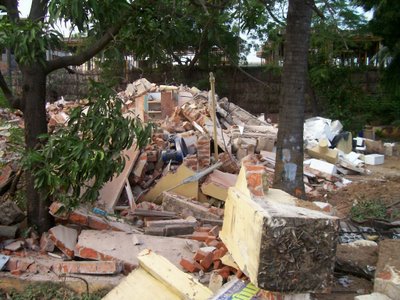 At the site, there are a whole bunch of shady looking characters hanging around. The place is being fenced off and I'm certain construction will begin soon. Aruna's equpment has been stolen and damaged but the police are telling her to get out of there. The Assistant Commissioner from the J1 police station said she had no business there. The goons are even trying to sell the media photographs of her "stealing" Venkatraman's property.
Husband and wife pair of Sudhir and Aruna were running a successful spice manufacturing unit in Perungudi called TilSpices Pvt. Ltd. (Til for Trust in the Lord). They had entered into an agreement with the owner of the property, a man called Venkatraman who got the power of attorney from his father who is in coma. The agreement signed by him in 2004 says that he will sell the property to them for 60 lakh rupees. However at the time of registration he backed out, given that land prices were going through the roof along the IT corridor.
 Construction activity is on everywhere, with buildings coming up on both sides of this demolished factory. The agreement for this 6 ground property was 10 lakh rupees per ground. But at the time of registration, Venkatraman never showed up.
 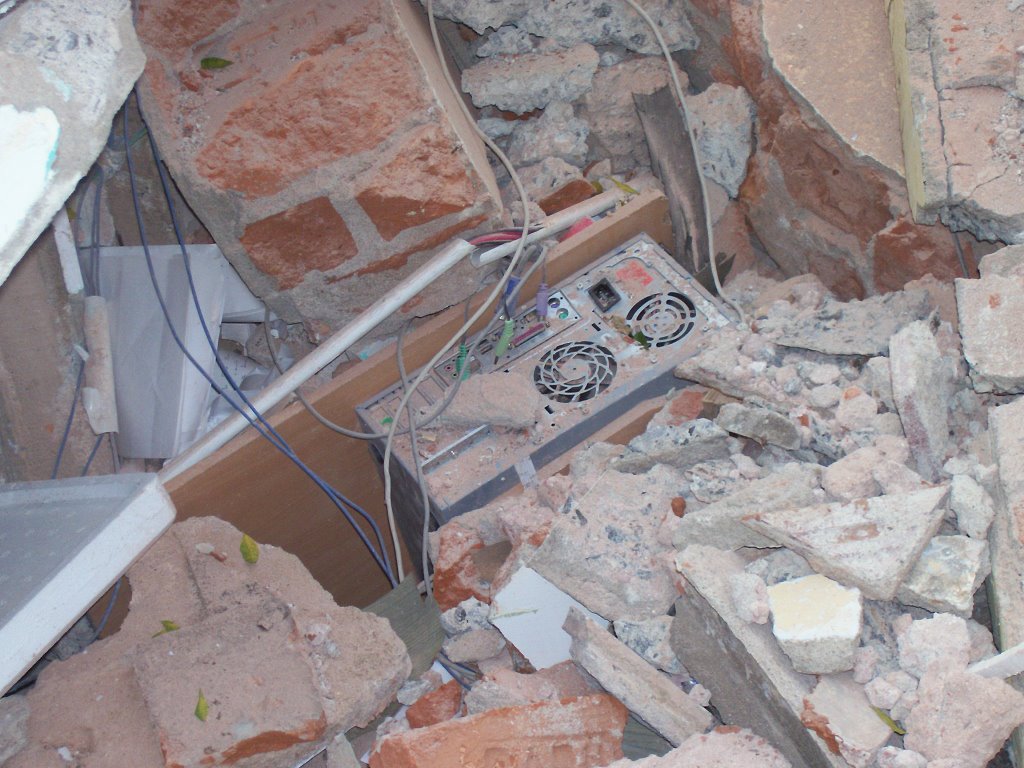 Aruna and Sudhir have suffered damages of nearly 3 crore rupees. Venkatraman and his bunch of hired henchmen have given stolen and destroyed their property. Aruna says, "Venkatraman also has two children like me. He's raising two more monsters for this world."
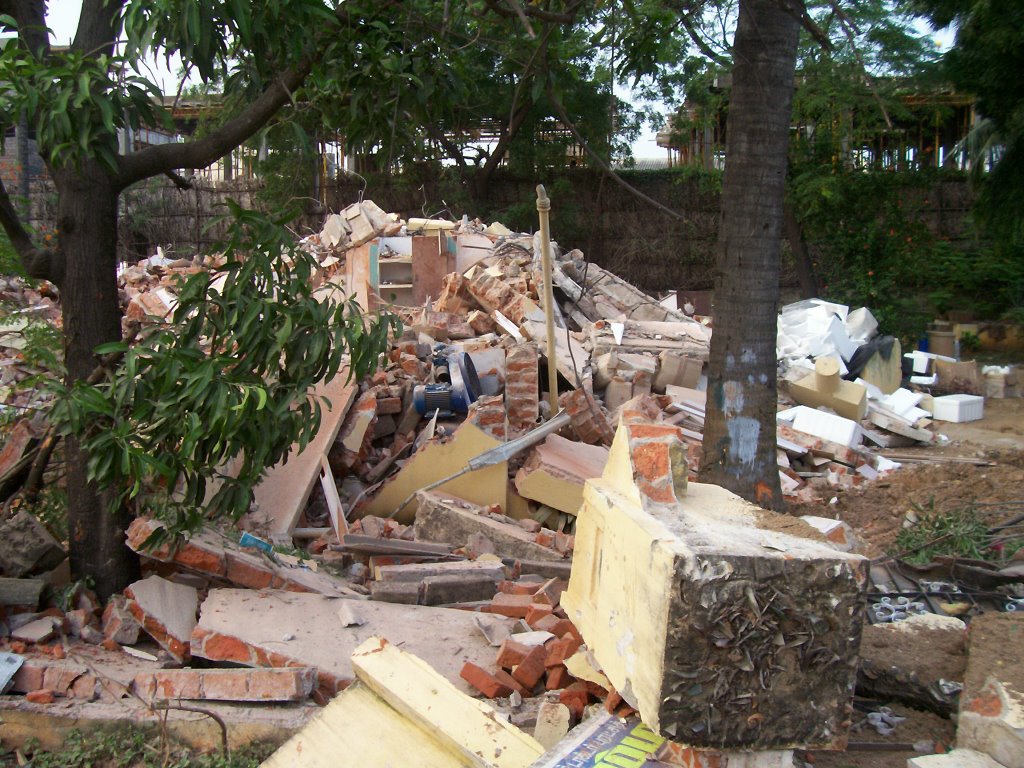 At the site, there are a whole bunch of shady looking characters hanging around. The place is being fenced off and I'm certain construction will begin soon. Aruna's equpment has been stolen and damaged but the police are telling her to get out of there. The Assistant Commissioner from the J1 police station said she had no business there. The goons are even trying to sell the media photographs of her "stealing" Venkatraman's property.
 But he didn’t re-negotiate with Aruna and that forced her to go to court to make him keep his end of the bargain. Venkatraman of course just ignored the court summons.
Now, Aruna says, the factory has been demolished at his behest to get her out of there by hook or by crook. A local land-broker, called Kodandaraman (with some heavy duty connections that include High Court judges) was hired for the job and in three hours 100 men with bulldozers smashed Venkatraman’s factory and Aruna’s business. Venkatraman can now get much, much more for the property with Aruna out of the way.
This brazen illegal act has the blessings of the police. A senior police officer told Aruna that his hands were tied because somebody above him had been bribed. The officer admitted to her that it was a rape of justice and that he was truly ashamed. But alas, honest men can do nothing.
This story has sickened me because the rot of corruption has such deep roots. Not that I didn’t know it, but it sickens me because perfectly decent, honest people are attacked in this manner and their livelihood is destroyed.
The people who should protect us are the ones we need protection from – the police. This entire episode has left Aruna and Sudhir shocked because everywhere they turn they find people have been bought up. Aruna says, “I am strong and I believe in God, so I am able to take this shock. But what if someone had ended their lives because of this?”
The police and Venkatraman would’ve heaved a sigh of relief. That’s how soulless this tribe is. But its got to come back to haunt them and I hope they suffer the consequences of their dirty greed.
Monday, December 04, 2006
KOLDINGHUS
In the centre of the city of Kolding, stands the castle of Koldinghus (pron. Kollinghoos). On this site once stood a fortress built by the Danish King - Erik Glipping in the year 1268 - meant to guard the border between the Kingdom of Denmark and the Duchy of Schleswig (in Germany). The fortress was rebuilt as an unfortfied castle in the mid-16th century at which time the King often stayed at Koldinghus. In the 1720s the castle was again rebuilt but by then the members of the royal court were only infrequent visitors and the castle was allowed to fall into disrepair.
In 1808 some Spanish auxiliary troops, stationed there in the Napoleonic wars stoked the fire in one of the hearths so fiercely that the castle itself burnt down. Reuilding work was not started until as late as 1890.
The rebuilt castle (above) today draws plenty of visitors. The architects who restored it are Inger and Johannes Exner. Scandinavian design is truly classic and minimalist, employing material in its natural form to achieve both function and style. The castle has been restored in keeping with that tradition. Indeed, the reconstruction is modern and seems incongruous at times – contrasting sharply with the weathered red brick walls, although, it does not diminish by way of aesthetics.


There is a magnificent view (below) from the top of the Great Tower. (Great Tower known as 'Heroes Tower' was added around 1600.)
In 1808 some Spanish auxiliary troops, stationed there in the Napoleonic wars stoked the fire in one of the hearths so fiercely that the castle itself burnt down. Reuilding work was not started until as late as 1890.
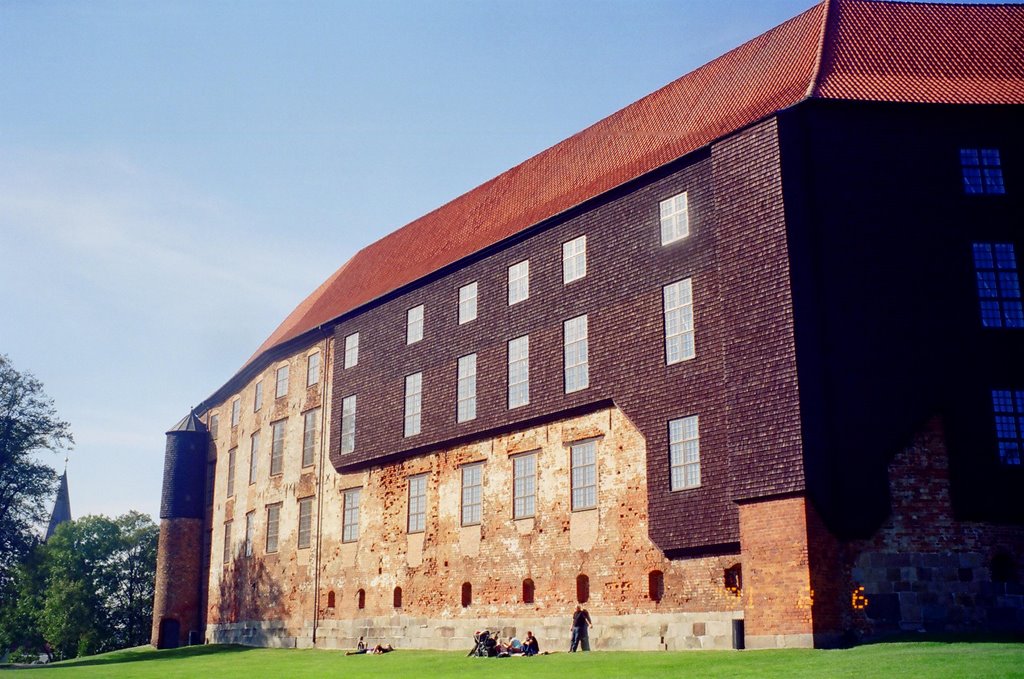
The rebuilt castle (above) today draws plenty of visitors. The architects who restored it are Inger and Johannes Exner. Scandinavian design is truly classic and minimalist, employing material in its natural form to achieve both function and style. The castle has been restored in keeping with that tradition. Indeed, the reconstruction is modern and seems incongruous at times – contrasting sharply with the weathered red brick walls, although, it does not diminish by way of aesthetics.


There is a magnificent view (below) from the top of the Great Tower. (Great Tower known as 'Heroes Tower' was added around 1600.)
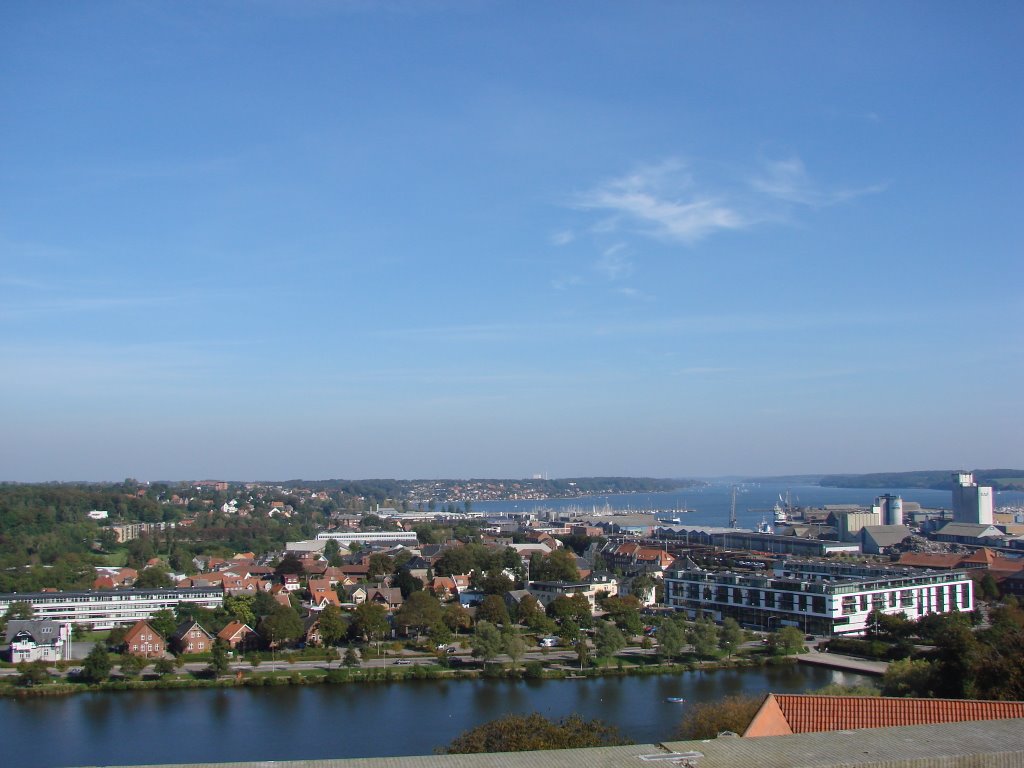
 This is where you park your car, where the stables once were.
Right next to the castle is a river where you will always find a boat. This particular boat (sorry, no picture) has to be kept ready at all times for the Queen. If the Queen were to arrive at the castle and wanted to cruise down the river, then she should never be disappointed and for that aim to be fulfilled the boat remains docked in this river perennially.
The Danes incidentally are quite crazy about their monarchy, following their lives and loves as closely as any monarcho-phile in, lets say, Britian. I asked an agricultural teacher, Jørgen P. Jensen why they loved their monarchy so much and he said, “I think its because they are quite sensible people.” Down to earth for sure, because when we were in a place called Gråsten (pron. Grosteeng) where the Queen has her summer home, people say, you can actually run into her, shopping for groceries in the neighbourhood supermarket.
Subscribe to:
Posts (Atom)