Apologies for the drought here in recent months. I've been working, worrying, traveling, thinking etc. etc. There have been a few updates on the travel blog so let me direct you there while I think of something sensational to say here.
Showing posts with label Travel. Show all posts
Showing posts with label Travel. Show all posts
Monday, January 17, 2011


Friday, August 13, 2010
A scare and a scowl on the Tube
I sat down in the only empty seat in the middle of the compartment, dropped my tote bag near my feet and settled down to read the newspaper on the tube ride home.
I had the paper open, directly in front of my face and was reading quite attentively, when I felt a tap on my left shoulder. It was the guy next to me asking in a concerned tone, “Excuse me, is that your bag?”
I was convinced he was referring to my black tote bag on the floor but I folded the paper to have a look anyway. I became mildly anxious when I found that he was referring instead to a white plastic bag, inside which I could see the top of a black shoe box. Beside it, outside the bag, was another blue shoe box.
Since it wasn’t mine, we asked the two women seated across from us and they both said it wasn’t theirs either. One looked calm while the others face betrayed her nervousness. But at that point, we were all in a state of paralysis, unsure what to do next. The train was barreling through the tunnel, the white bag didn't belong to anyone and we were the four closest to it.
I think we may have all gotten off the train at the next stop if the guy next to me, the one who tapped my shoulder to begin with, hadn’t done a brave and stupid thing. He stuck his hand into the white plastic bag and fully opened the partially open black cardboard box. It was empty. Then he did the same with the blue box and thankfully that too was empty. We all heaved a huge collective sigh of relief and in our heads, cursed out the person who had thoughtlessly left the skeletons of their shopping behind.
With the passing of the crisis, I went back to my newspaper. But this time I found myself reading and re-reading whole paragraphs before they made any sense because my mind was terribly jumpy after the earlier jangling of the nerves. Even so, I persevered, trying to focus and read very consciously. But as if one scare wasn’t enough for one evening, I suddenly experienced, what felt like an someone angrily and violently punching my newspaper, making it fall out of my grasp, to lie crumpled on my lap.
I looked up to find a woman trying to squeeze out of the compartment even while apologizing to me, because it was probably her hand or her bag that hit my paper by mistake. But the suddenness of it, compounded with the earlier scare, had caused my heart to shoot straight into my mouth. I was in no mood to be mollified and gave her the coldest narrow eyes and a deep scowl.
Thursday, August 12, 2010
Travel update from the Cumbrian coast
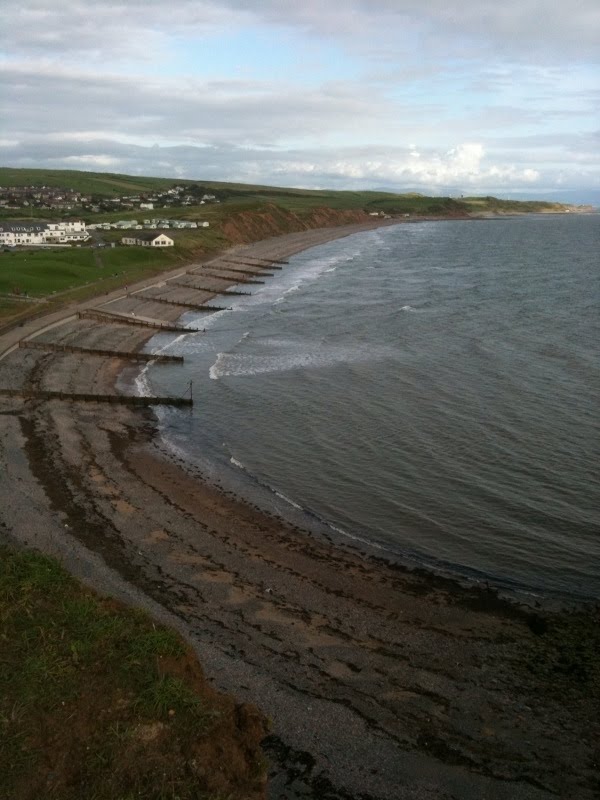
Went to the Lake District recently and on an impulse drove to the Cumbrian coast, to the little village of St.Bees. It was a brief but memorable stop of about two hours. Met two very busy old ladies and also stumbled upon a very moving sight on a promontory on the red sandstone cliffs of St. Bees. Read about it here.
Thursday, July 15, 2010
Travel blog update from Derbyshire
Hello all! I've just updated the travel blog with a piece on a most haunting story about how a village in Derbyshire lived through the plague. Read about Eyam here.
Sunday, June 06, 2010
Travel Blog Launched!
Dear Readers,
I've just launched a separate travel blog because I felt this space was getting rather confused. One day I was writing about international affairs, the next day about my fear of birds and on the third about a trip to the Czech Republic. All very muddled. Thats how the idea of a separate travel blog was born.
Besides, I've been wanting to switch to Wordpress for a long time... well ever since I heard it works much better than Blogger. Initial impressions confirm the same. This blog will continue to remain active and everytime I post to the travel blog, I'll be sure to direct you there. For now, hurry on to http://alaphia.wordpress.com!
Saturday, February 20, 2010
What to do in Bath in 48 hours? Everything.

The Roman Baths are below street level. The rising steam from the hot water spring gives it tremendous mystique. The Romans built a very sophisticated bathing and spa complex around it. During Roman times men and women would bathe naked in this pool. I can't imagine they didn't get up to some mischief.

The fan-vault ceiling of the Bath Abbey which stands right next to the Roman Baths. It has a gift shop which sells the most wicked fridge magnets. I bought one which says, "Fridge Pickers Wear Bigger Knickers."

The Royal Crescent - a grand sweep of semi-circular symmetry built many centuries after the Roman Baths. This was the fashionable end of town during Jane Austen's time. The best time to see the Crescent is in the morning when the sun is directly across it in the sky. It lights up this honey-coloured show-piece of Georgian architecture.

I had a wonderful time at the Fashion Museum in Bath. They have some really interesting sections like the one on the evolution of women's underwear and this one on English dress. What I still don't understand however, and I'm serious here, is how you can sit with a stiff frill on your bum?

When you go to Sally Lunn's restaurant in Bath to eat the world's best bun, remember to nip down to the basement for a quick peek into their kitchen museum.
Of all the empty seats in all the world, the woman with the whooping cough had to occupy the one opposite ours. We were on an early morning train to Bath in England, eager to get near its famed hot spring. Having just rid myself of flu germs, the last thing I wanted was to be bathed in hers.
If we were Romans visiting 2000 years ago we would have inscribed a curse on a strip of pewter and tossed it into the hot water, praying to the Goddess of healing, Sulis-Minerva, to pre-empt disease.
The only thing we could do really was jump off the train in relief when it pulled into the Bath Spa station. We crossed the new shopping mall and within less than four minutes we were standing in the heart of Bath, outside the entrance to the Roman temple and spa complex.
While the city centre still throbs because of what the Romans built nearly 2000 years ago, all around it are the layers of the centuries. We sought out the 20th c. by diving into a Costa for a bit of coffee and cake.
We took an hour to warm the insides waiting for the doors to open at 9.30. Straightaway, I grabbed the free audio guide for its interesting section with Bill Bryson’s observations and was eventually disappointed that he didn’t make any wise-cracks.
Unlike many Roman towns that came up around a fort, Bath developed because of its religious and ritualistic significance thanks to the hot spring. Today we understand the science behind the hot water but you really have to envy the powerful grip it must’ve had on Roman imagination - a dark green pool of steaming H2O curing all kinds of aches and pains. That’s why they erected a large temple and sprawling spa complex around the hot spring which continues to bring up nearly a million litres every single day at a toasty 46 degrees celsius.
The audio guide gives you so much freedom to explore at your own pace that we didn’t feel like joining the tour guide. In any case, he was so brusque with me that I lent him a cold shoulder instead of my ear.
The most entertaining section of the complex is the little museum which houses the Roman objects that were found in the spring. The Romans wished for all sorts of favours and blessings but the more colourful amongst them, threw in a fair number of curses as well, inscribed in Latin, which were later found at the bottom of the pool for the entertainment of future generations.
One guy complained, “Dacimedes has lost two gloves. He asks that the person who has stolen them should lose his minds and his eyes in the temple where she appoints.” Tough crowd!
From the Roman baths we hopped across to the Bath Abbey, which is much younger at about 500 years. We did a quick walk through gawking up at the pillars that merge with the ceiling by bursting into what look like Chinese palm fans. Its really quite beautiful but having woken up at 5.30 am that morning visions of a soft bed kept distracting us.
We decided to pack in one more thing before we retired and sought out the Pulteney Bridge. This is only one in four bridges in the world with shops on either side of it. It makes a pretty picture but being on the bridge itself felt like being on any other road in Bath. Underwhelmed, we decided it was time to check in to our B&B.
On Sunday morning we left the Roman bit of Bath behind to discover its Georgian end. This is the bit with the grand, honey-coloured buildings and where Jane Austen’s characters flitted and flirted. At that end of Bath you can quickly forget the Roman spa and I began to realize how much Bath is like Madonna. It has constantly reinvented itself.
After the Romans left, the Middle Ages, like the Middle Ages will, saw the spa complex go to ruin, till it was revived again in the 18th century and became the place to see and be seen for fashionable England. Jane Austen lived there briefly and rather unhappily and you can pick up fragments of her life around town as well as at the Jane Austen Centre. The owner of our B&B, warned us that it was the “Disney version for the American tourists” but I learnt a thing or two nonetheless.
We just walked and walked on Sunday checking out the beautiful Royal Crescent – a massive semi-circular building and the neighbouring Circus – a great big circular residential block. Bath’s Georgian architecture imitated the Italian Palladian style with its strict use of symmetry – all perfectly elegant as well.
We kept our last stop for the evening for the oldest house in Bath home to the Sally Lunn restaurant. Sally Lunn was allegedly a refugee from France who came to England nearly 300 years ago. She is credited with creating one of the most delicious buns I have ever tasted. Ever. When you tear off a piece, its like tearing off bits of cotton candy. Utterly and completely satisfied, we boarded the 8.30 train back to London with a bag full of buns, making it the oddest bit of shopping I have ever done.
Collapsing in my seat, I pulled out my list of ‘Things to do in Bath’ and found that 48 hours later, I could check off almost everything.
Trip Planner:
There are plenty of trains to Bath Spa station from London Paddington station. The train ride is an hour and a half. Tickets can be booked at http://www.thetrainline.com/. You can even do a day trip just to see the Roman baths. It is well worth staying in the UK for an extra day for it.
Where to Stay:
Bath is a really small town and you can get to all its attractions on foot. If you’re really exhausted taxis are cheap. This means that you don’t really have to stay in the middle of town near the Roman baths. Hotel prices can be quite expensive. We stayed at the Grove Lodge – a B&B off the London road which is a 20 minute level walk from the Roman baths. It is an excellent Georgian villa with tastefully decorated, spacious rooms and large bathrooms. The owner, a former teacher Isabel Miles offers a great vegetarian breakfast and good local advice on sight-seeing. 85 GBP a night. www.grovelodgebath.co.uk
When to go:
The best time is when it becomes warmer. But going in the winter ensures that you are not navigating throngs of tourists.
This piece was published in The Indian Express on 21st February 2010.
Wednesday, February 10, 2010
5 Easy Steps to Build Lovely Museum (like Musee D’Orsay)

Everything within touching distance at Musee D'Orsay

View of the main hall as you enter Musee D'Orsay
Step 1: Take old, unused railway station.
Step 2: Find lots of money to convert it into museum.
Step 3: Invite talented architects to get job done.
Step 4: Select famous painters like Van Gogh, Cezanne, Degas, Manet, Monet etc. and put all their work under one roof.
Step 5: Keep all art-work within touching distance. Allow people to feel they are looking at fantastic human creations and not Crown Jewels.
Your museum is now ready for inauguration. Open and Enjoy!
Thursday, January 28, 2010
Its Never Us. Its Always Them.

“Have you ever faced any harassment in public spaces in London?” he queried, as a wooly microphone descended from on high.
“Nope. Can’t say I have.” I replied.
“Well, I guess you’ve been lucky so far,” he added.
I moved on but pondered his question. Why had he asked me that? Was it not safe for women? What happened here after dark? What kind of harassment was it? How serious?
A few months later, I can answer some of those questions and oh how different my reply to that reporter would’ve been. The thing that’s happened between now and then is that I’ve been to Southall. A lot.
Southall, if you’re familiar with London is the big Indian Punjabi neighbourhood. Get off the train there in the morning and the smell of frying onions will come wafting gently by. The Southall Broadway is lined full with shops selling glittery Indian clothes, pressure cookers, Bollywood CDs, kadhais, cheap plastic toys and all other essential items.Theres not much pavement space left after the make shift masala corn seller, the Kashmiri chai guy and the jalebi man set up stall. Women in sarees wearing monkey caps, shaped more like whipped cream toppings than head gear, hand out leaflets advertising palmistry or astrology.
In the last two decades, since the civil war in Somalia in 1991, a lot of Somalis have also settled in this neighbourhood. Today, tall burkha clad black women and Somali men are an equally common sight on the main street as are Sikh men in turbans and women in salwar kameez.
Southall is a gritty, working class neighbourhood – a bubble at the western end of London with the unfortunate feel of a ghetto about it. Theres not much by way of tourist attractions here and even if you love Indian food, there are plenty of great options elsewhere in London. So it remains a little secluded outpost that if suddenly transferred wholesale to Amritsar, would look and feel much the same, so alienated does it appear from posh central London 10 kilometres to the right.
Into this rich mix, throw in the disgruntled, sexist, chauvinistic, angry young man and you’ll see what I mean about the harassment on the street. Young women can’t walk around in Southall without inviting attention that could range from long, hard, shameless staring to lewd comments and nasty abuses.
Its happened to me so often that now I grit my teeth while I prepare to pass a group of men on the street, shocked and relieved if they say nothing. But when they do and I’ve confronted men who have, they become so abusive that it makes me think I’ve tapped into a well-spring of anger against everything that comes rushing up at the slightest sniff of a challenge.
Given this personal history, I was particularly amused while chatting with the British Asian man who came home to fix our boiler.
“Do you live around here?”, I asked.
“Southall,” he replied. “Do you know it?”
“Yeah.. I shop there,” I said.
“Good for Indian spices and stuff in'nit?” Then suddenly becoming a little defensive he added, “It used to be a really nice neighbourhood but things have become really bad since the Somalis started coming.”
I groaned invisibly. This man had clearly forgotten that plenty of people have blamed him and his parents for all of Britain’s problems, yet there he was doing it all over again to someone else. I wanted to tell him that the very many times I have been stared at, harassed and abused in Southall, its never been by a Somali man, but always South Asian men.
Yet its never us. Always them.
Wednesday, January 06, 2010
Because I Thought of Chicago....


Sunday, December 27, 2009
"Thoooo", Says the UK Border Agency
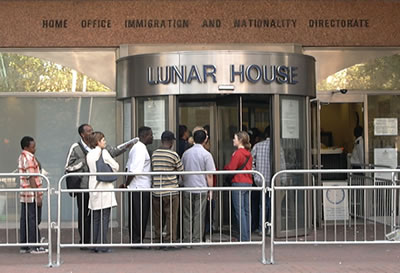
The snow flakes fell steady and gentle from the grey skies. The streets were devoid of the usual throng of people and cars. As I pushed on against the wind, my shoes cold and wet in the snow, I had an uneasy feeling about what lay ahead.
My client, Nazira (name changed) pushed her baby buggy along in the slush, her knuckles and hands going white from the cold. I gave her the extra pair of gloves I happened to have with me; their purple and black stripes adding a touch of the absurd to her otherwise sober dress –brown salwar kameez, a white jacket and a pale green shawl. I wondered how she managed to weather the cold in that.
We had travelled a long way across London to get to our destination - Lunar House - home to the offices of the UK Border Agency (UKBA). It is an uninviting place at the best of times and on this dark morning it rose up like a Castle of Doom.
I had to make the journey with Nazira to the UKBA because she didn’t know how to navigate public transport in London. The plan was to accompany her into the building, as far as I was permitted and eventually leave her with an interpreter. Nazira’s mission was to claim asylum in the UK because Pakistan was no longer safe for her.
I had written a research paper in college on immigration to the UK and the honest-to-God truth is that its policies seemed designed to keep out Blacks and Asians. Lunar House, I knew, had a very dusty ‘Welcome’ mat; the word barely discernible; trampled upon by the thousands who came each day, and who it seems were often only grudgingly given entry into the UK.
So I was actually quite curious about what it would be like inside this notorious and famous building.
I knew within 20 minutes.
Asylum seekers are directed to a separate floor and Nazira was escorted up in the lift by a staff member while I was asked to take the stairs. I met her upstairs and we went through another round of security screening. The UKBA had a nice assemblage of races on display. A South Asian male officer went through our bags while a Caucasian male chatted with two women – one Black, the other Caucasian. They were discussing dry skin and how to moisturize it in the winter.
At the end of the screening, I approached their desk because Nazira doesn’t speak much English, and politely informed them that I was accompanying Nazira who wanted to make an asylum claim.
“Who are you?”, the Black woman shot back.
“I’m her case worker from a voluntary organization.”
“Do you have any identification?”
I didn’t because I hadn’t intended on staying with her. But since she asked me I showed her the only thing I had.
“I have a driver’s license.”
“Are you American?”
“No, I’m Indian.”
At this point, the White woman, who had been standing like a boarding school matron to the left of the desk, felt the need to butt in.
“Do you have a work permit?”
“Yes.”
“Hmm… strange. I wonder how that happened,” she said, being unnecessarily sarcastic.
They don’t like pesky representatives of asylum seekers because it forces them to be restrained. Not surprisingly, both women had it in for me. All veneer of professionalism was dropped and before me emerged two ordinary morons with extraordinary powers.
The Black woman said rudely, “I want you to stand back so that we can talk to her (Nazira).”
“Alright, but she needs an interpreter.”
“Yeah, we’ll have one but you go stand back. I don’t like who you are.”
I was outraged but unsure of how to respond to this verbal assault. I feared they would take it out on Nazira. But so stinging was the effect of her words that I laughed dramatically while repeating her words, saying, “You don’t like who I am? Ha!”
However, with no ID, I was forced to step back and let Nazira take over.
She was given a shitty ride. They attacked her in their fluent English without calling an interpreter while she mumbled feeble responses to them in whatever English she could muster up. They discredited her story openly and eventually told her to go wait in a queue for an interview. I don’t know what happened after that because the white male officer was dispatched to physically intimidate me into leaving the building.
Lunar House had spit me out in 20 minutes. The heat of my anger made me oblivious to the miserable cold outside. I walked back hotly to the train station to make the long journey back to the other side of town. It was as if all the adorable things about Britain – Marmite, Bobbies, double-deckers, Quality Street, Mini Coopers and afternoon teas – had all gone up in one big mushroom cloud of smoke.
One week later:
Nazira made her claim and will be called for an interview in January. My life is good and fine again and the perspective is back. They were two morons in a country of about 60 million.
Now where did I keep those chocolate Digestives?
Tuesday, December 08, 2009
Book Review: Life on the Golden Horn

Why should you read a travelogue on a journey from England to Turkey written in the early 18th century? There are, after all, plenty of resources today, some would argue too many, to get information on these places that is both current and well-researched. Yet, I can safely say that I’ve learnt more about what life was like in the Ottoman Empire through this travelogue ‘Life on the Golden Horn’ than any history book or encyclopedia could have taught me.
This slender volume is a collection of letters written by the English woman, Mary Wortley Montagu who travelled through Europe to Constantinople as the wife of a diplomat. Incredibly, she is heavily pregnant through the whole journey, but such is her curiosity about people and places that in all her letters back home there is hardly any mention of a trimester or morning sickness. Instead she drinks deep from the cup of life leaving behind a most memorable account of the attitudes of the time but more importantly giving the English-speaking world an important glimpse into the world of women in the Ottoman Empire. Her feminist perspective confirms the place of travel writing as literature, history, anthropology and even international affairs and journalism.
Mary Wortley Montague traveled through the 'war-torn Balkans' and ended up in the Turkish capital, Constantinople, from where she sent some of her most entertaining dispatches. Most accounts of the Ottoman Empire till her arrival had been written by men, with no window into the lives of women and who therefore could only make prejudiced guesses. Montagu ‘s first achievement then is to bring a gendered perspective to travel writing. She writes with a fine confidence, declaring, “Now that I am a little acquainted with their (Ottoman women) ways I cannot forbear admiring either the exemplary discretion or extreme stupidity of all the writers that have given accounts of them.”
Her most memorable accounts are the times spent with various Turkish women. She generally finds them extraordinarily beautiful, extremely warm and lavishly gracious hosts. She says, “’Tis surprising to see a young woman that is not very handsome.” When she enters a hamam for the first time, it is packed with women sprawled on the floor in various poses of indolence in a “state of nature.” But, she remarks, that contrary to the sniggering and whispering that may have accompanied the entry of a new woman into such close circles in Austria or England, here she encounters only smiles and welcoming eyes. She is even urged to undo her elaborate garments to join them in their indolence, but when the complex machinery of an 18th century English gown is revealed to them, the quest is duly abandoned.
The relevance of travel writing is further underscored by Montagu’s observations on the veil. Far from the cloak of oppression it symbolizes today, Montagu finds it a liberating “masquerade”, allowing women to go where they please, take on lovers and be free from street harassment (some things apparently don’t change).
But Montagu wouldn’t be so interesting if she didn’t also say things that would certainly end any travel writers career today. Her prejudices are all laid bare before a more politically correct 21st century reader. For instance, she declares in a sweeping generalization, that all Austrian women are generally ugly. Her offence is not restricted to Austrians. Interestingly, she says that every Turkish Pasha has a Jew who is like his homme d’affaires without whom functions of state could not be carried out. She misses the irony in her own declaration when she claims that Jews have made themselves so useful that they are guaranteed the protection of the state. Far from recognizing why they may need protection, she sees it as Jews exploiting “every small advantage.” Today she can comfortably be accused of displaying anti-Semitism.
Montagu is a product of her times, so her writing often reflects prevailing attitudes. But to her credit she also attempts to bust many of the myths surrounding the Ottoman Empire and its people. She insists they are not the barbarians of popular imagination. By way of example she points out that she sees the Turks treating their slaves in a much more humane fashion that people in England. She also says that crime in the Ottoman Empire is much lower than in, England again.
At some point during these travels, Montagu gives birth to a baby girl. But she is so taken up by the splendors of Turkey that her new daughter barely gets a mention in the letters. In her last letter from this collection she wistfully says that she envies the blissful ignorance of a milk maid who knows nothing of what lies beyond England’s shores. In fact, faced with living under England’s gloomy winter skies again, she almost wishes she forgets about Constantinople’s evening sun herself.
One of the pleasures of Montagu’s writing is the fact that it is unfettered from trying to be politically correct. Her observations are sharp, acerbic, generous, unkind, rapturous. So much of today’s travel writing pales in comparison. That’s why her 18th century account of her travels can still enlighten.
Friday, November 13, 2009
Are You Potty-Drained? Early Lessons in RVing.

In an RV Park off the George Parks Highway outside the Denali National Park and Preserve
Arguing is generally not a good way to start a vacation. But since it involved a most crucial aspect of our holiday – our mode of transport – we really didn’t have a choice but to haggle heatedly over it.
We had booked air tickets to Alaska for 12 days and now we needed to figure out how we were going to see this monumentally large American state. Should we hire a car? Take ferries? Charter little planes? Do all three? Or do the unthinkable and rent a 29 foot RV (motorhome)? It was unthinkable because none of us had driven in the US before and yet here we were discussing plans to rent a truck-sized home and tootle off into remote parts of the state.
Arguments therefore were bound to ensue. Our five member group had seven opinions on the viability of the plan and in the end the proponents of the RV prevailed; although only after detailed research that included reading other peoples testimonials and consulting every conceivable guide book and website on traveling in Alaska. RVing, we finally concluded, was a venture worth undertaking.
So it was with a fair amount of nervous anticipation that we landed in Anchorage for an RV tour through south-central and interior Alaska. The most important document to accomplish all of this was of course an international driving license. The license issued in Tamil Nadu looks a bit dodgy and not surprisingly the lady doing our paperwork in Anchorage gasped and made an “if-you-say-so” face when she looked at it. But since we didn’t look like highway robbers she probably decided it would be safe to hand over the vehicle after all.
We were given an RV tutorial by Gary who gave crisp, clear instructions, including assurances that driving and living in the RV would be as easy as pie – unless of course we all got mad at each other and wanted more than 2 square feet of our own space. I made furious notes while Gary went through the steps on how to drain the potty, refill the water tank, turn the dining table into a bed and other pleasures of life on wheels. My notes would be needed, I thought, if the RV suddenly caught fire, spluttered to a halt in the middle of a frozen highway or sailed into a ditch.
Before I get into our travels, let me say that I am now a life long fan of RV design. Five adults thrown into a space of less than 300 square feet, sleeping in three separate beds, cooking dinners, playing cards, living out of small suitcases and mostly getting along is a remarkable feat of interior design amongst other things. Not to mention, that the thing moves, takes you over hill and dale, and gives you the most stunning views you could wish for from your window.
We took custody of our RV and decided to take a spin around Anchorage, figure out how the RV drives and buy groceries to stow away in our little refrigerator before heading out of the city. We moved slowly out of the RV park and onto the street and in a few minutes found ourselves barreling down a one-way street, going in the wrong direction. We immediately pulled into a parking lot and turned around hoping, that the gadget on the traffic light was not a camera.
That blunder notwithstanding, we found the RV very easy to drive thanks to the modern miracle of power steering and empty Alaska roads. We wandered over the next 12 days, first by heading south into the Kenai Peninsula, then west towards Valdez and finally north towards the interior to Fairbanks stopping off at several small villages and towns along the way. Alaska has a small but excellent network of highways designed to ensure that you never get lost. These highways cut through such spectacular country that it would be a crying shame not to stop and be able to enjoy the quiet, majestic beauty. On the Seward Highway with the mountains on one side and the waters of the Cook Inlet on the other, we crossed several buses packed with tourists and I couldn’t help but feel sorry for the poor souls who could only gaze from behind a wall of glass or stop only when the driver thought it best.
Our RV company had thoughtfully kept a copy of ‘The Milepost’ – a magazine with elaborate maps and information about facilities at every milepost – in our vehicle. This is a Bible for road users in Alaska and we could see why. While we could park the RV anywhere we wanted for the night, we generally wanted to stay in RV parks where we could access the internet, use proper showers rather than the RV shower, refill the water tank etc. We would consult ‘The Milepost’ around 6 pm, find an RV park in the vicinity where we wanted to park for the night, call, book a spot and drive into the park around 8 pm. We would settle down to a snug evening hoping for dark skies but in May Alaska has nearly 20 hours of sunlight so the sun would “set” close to 11 pm and “rise” again by 4 am.
Its hard to say if driving in Alaska during peak tourist season between June and September, would be as easy as it was for us towards the end of May. But in May driving was so wonderful we wondered why more people weren’t doing it.
It is possible that we won’t miss putting on plastic gloves and draining the pot every morning (although it has great potential for character-building). But beyond that there can and must not be any arguments about whether RVing is a good idea. We are now in complete agreement, which is a great way to end a vacation.
This piece was published in The Hindu Business Line on 13th November 2009.
Friday, October 09, 2009
A Trove At the End Of the Road in Alaska
The Sterling Highway in Alaska ends at the tip of the Kenai Peninsula in a town called Homer. Homer’s main claim to fame though is, its famous spit – a narrow, hooked finger of land, nearly seven and a half kilometers long, jutting out into the waters of the Kachemak Bay. We were on a 12 day road trip in Alaska in an RV (Recreational Vehicle or motor home) and this really was turning out to be a vacation of good clichés. The journey was as important as the destination and we went where the road took us. That is partly how we ended up in Homer.
We rolled into town in the evening and headed straight for its spit. There aren’t too many of these in the world so we were keen to see it and find an RV park on the spit itself. The Homer spit is a lively place with shops, cafes, seafood restaurants and tour operators for fishing expeditions and chartered flights. But as we continued on down the single narrow road that runs to the end of the spit, the landscape became distinctly more scarred. There was junk lying around from what appeared to be abandoned boats and broken down cars and all the RV parks were over priced and crowded with everyone who had reached the end of the Sterling Highway, deciding to stay on.
After just a few days in Alaska’s lonely wilderness, crowds were beginning to annoy us. So we quickly turned around, and found an RV park inside town, away from the spit. It turned out to be a wise decision since it was empty and offered what we really wanted - a breath-taking, uninterrupted view of the Kachemak Bay state park across the water.
But when we woke up the next morning, we didn’t know what to do in Homer. We didn’t want to wander aimlessly through the shops and we certainly didn’t want to sit around in a café all morning. With such beauty outdoors we didn’t want to dive into a museum and while Homer is a great destination for those interested in fishing, the thought of sitting in a boat with a string out, waiting for something to bite, didn’t exactly thrill us to the bone. We were a fussy bunch that morning. So what now?
In the next half hour we worked the phones and came up with a plan that we will congratulate ourselves for, for the rest of our lives. We got out of Homer. Just across the water from Homer lies the Kachemak Bay state park, a vast 400,000 acre playground of mountains, valleys, glaciers and wildlife and therefore a haven for hiking. The only way to get there is to hire a plane or a boat. We found a guy from upstate New York who shows up in Alaska every summer to make some money running a water taxi service between Homer and the Kachemak Bay state park. So in about two hours of waking up and twiddling our toes wondering what to do, we found ourselves huddled in warm clothing, racing in Todd Scanlon’s boat across the cold water to the other side for a five hour hike.
Todd dropped us on a lonely gravel beach that marks the start of the “Glacier Lake Trail” and headed back for Homer. To our deep satisfaction there was absolutely no human being in sight and we entered the trail through the woods with little idea of what lay ahead. Just as we were growing comfortable with the forest of cottonwood and spruce, it ended abruptly opening into a treeless zone of gravel. We marched on, following the trail, curious about where this sudden change in the landscape was leading us, when the trail suddenly started sloping downhill. We could see a huge mountain in the background and as we advanced we felt the excitement similar to an audience waiting for the curtains to go up.
In a few minutes a dramatic sight emerged. We found ourselves standing at the edge of a lake, which had a rim of ice cubes and icebergs in the middle. And coming down into this lake at the opposite end was a majestic river of ice – the Grewingk Glacier.
The glacier, the lake, the rocks, the raven overhead, all seemed to have a personality and it felt as though they were looking at us than we at them. We felt, we were interrupting something very private in this natural kingdom, as though we weren’t supposed to know that this place existed. We just stood there in dumb-founded silence unable to express any admiration for the sight before us. After taking in as much sensory pleasure from the place as possible, we decided to address our hunger pangs. On a fine flat rock we laid our out makeshift lunch of strawberries, granola bars, grapes, bananas, Oreo cookies and a packet of trail mix and found that never had a meal of such odds and ends been so satisfying.
Having seen off our hunger pangs, we bid farewell to our private glacier (we now feel proprietorial to the Grewingk glacier) and started out again to complete the rest of our hike downhill. During the summer, Alaska has nearly 20 hours of daylight so there was no fear of the sun going down on us in the middle of the forest. But it was starting to get grey and cloudy and we really didn’t want to get stuck in a cold rain. Secretly everyone prayed that Todd had not forgotten us.
As we started on our descent the Kachemak Bay came into view again. In the far distance we could see a little speck of a boat heading our way. Again, secretly everyone hoped it was Todd and not a fishing expedition. The boat kept coming closer and closer as we kept getting nearer and nearer the shore – the scene building up nicely for a Hindi cinemaesque slow-mo reunion. We were about 100 feet away when the bushes finally cleared and we got a good view of the boat. To our immense relief, it was Todd who had shown up at the stroke of five!
All sides were proud of their clockwork precision without the exchange of even a single phone call. We jumped into the boat, happy and exercised, and with the warm glow of those to whom nature has revealed a little secret – beyond Homer where the road ends.
This piece was published in the Indian Express on September 27th 2009.
Tuesday, September 15, 2009
Alaska - Views to Drive For

Parked in an RV park just outside the Homer Spit. Everyone raves about the Homer Spit but we found the RV parks there crowded, expensive and frankly a bit trailer trashy in appearance. So we got out of the spit and stumbled upon this amazing RV park with just the most spectacular, uninterrupted view of the Kachemak Bay.

Another RV park along the the Sterling Highway. You are guaranteed scenic views pretty much everywhere on the Kenai Peninsula.

This is the view you get while driving along the first 50 miles of the Seward Highway. These are the waters of the Cook Inlet, the Alaska railroad hugs the coast and the Chugach Mountains rise up all around.
Views to Drive For
Do the words ‘vacation in Alaska’ evoke an image of a fine white cruise ship sailing silently past glaciers and icebergs? Do you imagine yourself standing on deck, binoculars firmly in place, trying to spot the odd beluga whale or polar bear? If you do then you are not alone my friend. Travel companies over the years have built a formidable reputation around Alaska as a cruise destination. But after a road trip through parts of the state, I must say that that branding has happened at the expense of another truly wonderful mode of transport – the RV or motor home. “But wait”, you say, “RVing sounds difficult.” “What are Alaskan roads like? How can I drive there? Surely, I’ll get lost!” We had many of the same apprehensions at the start of our journey into the centre of Alaska so read on for how it all turned out.
How can I drive an RV?
We flew into Anchorage and rented our RV from there. It was 29 feet long and basically when we saw our RV we gulped knowing that we were all graduating into the big boys club. Size, however, is deceptive. Thanks to power-steering and automatic transmission driving an RV is so embarrassingly easy that you really don’t get any bragging rights. No gear shifts, no muscle testing tackles with the steering wheel and no neck Twizzler reverses either. When you want to back up just send one of your co-passengers to guide you. And when you want to go forward, well, just do it! But the only way you’re getting your hands on the big baby is if you have an international driver’s license which you should take with you from India.
What are Alaska’s roads like?
In the summer, they are mostly splendid and if you go there in mid-May like we did, just before the peak season starts, the roads are also empty. This combination makes it a great driving experience. And since this is Alaska the views are to drive for. A personal favourite of ours is now the Seward Highway – it takes you south from Anchorage into the Kenai Peninsula and is flanked in the first 50 miles by the waters of the Cook Inlet and the Chugach Mountains. Remember those car scenes in old films? You’d know the car is stock still while the scenery in the background keeps changing to give the appearance of movement? Driving on some of these roads can feel like that because the vistas remain fantastic for miles on end.
How many can stay in an RV?
Legally the number of people in the RV should be equal to the number of seat belts in it. Period. Practically, you don’t want to be packed in like sardines. So it really depends on what you’re comfortable with. We were five adults in a 29 foot RV meant for six and while it was impossible to do anything without bumping into one another, at night we all had separate spots and slept comfortably.
What is the inside of the RV like?
If you live in an RV for a few days you will not be complaining about how small your house feels (if it does). There is more room there than you can imagine and at the end of our trip the RV fan club had grown by five. Life and space are in fact what you make of it. The RV has a kitchenette complete with stove, oven, sink, fridge and some counter space. It also has a shower area, a separate toilet, a “master bedroom”, a dining table that turns into a bed at night, a bunk bed above the driver’s seat and several other nooks that are a marvel of space management. Ironically if you want privacy you have to escape into the outdoors – where for miles on end you can potentially meet noone.
Where do I park for the night?
There are RV parks all along Alaska’s highways and most of them have excellent bathrooms and a laundry room. You can save many of your RV’s own resources and plug into the public ones for a small fee per night. During peak summer you have to call and make bookings in advance but in May most parks are still empty so you can simply drive right in, find a spot you like and park. If the manager has left for the day then settle your bills in the morning. Of course you could just as well park anywhere that catches your fancy – by the side of a stream, or on the base of the Chugach mountains or anywhere really but you need to have a full battery and water tank to support such a move.
Is it expensive?
RVing is not expensive but it is not cheap either. What I mean is that the advantage it offers over staying at hotels is reaped if you have a big group in the RV and you do it for a longer duration of time. Economies of scale sort of thing. We did it over 12 days and saved a lot of money on hotel stays and food because we cooked many of our meals. But you are still paying a daily rental fee, mileage charges, fuel costs, RV park rentals and a one-time house-keeping fee. It can add up but it is oh so much fun!
We drove along some of Alaska’s best highways like the Seward, Sterling, Glenn, Richardson and Parks highway and its safe to say that pretty much all of them offered spectacular views – some just more consistently than others. I don’t know the joys of a cruise ship but I’ll bet a million bucks on the thrills of RVing in Alaska.
Saturday, August 29, 2009
Book Review: Notes From a Small Island

I will now be reviewing books on this blog. It’s not so much a passion for a new genre than a need to keep my memory from simply erasing the contents of a book 3 months after reading it.
For instance people often ask if I’ve read so-and-so book and I nod enthusiastically because I have a vague memory of having extracted a lot of joy from it. Then that person might go on to say, “The character of Dorothy Waldorf Kent is so well developed - like the time she runs away with a married man abandoning her husband of 12 years only to find that this married man is an old git and farts even louder than her previous one. Remember?” This will leave me completely mystified because neither will I remember anything about old gits and farts; nor will the name of this adulterous Mrs. Waldorf Kent set off any bells.
It is to rectify this situation that I am now going to write book reviews and here I begin with Bill Bryson’s “Notes from a Small Island.”
The Times blurb on the cover of my book warns that this is “Not a book that should be read in public, for fear of emitting loud snorts” and I am glad that I didn’t take it out of the house because I found several loud snorts essaying forth quite involuntarily.
The small island Bryson is on is the British one and in this book, travel writer Bryson criss-crosses the foggy, rainy country from John O’Groats (this is really a place, not a person) up in Scotland to Exeter and Bournemouth in the south. He is on a long trundle through the country to rediscover it before hauling himself and his family back home to vast America.
Bryson’s observations on Britain are often quintessentially American. He likes his gratification instant and his logic cold. But as a resident of North Yorkshire for many years Bryson also knows the country really well so his disdain or sheer delight at the idiosyncrasies of Britishers has complete credibility. Like the time when he says that Communism should have been left to the British instead of the Russians who we all know botched the whole thing up. He says Britishers would have done it properly because all the conditions are right. They like “going without, queing up indefinitely and accepting with rare fortitude the imposition of rationing and bland diets” among a host of other things.
Bryson tickles with his wonderfully keen eye for little detail. He has the ability to entertain while being utterly bored out of his skull himself. He does not leap from one grand adventure to the next. Instead he delights with his gift of making everyday observations about fellow diners in dull restaurants, empty town squares in quaint British towns, long train rides and several other mundane things that all travelers need to do to get from one destination to the next.
Through his eyes, Britain emerges as a funny, silly, grand and wonderful place. In the early part of the book Bryson is mostly in places he doesn’t take a shine to – criticizing everything from Oxford’s awful new buildings to crusty old Britishers who love dissing America. But as the weeks go by and he wanders from one town to the next, all the quirks of the British system and way of life are brought alive in the most hilarious sketch I’ve read in a long time. About Britain, Bryson concludes, “What a wondrous place this was – crazy as fuck, of course, but adorable to the tiniest degree.” Makes you want to immediately pack your bags and away to Her Majesty’s blessed plot.
Monday, August 17, 2009
Insecure at an Indian Airport

I have held the view for a long time that Indian air passengers are plain lucky. In fact, there should be a prayer room at every arrival lounge because security at Indian airports is so lax that every time we fly and emerge at the other end of a flight alive, we can all head to the prayer room for a little thanks to the Almighty.
I was flying from Chennai to Calcutta a few days before Independence Day, when everything is generally on “high alert.” At the Chennai airport, the machine that puts the stubborn plastic tape around checked baggage was not working. No one put any stickers on my lock and neither did they insert a thin plastic strip through the zipper handle that keeps bags locked. All I got was a flimsy sticker with the date on it and that too was ready to drop off at the lightest touch. I could have put a baby crocodile into my suitcase if it had suddenly caught my fancy.
I handed over my bag to the airline agent hoping that there would be another level of security after that so that anyone else deciding to travel with live animals or explosive devices might yet be detected. But there probably wasn’t.
After collecting my boarding pass, I headed over for a personal security check. I entered the ladies screening area and as the bored lady in a khaki saree started running her metal detector device on my upper body, I remembered that I had a set of keys in my jeans. But before we could get to my lower half she surrendered her device, stamped my boarding pass and sent me on my way! If I’d had the time, I might’ve insisted, “Lady, I have metal in my pocket. Don’t you want to check?”
But she may have still said no because it was lunchtime and two of her colleagues were already at a table in the curtained screening area eating rice in an eager, hurried manner. I shoved off to collect my things.
Once at my destination a few hours later, I found that one of my bags arrived without its lock. It was gone. Vanished. These days it’s more worrying because of the things people can put into your bag rather than remove from it. Anyone could’ve introduced a packet of some banned substance and had any sniffer dogs been around I would probably be clocking time in jail. Curiously, nothing was stolen from my bag but I can’t rule out the possibility that the person trying was disgusted with the tangle of clothes and probably just gave up.
None of the scary scenarios involving baby reptiles and contraband substances took place of course. But the manner, in which security was handled, really does not inspire any confidence in the security measures in place at many Indian airports. Even the basic, very first level of security is handled in a half-hearted, bored, perfunctory way that makes it all one big joke. Laugh on. Pray on.
Tuesday, July 14, 2009
Alaska by Road
 Ice on the edge of the Grewingk Glacier Lake
 Driving down the scenic Seward Highway in an RV

The icy waters of the Prince William Sound

A bear at a parking lot in Cooper Landing on the Kenai Peninsula

Todd, our boatman drops us off at the Kachemak Bay State Park

The Glacier Lake Trail inside the Kachemak Bay State Park
 A Russian Orthodox Church in the village of Ninilchik
It sounded like the tinkling of ice cubes in a glass; except there was no glass, only a large lake. The water on the edge of the Grewingk Glacier Lake had turned into cubes of ice and gentle waves knocked them against the gravel on the shore creating a jingling sound I had never heard before in the outdoors.
From the calving of a glacier through the cries of a kittiwake to the crunching of your own footsteps on a lonely gravel beach - in Alaska, you have to listen as much as you have to look. In bear country, your safety could depend on it.
With the goal of covering as much of south-central Alaska as possible, we rented a 29-foot RV (recreational vehicle or motor home) instead of getting on a cruise ship: No need to book hotel rooms or plan our sorties into the great outdoors and we could stop anytime to enjoy the Alaskan wildlife, landscape and history. RVing in the crisp early summer on Alaska's empty highways was freedom unlimited.
We picked up our RV after landing in Anchorage and headed south for the Kenai Peninsula where our first stop was the port town of Whittier. To get there we started down the eye-candy road called the Seward Highway which is flanked by the Cook Inlet and snow-capped mountains, with views to challenge the sharpest drivers' concentration.
Whittier is a small, dull town but it is one of the gateways to the Prince William Sound. We got on a boat to make the day-trip through the Sound to look at glaciers. Everytime a glacier came into view the captain of the boat inched as close as possible to it and cut off the engines as everyone on deck waited and watched for calving - the process by which chunks of ice break off resulting in the birth of an iceberg. It was hard to train our sights on the exact location where the ice was calving because of the wall of white before us but everytime a piece fell it went down with such a clap of thunder that you will eventually see one.
From the Seward Highway we headed further south down the Kenai Peninsula on the Sterling Highway. Back in 1867, the Russians sold Alaska to the Americans for the grand sum of $7.2 million. On our drive down the Peninsula we kept a keen eye out for this Russian influence. Wanting to see atleast one Russian Orthodox Church we got off the Sterling Highway entering the village of Ninilchik and found one at the end of the appropriately named 'Orthodox Avenue'. Just before the land dropped sharply into the sea, stood a beautiful white church with a green roof and ochre onion domes. As we marvelled at the Matryoshka dolls inside, a bishop emerged to start a service with all of two individuals. We stood near the entrance in awkward silence for a few minutes before shuffling out, only to find a notice about a funeral service! We had stupidly stumbled into someones 'leave taking' ceremony!
From leave taking ceremonies we finally reached lands end at Homer for the stuff of life. We hired a water taxi to take us across the Kachemak Bay to the wilderness of the 400,000 acres of the Kachemak Bay State Park full of forests and wildlife. Bulked up in layers of warm clothing, we raced along the water, landing on a lonely shore 20 minutes later. Todd, our boatman from upstate New York (the tourism industry seems run entirely by non-natives from the lower 48!) promised to return in five hours. We embarked upon the Glacier Lake trail, keeping up a loud chatter to alert any bears in the neighbourhood of our presence - a good thing too, because we came across dollops of fresh bear dung. Thankfully, the trails in Alaska's state parks are well-marked and watched over: Hikers sign a register before setting off, ensuring their absence will be noted should they get lost.
The trail took us uphill through a wooded area of spruce and cottonwood trees, plateaued and then opened up suddenly into a beautiful lake with the Grewingk Glacier flowing frozen into it. And it was here that we heard nature's little jingle of ice cubes clinking against the shore. The only disruption came from a cawing raven, probably irritated by us intruders.
From Homer, it was time to turn around the RV and head back to Anchorage to proceed east to Valdez. But we still had a gaping bear-sized hole in our Kenai experience. This longing to see a bear was fulfilled in the most unexpected of places - a parking lot. Halfway to Anchorage we pulled into a parking lot by a stream near Cooper Landing and found that about 20 feet away from us a brown bear was scrounging for food. He stayed completely oblivious to the five faces plastered against the window of the RV. We had five exclusive minutes photographing him up close till alert drivers along the highway started pulling in, sending him right back into the woods.
After four days on the Kenai it was hard to imagine that a few US Congressmen had opposed the purchase of Alaska from Russia. The place was derisively labeled "Icebergia" and "Walrussia" and the newspaper New York World declared, "Russia has sold us a sucked orange." Clearly, in the mid-19th century, it was hard to imagine you could do anything in Alaska but bundle up in layers of wool and stay indoors. But an Alaska summer is incredible fun, offering plenty of options and 20 hours of daylight.
And of the many sounds we loved, perhaps the one we grew most attached to was the gentle roar of our RV - a great big beast of a vehicle that took us to all the incredible nooks and became home even while allowing us to roam free.
Published in the Mint on 11th July 2009
Subscribe to:
Posts (Atom)