Sunday, June 03, 2007

PARTY POOPER'S MESSAGE

For me driving around in Chennai over the last few weeks has been a nauseating experience. I just can’t understand how people can be such sycophants and plaster the city with unlicensed, illegal hoardings of one man and his family and treat him above God Almighty and surrender their conscience and soul to him.

M.Karunanidhi has done nothing publicly to rein in his delinquent son M.K.Azhagiri for the murderous violence his supporters perpetrated on the employees of the ‘Dinakaran’ newspaper. I have little sympathy, mind you, for the Maran brothers who have thus far ridden happily on the back of a political empire to become all-powerful in this state. But to return to the earlier point, the DMK rank and file, far from mourning the behaviour of their colleagues in Madurai, far from hanging their heads in shame for belonging to a party responsible for the death of three people, are instead going berserk displaying their 'love' and loyalty. From laser shows and talking images of Periyar and Anna singing MK’s praises to people turning up from all corners of the state to wish their leader on his birthday, this celebration smacks of vulgarity that has become too commonplace to make news.

Why is a private function so public? Why must we be subjected to having our already ugly cityscape made worse by pictures of corrupt, duplicitous politicians?

Why isn’t there any outrage?

What can we do?


Saturday, May 05, 2007

FINALLY, THE TIDE TURNS

I was delighted to open the papers this morning. The headlines in 'The Hindu' - 'Geetha Johri report speaks of "collusion of State government" and next to that 'Rasheed names MPs, ex-Minister'. Occasionally the tide turns against the people who govern this country and its deeply satisfying to find that somebody can put the fear of God in them.

What is fantastic is that people within the system exposed the dangerous and delinquent officers. First a damning report by Geetha Johri, IGP where she says the entire episode of killing Sohrabuddin, his wife Kauserbi and a key witness Prajapati, "makes a complete mockery of the rule of law and is perhaps an example of the involvement of the state government in a major crime."

But Geetha Johri was removed and Rajneesh Rai took over. The officer shocked his superiors by actually arresting the notorious trio and killer-in-chief, D G Vanzara. He has now been removed and reports suggest its because he was pushing for a narco-analysis test on the three arrested cops. But Geetha Johri is back and the state government has to submit its report on May 15th. Based on that the Supreme Court will decide whether to order a CBI probe or not, something Johri herself had recommended. This is certainly a story to follow till the very end if we are interested in promoting the efforts of officers with integrity like Geeta Johri and making sure that such rogues are exposed - rogues who have no respect for the citizens of this country.

Thursday, April 19, 2007

MORE ON THE BLACK BUCK

I was presented with a request by a reader to delete the photographs of dead deer and black buck on the IIT Madras campus from my blog. The person who supplied the photographs to this reader, wants them taken off because he or she does not agree with me.

The dilemma was - this is my blog and I am entitled to write what I want and was given the photographs. Yet that does not make the photographs mine and now the person who gave them wants 'their' photographs removed.

So what I have decided to do this time is to remove them because I did not take them in the first place.

The people at IIT who introduced me to whats happening to the deer and black buck inside are disappointed that I am swayed by Ranjit Daniels argument of cutting down 30 hectares of trees. But I think I would go with a scientist with 30 years experience than a layperson.

Ranjith Daniels says, "My methods are not based on a whim. A lot of effort has gone into this. Let people be assured of that. Whats destroyed the IIT campus is the Prosopis Juliflora tree. Now we are trying to clear two or three hectares on an experimental basis. World over, loss of habitat is the biggest problem faced by conservationists."

Its no different with the black buck and thats why they are dealing with that threat first.

But people have argued that why not deal with the solvable problems first - like controlling traffic and construction activity? Ranjith acknowledges that traffic is a problem and signs will be put up to request people to drive slowly. But he says that these fears of traffic and construction are not the biggest threat and steps are being taken to ensure that the black buck isn't allowed to go extinct.

As far as the birds and other life in the trees that he plans to cut is concerned, he says, "The Juliflora has not allowed anything else to grow. Birds nests are not just in trees but in bushes also and these trees have destroyed the biodiversity on the campus."


Monday, April 09, 2007

THE OTHER HORROR OF NITHARI

Take twenty minutes, don't take calls and read this horrific, chilling expose on how the cops in Uttar Pradesh were in cahoots with the wealthy Moninder Singh Pandher.

Sunday, April 08, 2007

VERY MUCH SHOCKED LETTER

Mildly funny letter written by Thiru M.Karunanidhi to the External Affairs Minister Pranab Mukherji wishing the latter a speedy recovery after his accident.

Dear Mukherjijee,

I am very much shocked (just shocked should do or perhaps very shocked if he insists) to hear the sudden news of the accident and I was a little relieved to know that you have escaped with head injuries (theres something wrong about being a little relieved when someone has just had their head bumped in many places. What he may have wanted to say was that he was relieved he had escaped with only ...only head injuries. Anyway...) At this age of yours, you should take all precautions while travelling. Your good and sincere services are very much needed for the country. While I wish you speedy recovery, I kindly request you to take complete rest before you resume your work. (Of course...of course)

Yours sincerely,
M.K.

Wednesday, April 04, 2007

APRIL WEIRDO

Johnny Deep's inspiration Keith Richards of the Rolling Stones snorts some really weird stuff. Scary!

Now a regular reader has found that Richards was apparently kidding.

Monday, March 26, 2007

MISTAKES AND INDIANISMS

Some awful Indianisms have made their way into the newspaper. It’s so disorienting to see it in print…. Quite, like an itch in the middle of your back. I remember meeting a farmer in Thanjavur recently, who said that he spent his evenings at the local library reading ‘The Hindu’ to learn English. If he’s read the following, we know which way his English is headed.

After India’s shock defeat by Bangladesh ‘The Hindu’ carried a front-page photograph of some delinquents destroying Dhoni’s house. The caption read, ‘People breaking M.S.Dhoni’s under-construction house.’

Then there was another story on the inside pages about education and ended with ‘students going to abroad.’

The New Indian Express splashed the story on Bob Woolmer’s death on the front page. But it was littered with mistakes. It said, Bob Woolmer was planning to ‘part company with’ the Pakistanis. Then the paper informed us that it was a ‘high pressurized job.’ It ended by saying that the stresses of coaching the Pakistani side might have taken their ‘tol’.

On the second page of that days paper was a puzzling headline which read, ‘Middlemen play on the poor.’ What ...like step on them and use them as a playground? What?

And if anybody from a newspaper office is reading this, could you please stop saying, ‘Very much thankful’. It’s wrong.

Have you seen the totally bland quotes that make headlines in ‘The Hindu’? For instance, ‘Parents advised to guide students during exams.’ I always look forward to reading the headline on the Governor’s insipid speeches. For example, ‘Governor advises youth to work hard.’ Such illuminating stuff!

I’ll end with this hilarious headline from ‘The Hindu’ once again, the morning after the Ganesh Chaturthi festival. ‘Idols immersed, Three feared drowned.’

Wednesday, March 21, 2007

WOMEN AND THE MEDIA

The following piece is the text of a talk given by my friend S. R. Madhu on 'Women and the Media.' I thought this would be a good place to reproduce it.


Friends,
Before I plunge into the subject of "Women and the media," let me conduct a little quiz on the subject.

Who is the first journalist to earn a salary of a million dollars a year? (Barbara Walters)
Who is the lady journalist from Kerala who covered several wars for CNN and Time magazine? (Anita Pratap)
Who is the editor of the best-known Indian magazine for women’s empowerment? (Madhu Kishwar, editor of Manushi)
Who is the only woman editor today of a major Indian daily newspaper? (Mrinal Pande, editor of Hindustan).

Why should we study women and the media? Because this subject is a mirror of women’s empowerment, according to Gloria Steinem herself. There’s a strong connection between women’s media and women’s empowerment.

What are the strengths of women as media specialists? They are more observant than men, they are more sensitive to unfairness and injustice than men, they often speak and write better than men.

Further, women are more effective than men in drawing people out, getting them to speak. They are more effective interviewers than men, particularly when the subject is a celebrity. One reason is that women have easy access to the celebrity’s wife, daughter, sister or mother – who are often the best sources of rare nuggets of information.

In my talk today, I’ll compare the status of women in the media about 50 years ago and now. I’ll discuss some issues concerning women in the media, then give you a few snapshots of some outstanding or exciting women achievers in the media today.

The status of women in the Indian media has undergone a tectonic shift. In the 1960s, most newspapers did not even have a single woman. Rami Chhabra was 19 when she met Prem Bhatia for a job in the Statesman of Calcutta. She was well qualified, she had just won an award from the BBC, and she was passionate about working in a newpaper.

Prem Bhatia looked up from his desk and said "Young lady, if you want to work in a daily, wipe off that lipstick and remove those ear-rings. Pretty girls shouldn’t be in newspaper offices. They distract the men." Prem Bhatia went back to his work, and Rami Chhabra stood dismissed. She approached other newspapers, but they said: "We know you write well. But why don’t you just sit at home and give us articles? We’ll both be happy."

In fact, some of the most legendary editors in India uttered similar sentiments. Girirlal Jain of the Times of India said a daily newspaper was no place for a woman. Later his own daughter joined a daily newspaper. Pran Chopra, another great editor, denied Razia Ismail a job saying "I’m sure you’ll refuse to do night shifts." Razia Ismail later had a distinguished career in the United Nations.

Difficult working conditions

But gradually, the prejudice against women in newspapers weakened. Newspapers in India started hiring women as reporters and subeditors. But they faced difficult working conditions.

-- There was no separate toilet for them, and a girl reporter often had to go down three floors or go up four floors to find a ladies’ toilet.
-- Usha Rai of the Times of India, wife of famous photographer Raghu Rai, says that when she got pregnant, she was shocked to discover that there was no provision for maternity leave! She had to fight for it before she got it! Some newspapers peremptorily divided three months of maternity leave into six weeks before the baby, six weeks after the baby. If the lady said, "I want only one week before the baby and seen weeks after the baby," managements didn’t agree.
-- Women had complaints about unequal pay and work conditions. Women were often given low-fee contracts, not absorbed on the staff. And women were always assigned soft stories – flower shows, gallery shows, fashion shows, beauty contests, book launches, film and drama reviews. They were thrown crumbs from the reporting beat, while men covered Parliament, the Prime Minister’s office, the Home Ministry, Finance Ministry and so on.

There was sexual harassment. In Mumbai, a news bureau chief assigned a girl to do a story on pornographic literature on the pavements, and passed on to her on his collection of pornographic limericks as "research material".

Ammu Joseph who lives in Bangalore, has written a book titled Making News: Women in Journalism. It is based on interviews with 200 women journalists from different parts of India. The book contains many interesting stories and anecdotes, many of them unpleasant.

In a newspaper office the night shift is the most important. Meena Menon of the UNI says when she volunteered for night duty, the news editor remarked: "So you don't mind being raped!' And broke into a laughing fit till he became breathless. Some women who walked home after night shift were harassed on the road. People assumed that a woman alone on the street at night could only be a prostitute.

In the 1980s, labour laws were passed saying that no woman should work alone on a newspaper night shift, there should be at least two women. And they should be provided transport back home. Because of this rule, many newspapers all over India did not employ women on the night shift.
On the other hand, some newspapers were sometimes overly protective about women. Usha Rai was once covering a price rise demonstration outside the Super Bazar in Delhi. Word broke out that the police had resorted to tear gas. Her bosses in the Times of India broke into a panic. They got two male journalists to locate and rescue Usha Rai.

In The Statesman, Tavleen Singh, who is one of India’s best-known columnists, insisted that she would drive home in her own car after night duty, she wouldn’t take the office car. For a whole year, The Statesman sent a chauffeur- driven office car behind Tavleen Singh’s car, to escort her.

The Renaissance: Women in the Media after 1976

In 1976, after the emergency was lifted and Mrs Gandhi was thrown out of power, the Indian press went through a renaissance. Many new magazines started. For women, it looked as if the floodgates had opened. Opportunities for them expanded and opened up. And today, newspapers and magazines are teeming with bright women. They are everywhere, doing everything -- covering political and economic news, the CBI, the foreign office, sports and even the stock market. They are talented, well-educated, sharp, and extremely ambitious. And TV news is dominated by women.

I would like to provide a few snapshots of some of the best and brightest women in the media business today.

Snapshots: Anita Pratap

Anita Pratap first came to the limelight when she interviewed
Prabhakaran of LTTE and wrote on the shameful anti-Tamil riots of 1983. In fact there were rumours of a romance between her and Prabhakaran, and she discounted them fiercely, she said Prabhakaran was grateful to her for her coverage of the ethnic problem. She wrote the book "Island of blood" on Sri Lanka’s ethnic conflict.

Anita also reported several wars for the CNN and Time magazine – the Afghan war and the Taliban’s triumph, India-Pakistan wars, the Naxalite menace in the northeast, India’s nuclear tests. She has interviewed the Prime Ministers or Presidents of several countries.

She was the first TV journalist to report from the highest battleground on earth, the 22,000 ft Siachen glacier, where Indian and Pakistani armies exchanged fire almost every day.

Anita Pratap writes forcefully, insightfully, often caustically on political subjects. Besides hardcore breaking news, Anita Pratap has reported on development issues such as population, education, health care, poverty alleviation, women’s concerns. She is now an independent documentary film-maker.


Madhu Kishwar

Let me now talk about Madhu Kishwar, a social activist and the editor of Manushi, and a great symbol of women’s empowerment. Manushi has been described as one of the world’s best women’s magazines, also as the voice of India’s conscience.

Manushi was founded in 1978 by Madhu Kishwar and a few others with a capital of Rs 500. What makes the magazine unique is that it accepts no advertisements and no donations. Sometimes the magazine doesn’t have money even for postage. In its early years, it could not even afford a typewriter. The magazine has 6,000 subscribers in India, Europe, the US, Africa and Australia.

Says Madhu Kishwar. "In India, you get a lot of affection and respect if
if people are convinced that you're not out to make money, that you are a genuine social worker."

Madhu Kishwar desribes Manushi as a "catalyst to make our society more just and humane. We don’t just passively put together articles that come to us, we initiate positive and corrective change."

Manushi is more than a magazine. It provides legal aid, it conducts human rights campaigns, it publishes books, it even organizes street plays. It exposes discrimination against women. But it is not a magazine for women only. Manushi is also every thinking man's magazine.
Early issues of Manushi focused on atrocities against women and the pliht of the landless poor. But now, the magazine is more reflective and philosophical. It carries inspirational people profiles, it discusses Indian traditions and tribal rituals. It carries poetry, film reviews, book reviews, short stories and analyses of social trends and political events. Every issue carries a thoughtful piece by Madhu Kishwar herself. She once outlined a down-to-earth 10-point plan to strengthen Hinduism.
Readers almost died laughing when Manushi ran a piece on the superiority of Indian-style toilets over Western-style toilets!

Madhu Kishwar has remained unmarried. She is strongly attached to her family. Her father is a retired LIC officer, her mother is a housewife. She says she derives her strength from the unconditional love showered on her from her family – not just her parents, but grandparents, aunts and uncles.

Madhu Kishwar says "The only women I have had problems with are Indian feminists. They empathise with Western feminism, not with our own society and people. For some reason they're the only ones who can't stand Manushi. Nothing satisfies them. I don't understand what they want. I have an uneasy feeling that they want to remould Indian women into creatures alienated from their own social environment." Not everyone agrees with Madhu Kishwar but everyone respects her.

Barkha Dutt

Barkha Dutt is perhaps the first lady of Indian television. She has recorded so many "firsts," and won several awards, specially for her coverage of the Kargil war. She does interesting programmes every week. For her, and for many other TV reporters and anchors, nothing matters more than a good story. They are prepared to do anything -- even maybe risk their lives or break the law -- for a good story.

To illustrate this trait in Barkha Dutt, here's an anecdote. She wanted to visit Afghanistan and do an eye-witness story. India's Foreign Minister Jaswant Singh was going to Kandahar on a political visit, he wasn't taking any press people with him. But Barkha was determined to go. She rushed to the airport. When she saw a bread van about to leave for the tarmac and deliver bread to Jaswant Singh's plane, she sweet-talked the driver of the van, got into it and reached the plane. The Finance Minister was horrified and ticked her off. Barkha was disappointed that she couldn't pull it off. "But at least I tried", she told herself.

Mrinal Pande

Mrinal Pande is an icon of Indian journalism. She is the first Indian woman to be the editor-in-chief of a national daily newspaper, Hindustan. It is part of the Hindustan Times group and comes out from several cities.

Mrinal Pande has studied English and Sanskrit literature, ancient Indian history, archeology, classical music and the visual arts. She published a short story at the age of 21, and has been writing ever since, for the past 40 years – journalism, fiction, drama and essays. She has also been a columnist, broadcaster and television presenter.

She has spent several years on the National Commission for Self-Employed Women, inquiring into the conditions for rag-pickers, vegetable sellers and domestic help. Her recent book "Stepping Out, Life and Sexuality in Rural India", is a revealing book on the condition of women in rural India.

Mrinal Pande says "I may have neglected my family because of my work. But I believe that writers are selfish. Others make more room for writers, than they make for others."

Sucheta Dalal

Sucheta Dalal, 45, is one of India’s most powerful journalists. She is the person who exposed the Harshad Mehta scam in the early 1990s and the Ketan Parekh scam a couple of years ago. She is a consulting editor of MoneyLife, a personal finance magazine. She is a columnist for the Indian Express and for rediff.com, and a consulting editor of Financial Express.

Sucheta Dalal is known for a simple terse style, free of flourishes. She writes from the standpoint of the common citizen and the average investor, and she fearlessly exposes what is corrupt, what is dubious, what is questionable.

Sucheta is the author of two books,. One of them is about stock market scams, the other is a biography of industrialist A D Shroff. She has worked with two financial dailies -- Business Standard and The Economic Times. The government made her a member of the Investor Protection and Education Fund, and that has been warmly welcomed by the general public.

Bachi Karkaria

Finally, a few words about Bachi Karkaria. She is an excellent writer – witty, forceful, elegant. She has held one of the prize jobs in journalism in India, that of editor of the Times of India. She says her father passed on two mantras to her. One: make your own sunshine. Two, be flexible. If you bend, you won't break.

She is outspoken about how far women have come in the media. She says "The women we interview for jobs are so much better than men, that sometimes we take a man just as a token gesture for men." About the biggest challenge facing women in the media, she says: They should stop thinking gender, they should only think professional.

I think that’s a great message for the future. The media in India belongs to women – provided they don’t talk gender, they only talk professional.

Saturday, March 17, 2007

A DISAPPOINTMENT MR.BACHCHAN


Finally somebody did a story on Amitabh Bachchan's tasteless advertisement endorsing the law and order situation in Uttar Pradesh. When was Nithari moved off the UP map? He says he endorses UP and not the SP government but that is to completely discount the impression the viewer is left with - an important part of any communication.

Amitabh Bachchan says his decision was based on a Home Ministry report (a Congress document) which shows that the statistics in UP are not that bad and therefore the law and order situation is good. Err.... wasn't it in UP that the police refused to register FIRs of parents whose children had gone missing? Crime simply goes unreported in UPs police records, indeed, in the crime records of every state.

Amitabh Bachan has been placed on a pedestal by millions of people in India. His position and influence are unrivalled but in endorsing the likes of Mulayam Singh Yadav's governance, he seems to vacate that position on the pedestal. Unfortunately, as Outlook's latest survey suggests, we hate our politicians so much, that we will punish anyone who is seen with them.

Wednesday, March 07, 2007

DENMARK'S DEBT

Denmark recently witnessed the worst street violence in more than a decade. Youngsters came out onto the streets to protest against the takeover of a youth centre in Copenhagen. Squatters were evicted from the building and four days of street fights followed. The building had been offically abandoned but was used by punk rockers, left-wing groups and anarchists since 1982.

What struck me as incredibly cute and an indicator of just how peaceful Denmark is, is that, fearing further violence the Danish police has borrowed 16 lightly armored vehicles from the Dutch! Even sweeter is the fact that they have already taken on loan 20 police vans from Sweden.

My first thought was, "Don't they have these things?" But my conclusion is they don't need these things. Or atleast haven't till now. Its that peaceful.

Sunday, March 04, 2007

‘CUT TREES TO SAVE THE BLACK BUCK’

Last week was awful. I made too many mistakes, miscalculations and serious errors of judgment. Let me correct one of them here by publishing an interview with Ranjit Daniels. Ranjit is the man hired by IIT-Madras to do a bio-diversity study of the campus. Based on his findings IIT is now trying to implement the roadmap he has set out to increase the black buck population.

His key agenda is radical – he says we need to start cutting trees. Cutting trees!? What do trees have to do with Black Buck? Everything. And when Rajnit Daniels explains it, he makes the world of the Black Buck something beautiful.

For how long have Black Buck been in this area?
Black Bucks have been here for atleast 30 years. But we’re not entirely sure how they came to be here. The IIT land once belonged to a British family. They could’ve introduced the animals for hunting or perhaps they already existed there. We’re not very sure. But about 30 years ago, there were 30 black bucks in the IIT area.

So the current population of 12 is not so alarming?
These are insulated populations and maintaining an insulated population anywhere is a great challenge. Black Buck numbers have dwindled over the years and not suddenly so there is nothing alarming about this decrease. The Black Bucks became isolated from the animals in neighbouring Guindy National park in 1978 when IIT built a wall.

So can’t the animals just be shifted to the neighbouring park now where it is perhaps safer for them?
Black buck are shy and timid and its going to be very difficult to catch them in the woods of IIT. We might end up doing more harm than good. Also, for sentimental reasons I think we should save the animal right here where it has existed.

What are the threats to the Black Bucks inside IIT at the moment?
The problem inside IIT is that there are too many trees and Black bucks actually need open grasslands. That is their natural habitat. The other problem is feral dogs. People just bring them into the campus and let them be there. Dogs in a pack are a real problem. Dogs have been domesticated for nearly 50,000 years. They may have lost their instinct to eat meat but they have certainly not lost their instinct to hunt. Thats why we find that sometimes they attack the deer and black buck but don't eat them.

So how come they came here in the first place if open grasslands is their natural habitat?
They came first and the trees came next, because we all have this British concept of greening. IITians started planting trees in their quest for a green campus and someone has introduced several exotic species. The most damaging one has been ‘Prosopis Juliflora’ from the American continent. It’s a very invasive species and needs no human intervention to start multiplying. Before we knew it, the entire campus was overrun with this species, shrinking Black buck territory. Whats worse, IIT obviously thought it should protect the woods and constructed on remaining open ground further destroying Black Buck territory. Trees are not always good. We shouldn’t plant them where there once weren’t any.

So what now?
Now we are going to start cutting trees. That’s the radical solution I have given IIT. But we have to do it slowly so that we don’t scare away the animals. We have begun by clearing up the seeds on the ground today. The challenge will be to cut the big trees without alarming the animals.

How much open space do you need to create?
There are 4 males and 8 females on campus. One male needs atleast 8 hectares of land, so we are going to clear up around 30 hectares.

Why does the male need 8 hectares?
They need it to graze and mate. Black buck procreate through a process called Lek mating. Its quite like peacocks. One male black buck can mate with several females. Males stand at either end of a field and strut their stuff. The females decide which male they would like to mate with and that’s how they procreate. So open space is vital for us to improve their numbers.

There have been lots of well-meaning folk who want to save the Black buck inside the IIT campus but they have hijacked the debate by offering ignorant, unscientific advise. They might turn up with placards when trees are cut but Ranjit Daniels is an ecologist and knows what hes talking about. That’s why IIT hired him.


Thursday, March 01, 2007

SO CUTE!!

A pair of Sumatran tiger cubs and a set of young orangutans, all abandoned at birth, have become inseparable after sharing a room at an Indonesian zoo.

Monday, February 26, 2007

DEATH AT IIT-M


Inside one of the country’s most prestigious institutions of technical education – death is not a very uncommon occurrence. The blackbuck population inside the forests of IIT-Madras has come down to almost 12 and the population of spotted deer hovers around 150.
“The spanking new Himalaya mess has come up on Black buck habitation. There was no real need for that. They could’ve just had smaller messes around the different blocks”, says one concerned insider at IIT. Another lady says, “They came up with this crazy idea of making laws with Korean grass. That’s not what deer eat! Also, there is so much construction debris lying around that the animals are getting injured and dying.”

Feral dogs are another menace inside IIT and they have killed quite a few spotted deer. But the wildlife department officials seem unconcerned about this and are cooking up , what to me sound like excuses. Ashish Shrivastava, one of the wildlife officers says, “If we try to remove the feral dogs some people protest saying the dogs are their pets and we should not remove them.” Pursue the point further by suggesting that they are afterall the wildlife department and can’t be held hostage to peoples pet fancies, he has no answers.

Removing these animals to the neighboring Guindy National Park is not a solution because black bucks have such weak hearts and are so timid that they cannot survive such an upheaval.

(I have since updated this blog with a more informed opinion.)
04/03/07

Monday, February 19, 2007

AIADMK's SHAME

Kokilavani would have been the first graduate in her family. But this poor girl from Namakkal was burnt alive by a bunch of AIADMK sycophants when her bus carrying 47 students of the Tamil Nadu Agricultural College was waylaid by them. 18 girls suffered burn injuries and three died – Kokilavani, Gayathri and Hemalatha, when goons from the AIADMK went on a rampage on February 2nd 2000 protesting against a court verdict that sentenced Jayalalithaa to one-years imprisonment for her role in illegally waiving building rules to a hotel in Kodaikanal.
I saw the video footage of the flames engulfing the bus and the screams of the poor girls trapped inside. It was like watching death. The AIADMK men doused the bus in kerosene and then prevented the girls from escaping.

Some justice now after seven years. 28 of those goons from the AIADMK have been convicted. Its death for three and seven years and three months imprisonment for the rest of the mob. But will the images of those flames and their childrens suffering in death ever be erased from the minds of the parents? As a society, it should never be erased from ours.

Jayalalithaa took no disciplinary action against her party workers who killed the women whose cause she claims to espouse. Now her stony silence after the verdict is just as shameful.

Wednesday, February 14, 2007

WHO ARE WE TO TALK?

On matters of racism and discrimination, India will always speak from a glass house because of this.

Thursday, January 25, 2007

LAWLESS LAWYERS

Why bother with a trial for Moninder Singh Pandher? The media knows hes a killer. The police will ensure hes the killer and the lawyers and general public have of course given their verdict by beating him up outside the court. If Moninder Singh is guilty, show him no mercy for he deserves none. But according to Indian law he is innocent until proven guilty so lets all hang on till then!

We can't blame the police for a security lapse at the court because the police is sometimes helpless in the midst of these maniac mobs. What we can blame them for is a lack of planning and foresight. They should've expected something like this, given that in the past people have stoned Moninder's house and are baying for his blood.

But to me what stands out as truly shameful about this incident is the kind of street justice we are witnessing for a case that should be fought with science and forensics. And for lawyers, lawyers to be jumping into the melee for a few punches is the end of civilisation. This display of vigilante justice by the men who swear by the Constitution of India everyday is shocking. One lawyer appeared on TV justifying their act saying they are "human after all"?! Of course they are. We certainly don't think they are anything more or greater. And although our faith in the system be near zero, and we justify the act as public outrage against a system that failed us, can we stoop to this? Lawyers, of all people, should not.

Tuesday, December 05, 2006

FOR NOW....BRUTE ALONE TRIUMPHS

Early on 4th December, 2006, the factory of TilSpices Pvt. Ltd. was razed to the ground. In this convoluted civil dispute, a brutal land mafia has connived with the owner of the property to oust an honest couple who were the tenants on that property.

Husband and wife pair of Sudhir and Aruna were running a successful spice manufacturing unit in Perungudi called TilSpices Pvt. Ltd. (Til for Trust in the Lord). They had entered into an agreement with the owner of the property, a man called Venkatraman who got the power of attorney from his father who is in coma. The agreement signed by him in 2004 says that he will sell the property to them for 60 lakh rupees. However at the time of registration he backed out, given that land prices were going through the roof along the IT corridor.


Construction activity is on everywhere, with buildings coming up on both sides of this demolished factory. The agreement for this 6 ground property was 10 lakh rupees per ground. But at the time of registration, Venkatraman never showed up.

Aruna and Sudhir have suffered damages of nearly 3 crore rupees. Venkatraman and his bunch of hired henchmen have given stolen and destroyed their property. Aruna says, "Venkatraman also has two children like me. He's raising two more monsters for this world."

At the site, there are a whole bunch of shady looking characters hanging around. The place is being fenced off and I'm certain construction will begin soon. Aruna's equpment has been stolen and damaged but the police are telling her to get out of there. The Assistant Commissioner from the J1 police station said she had no business there. The goons are even trying to sell the media photographs of her "stealing" Venkatraman's property.


But he didn’t re-negotiate with Aruna and that forced her to go to court to make him keep his end of the bargain. Venkatraman of course just ignored the court summons.

Now, Aruna says, the factory has been demolished at his behest to get her out of there by hook or by crook. A local land-broker, called Kodandaraman (with some heavy duty connections that include High Court judges) was hired for the job and in three hours 100 men with bulldozers smashed Venkatraman’s factory and Aruna’s business. Venkatraman can now get much, much more for the property with Aruna out of the way.

This brazen illegal act has the blessings of the police. A senior police officer told Aruna that his hands were tied because somebody above him had been bribed. The officer admitted to her that it was a rape of justice and that he was truly ashamed. But alas, honest men can do nothing.

This story has sickened me because the rot of corruption has such deep roots. Not that I didn’t know it, but it sickens me because perfectly decent, honest people are attacked in this manner and their livelihood is destroyed.

The people who should protect us are the ones we need protection from – the police. This entire episode has left Aruna and Sudhir shocked because everywhere they turn they find people have been bought up. Aruna says, “I am strong and I believe in God, so I am able to take this shock. But what if someone had ended their lives because of this?”

The police and Venkatraman would’ve heaved a sigh of relief. That’s how soulless this tribe is. But its got to come back to haunt them and I hope they suffer the consequences of their dirty greed.


Monday, December 04, 2006

KOLDINGHUS

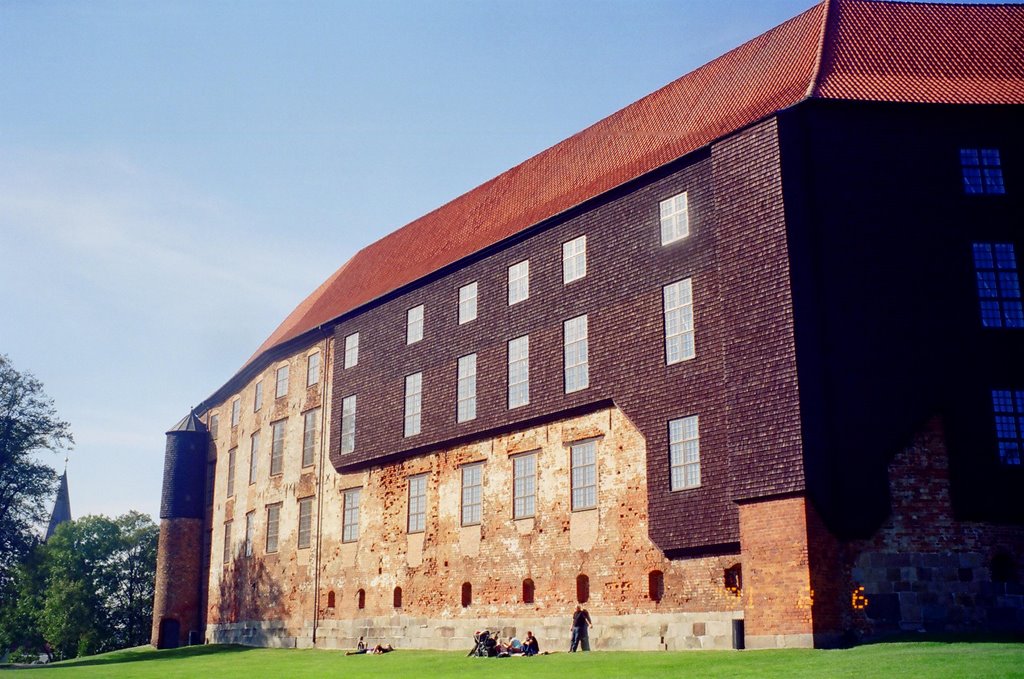
In the centre of the city of Kolding, stands the castle of Koldinghus (pron. Kollinghoos). On this site once stood a fortress built by the Danish King - Erik Glipping in the year 1268 - meant to guard the border between the Kingdom of Denmark and the Duchy of Schleswig (in Germany). The fortress was rebuilt as an unfortfied castle in the mid-16th century at which time the King often stayed at Koldinghus. In the 1720s the castle was again rebuilt but by then the members of the royal court were only infrequent visitors and the castle was allowed to fall into disrepair.

In 1808 some Spanish auxiliary troops, stationed there in the Napoleonic wars stoked the fire in one of the hearths so fiercely that the castle itself burnt down. Reuilding work was not started until as late as 1890.


The rebuilt castle (above) today draws plenty of visitors. The architects who restored it are Inger and Johannes Exner. Scandinavian design is truly classic and minimalist, employing material in its natural form to achieve both function and style. The castle has been restored in keeping with that tradition. Indeed, the reconstruction is modern and seems incongruous at times – contrasting sharply with the weathered red brick walls, although, it does not diminish by way of aesthetics.


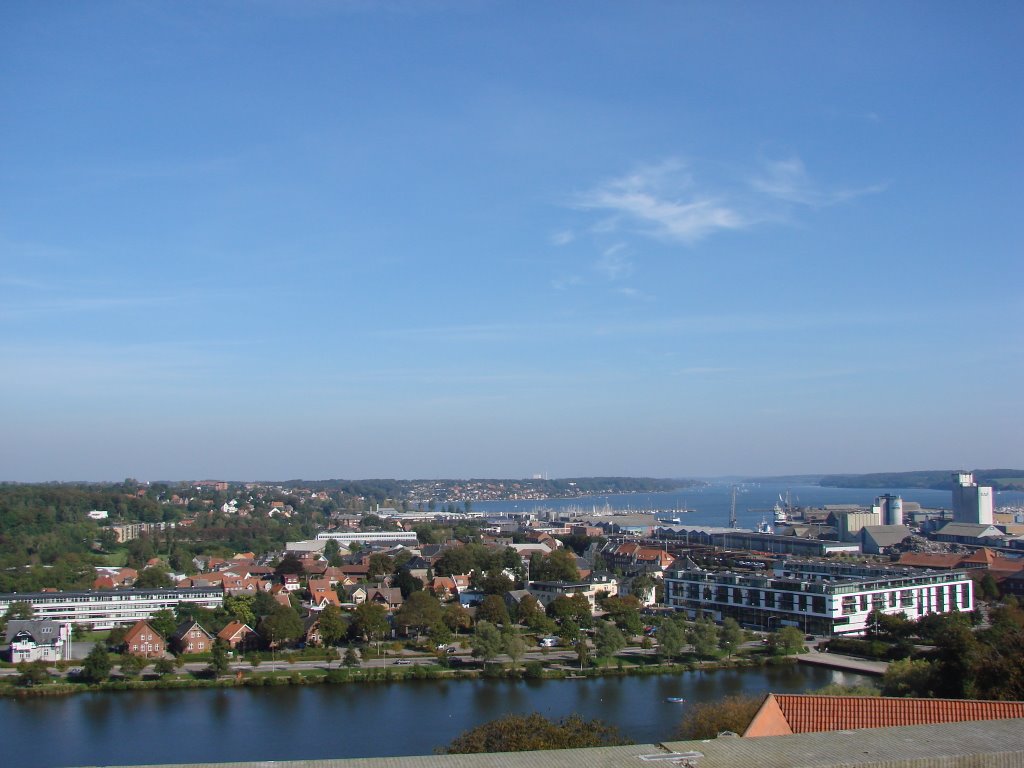
There is a magnificent view (below) from the top of the Great Tower. (Great Tower known as 'Heroes Tower' was added around 1600.)


This is where you park your car, where the stables once were.


Right next to the castle is a river where you will always find a boat. This particular boat (sorry, no picture) has to be kept ready at all times for the Queen. If the Queen were to arrive at the castle and wanted to cruise down the river, then she should never be disappointed and for that aim to be fulfilled the boat remains docked in this river perennially.

The Danes incidentally are quite crazy about their monarchy, following their lives and loves as closely as any monarcho-phile in, lets say, Britian. I asked an agricultural teacher, Jørgen P. Jensen why they loved their monarchy so much and he said, “I think its because they are quite sensible people.” Down to earth for sure, because when we were in a place called GrÃ¥sten (pron. Grosteeng) where the Queen has her summer home, people say, you can actually run into her, shopping for groceries in the neighbourhood supermarket.

Tuesday, November 28, 2006

SSSHHHH.... IT'S A VVIP EAR

(Photo Courtesy: Pratik Shah)

The VIP tribe of this country is a self-serving, smug one. If you live in Chennai and happen to drop in at 'Coffee' near the Music college, look for this PWD order painted on the wall.

Saturday, November 25, 2006

SHUT UP PLEASE, THANK YOU.

I hate noise. I can't stand it when people talk loudly and constantly interrupt me but I really hit the roof when people use their car horns. And God help me, if a bus or a truck is hooting away. I burst an artery. And when those bloody ambasadors - that symbol of power in India, comes along honking away with impunity, I just want to shed tears - shed tears at his stupidity and his arrogance and my own pathetic helplessness. What can I do to make people shut the F *** up? I feel so helpless.

(Even as I type this, some jackass on a bike has gone tooting down my road. May he run into a pole.Oh god! And now Onyx is here. What their workers do to keep the city clean is negated completely by the noise and air pollution their trucks release.)

There is a vast army of half-witted, insentient noise-polluters who have invaded the roads rendering common sense a rare and priceless commodity in India.

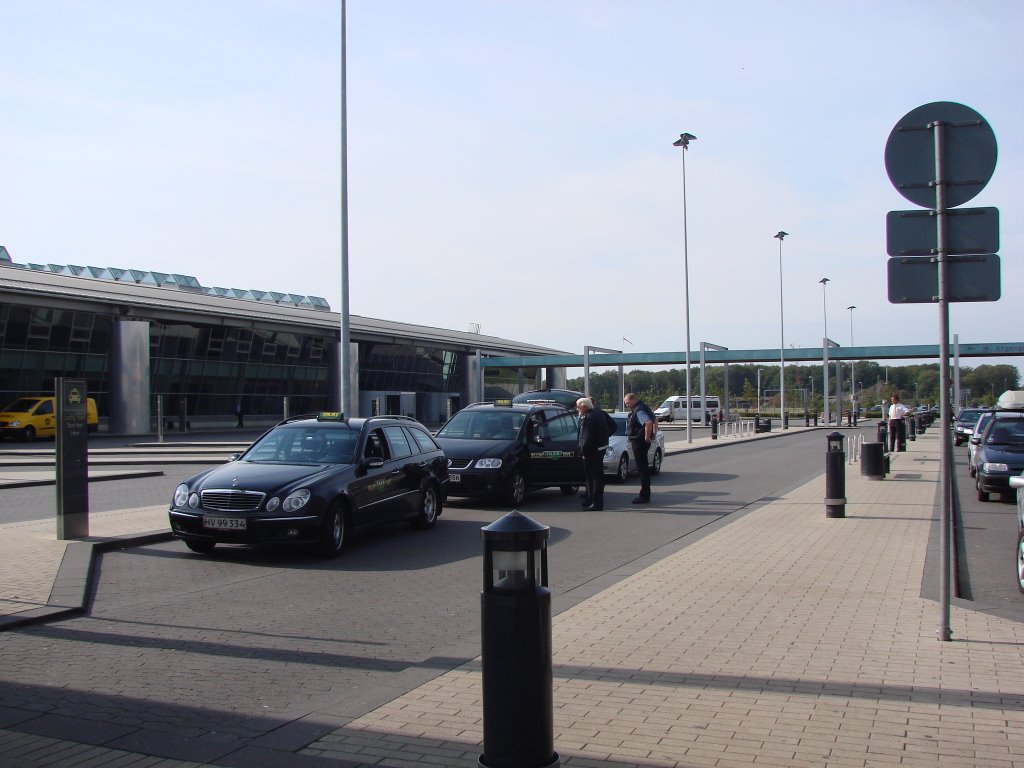
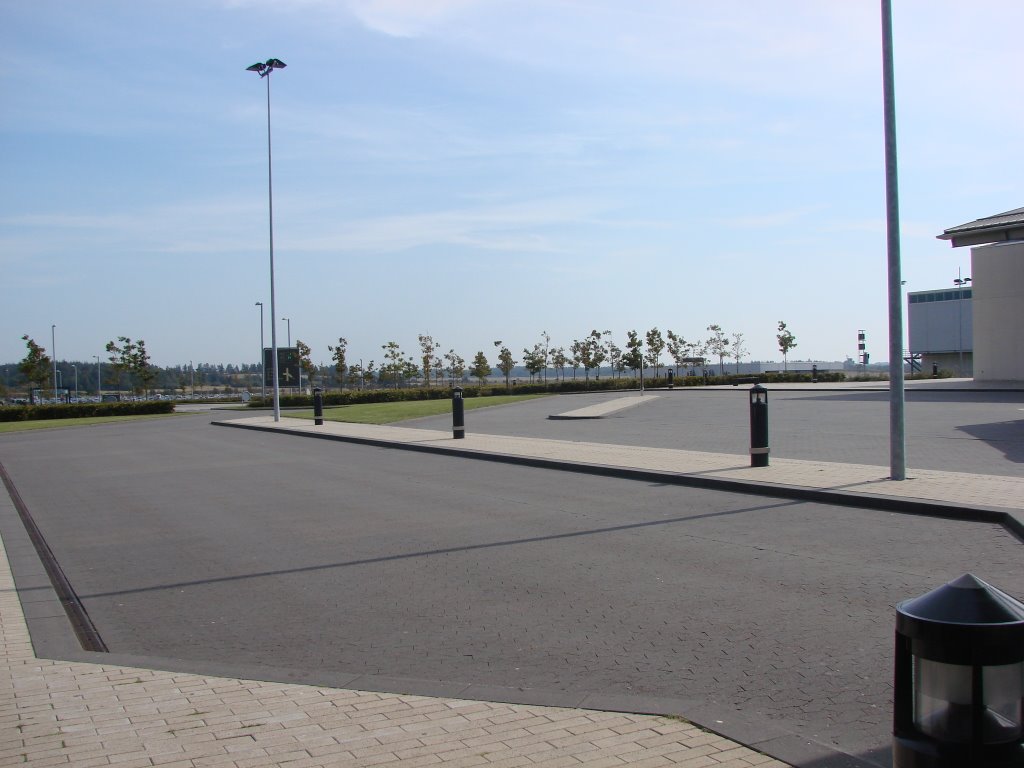
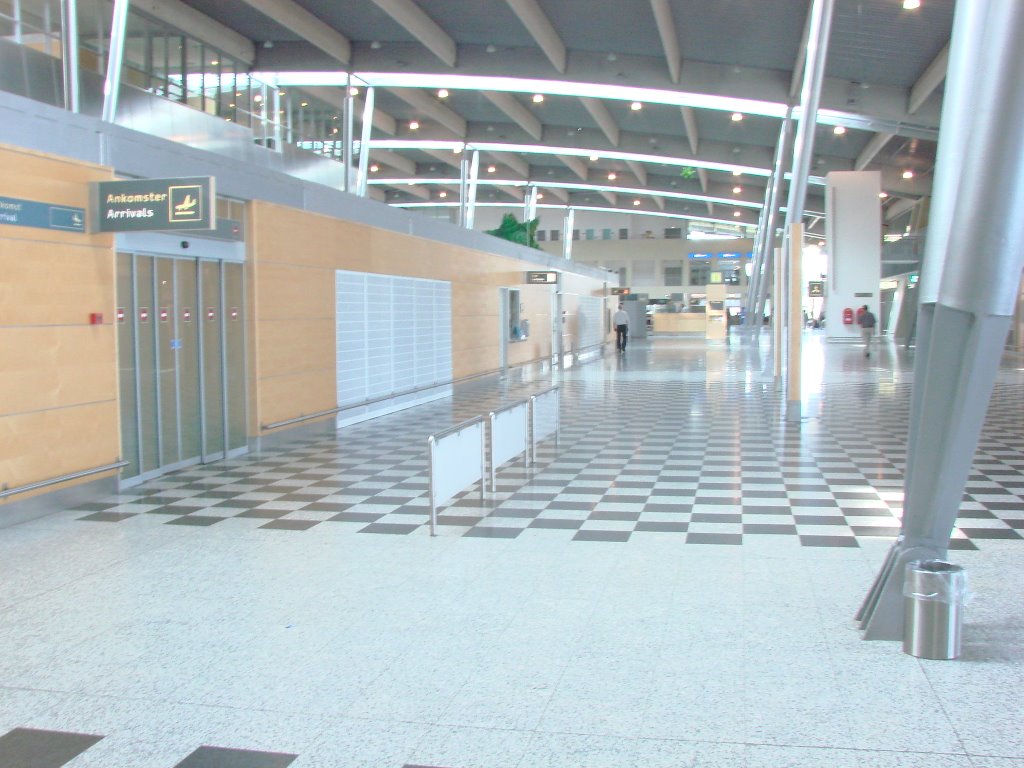
Thats why, when we first landed at the Billund airport (below) in Denmark, we could've easily assumed that the country was in a state of Emergency and all residents had been told to stay indoors and shut up. Everything was so lovely and quiet and empty. (Look at the last snap of the arrival lounge. Not a soul in sight!) Thats how it always is. I had a feeling things were going to go well. They did. I didn't see or hear a rude driver for 40 days and I will need a separate blog to start writing about how I was glowing with good health.


But seriously, what can we do, to make people aware that there is such a thing as noise pollution? That people use their horns ridiculously more than they need to. I have a good track record on the road having avoided dogs, cows, goats, cyclists and pedestrians deftly for nearly 10 years now and all this with only the gentle nudge of the horn in the rarest of rare circumstances. So why can't everybody else shut up??????!!!!!!! Waaaaaaaaah... Waaaah.

Friday, November 24, 2006

Monday, November 20, 2006

SKAMLINGSBANKEN

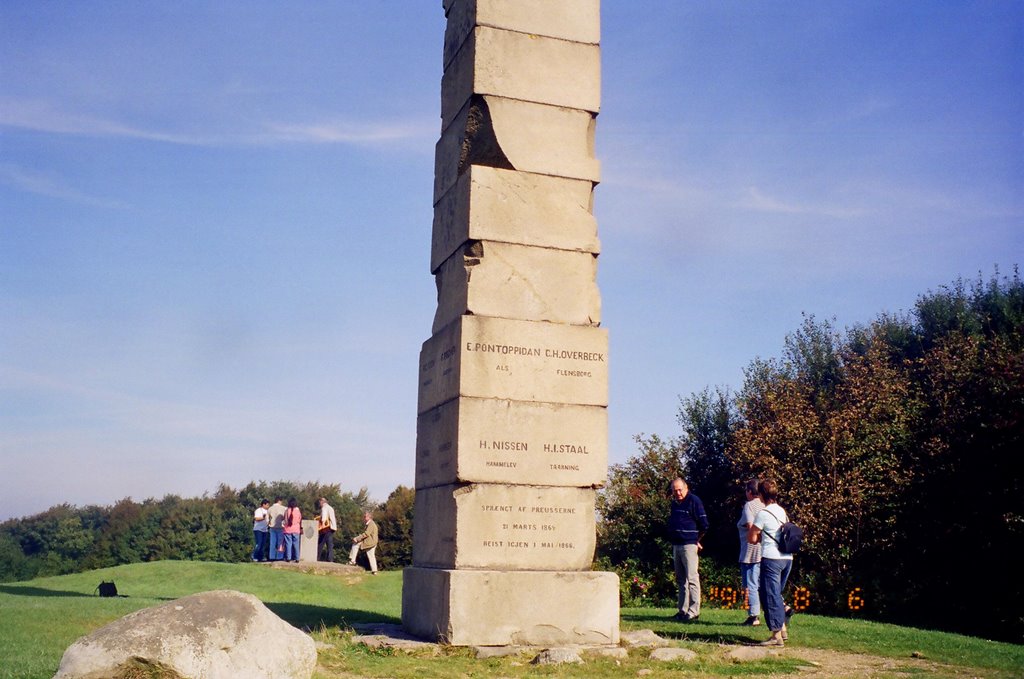
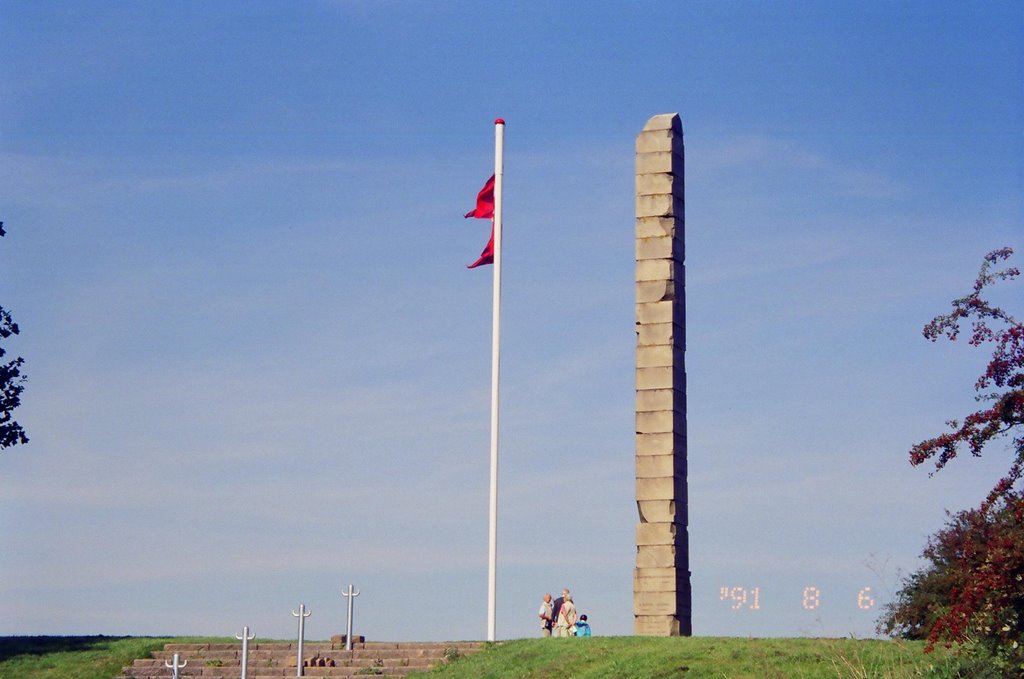
Denmark is flat country – so flat, that the second highest point – Skamlingsbanken is all of 370 ft high. But it offers a lovely view of southern Denmark and you can spend a quiet, refreshing morning there…. like we did, complete with a picnic basket and soda that topples over a lot.


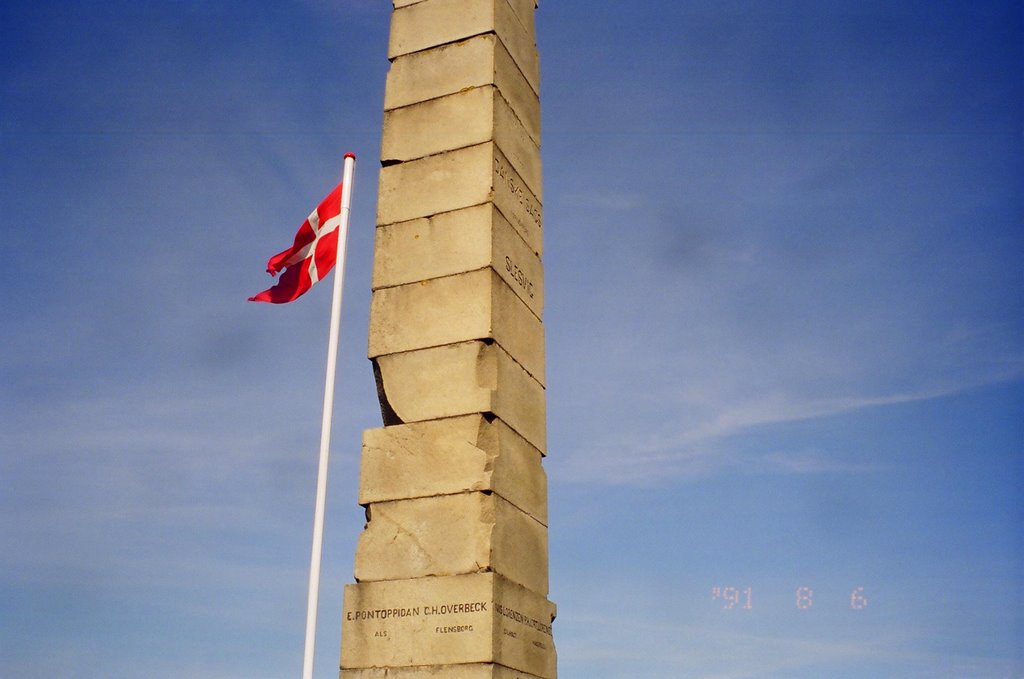
Right on top of the hill (bank is an old Danish word for hill) stands a tall obelisk – a memorial erected to commemorate the Danish nationality and way of life. It was erected at a time when the Danes were trying to fight off German aggression on the southern front. But in 1864, the Germans led a successful invasion and captured the south of Denmark and one of the first things they did was to blow away the stones of this symbol that their captives took great pride in. But villagers living around the area collected the stones and rebuilt the obelisk. The Germans left southern Denmark in 1920 after a plebiscite and have not staked their claim since. But it left behind a minority of Germans and Danes on both sides of the German-Danish border.


Today of course things are calm but Danish parents will still not send their kids to German schools or German parents to Danish schools for that matter, and, the older generation would still frown upon a German-Danish marriage.

There is a large Danish minority in the north German town of Flensburg where Danes like to drive down to do their shopping. People pay such high taxes in Denmark that its cheaper for them to drive down to Germany and do some monthly shopping there. Especially if they’re buying the famous Flensburger Pilsener also called Flens.


Back to Skamlingsbanken – and the great fluttering red flag next to the obelisk. Denmark’s national flag called the Dannebrog (old Danish for “The Danish cloth”) is red with a white cross that is not exactly in the center but a little to the left.

Its one of the oldest flags in the world. Legend has it, that during the Battle of Lyndanisse, in present day Estonia, it descended from the heavens at a crucial juncture, resulting in a Danish victory and given the Danish reverence for their flag, it goes without saying that the flag should flutter proudly next to the restored obelisk.

A MORAVIAN AFTERNOON

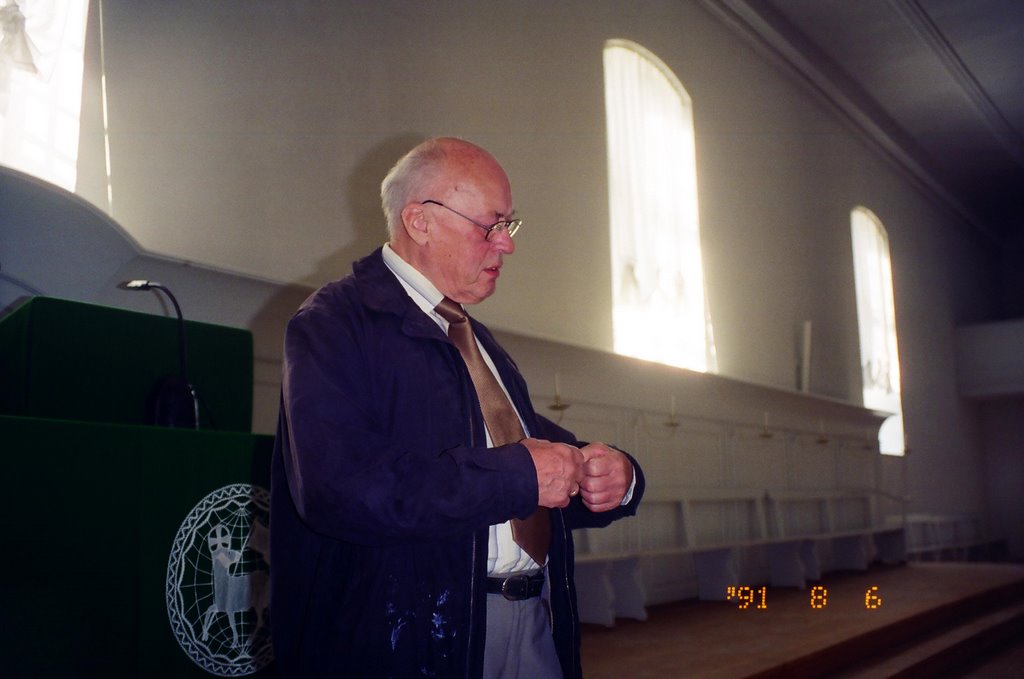
Its great to record a holiday like this. I can’t remember anything of previous holidays and thanks to the blog, I’ll never forget this one. So heres another little something from an afternoon spent at a Moravian Church with priest Lorenz Asmussen (below).


First a grab from Wiki: The Moravian churches form a modern, mainline Protestant denomination with a religious heritage that began in 15th-century Bohemia (now in the Czech Republic). It is sometimes also known as the Unitas Fratrum or Unity of the Brethren, or as the Bohemian Brethren.

Moravians were some of the earliest Protestants, rebelling against the authority of Rome more than a hundred years before Martin Luther.

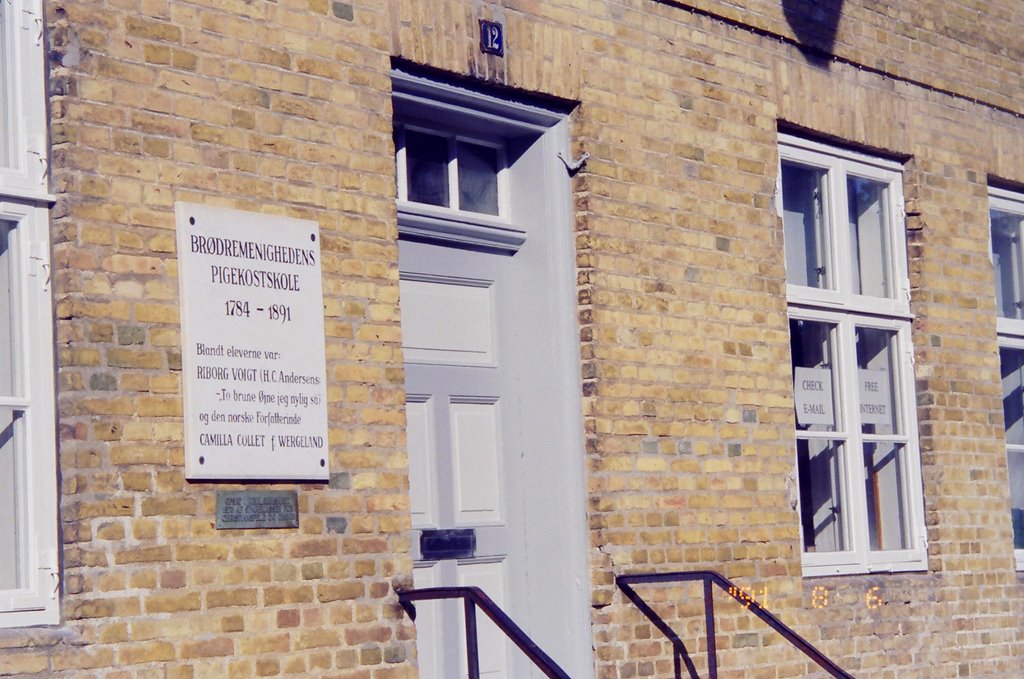
Christiansfeld – in South Denmark is the only Moravian town in Scandinavia and the youngest town in Denmark. It is named after King Chrstian VIIth who requested the congregation to build the town in 1772. Build it they did, and so well that in 1975 the town received an award for its distinctive style of straight streets and beautiful buildings.


Our walk began at the church square by the well, which is the center of the town. From there the measuring of the town was started, when it was founded.

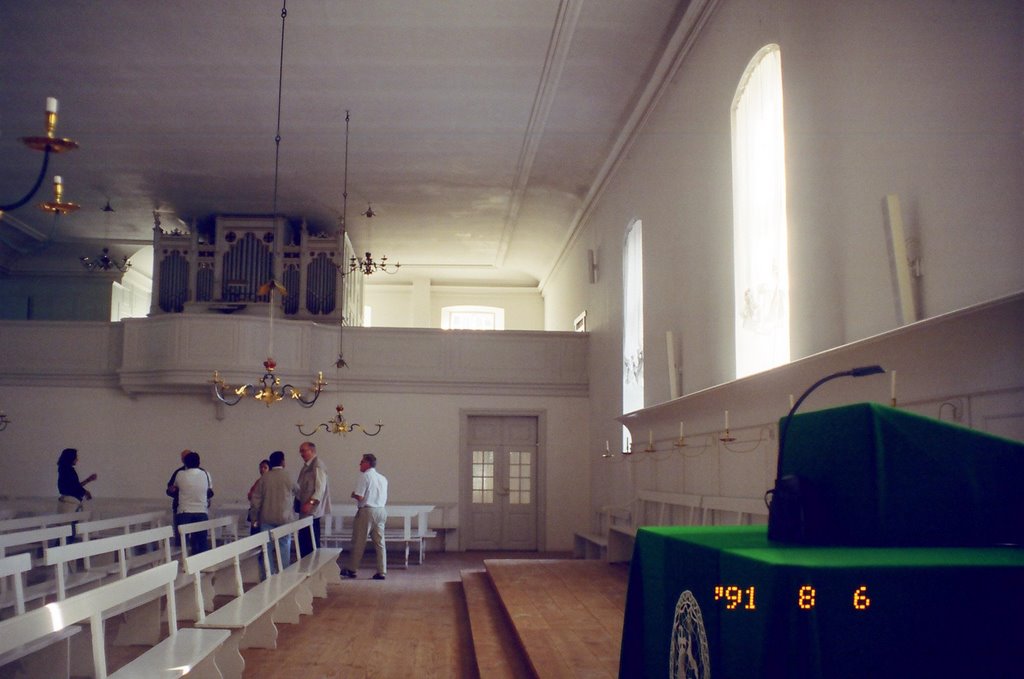
Inside, the church hall is all white, devoid of altar or pictures. The Moravian church has spartan interiors because they believe that elaborate art and décor are only a distraction. Another interesting departure from other churches is that the organist does not have his back to the congregation but faces it.


The Moravian graveyard is known as “Gods Acre” or “church of the dead” with the sisters buried to the right and the brothers to the left. All the gravestones are exactly the same as a symbol of all being equal and alike after death. Here the graves have been preserved since 1773. Interestingly, a Moravian funeral will not involve the telling of stories about the deceased by relatives and friends. Instead, as Moravians age, they start to document the story of their lives on their own and they remain a rich treasure for posterity.


Monday, November 13, 2006

EELAM DREAMS IN DENMARK

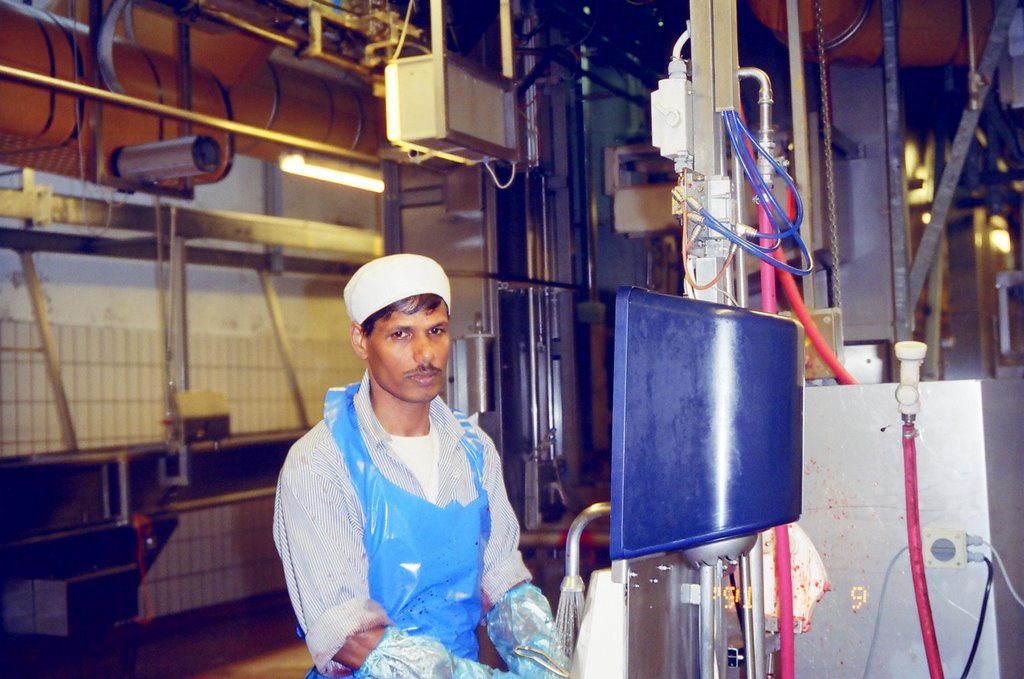
There were nearly 30 foreigners working at the Danish Crown plant in Grindsted. Many from Vietnam and a few from Sri Lanka – like Kandiah Kankanidhi (in picture). Kandiah is from Achchiveli in Jaffna and he fled the war in Sri Lanka in 1985. He landed in Tamil Nadu and lived in Purusuwalkam briefly before seeking asylum in Denmark. He lives in Grindsted with his wife and two boys aged 4 and 10. He still has two brothers back in Achchiveli and is able to send a considerable sum of money back home. He was making nearly 170 Kr. per hour, which is around 1360 Indian rupees. (People work 35 hours a week in Denmark.)

Kandiah is satisfied with his life but dreams of going back home. “I want to go back some day. I want the future generations of my family to remember Tamil. If we get freedom, I will definitely go back.”

I felt sorry for Kandiah - thousands of miles away from his homeland, holding onto the pipedream of a free Eelam.

Kandiah won't have a problem finding another job. Sri Lankan workers are generally valued for their hard work. Besides, Denmark, with a population of around 5.5 million could do with as many hands as possible.

WATCHING MY WORK

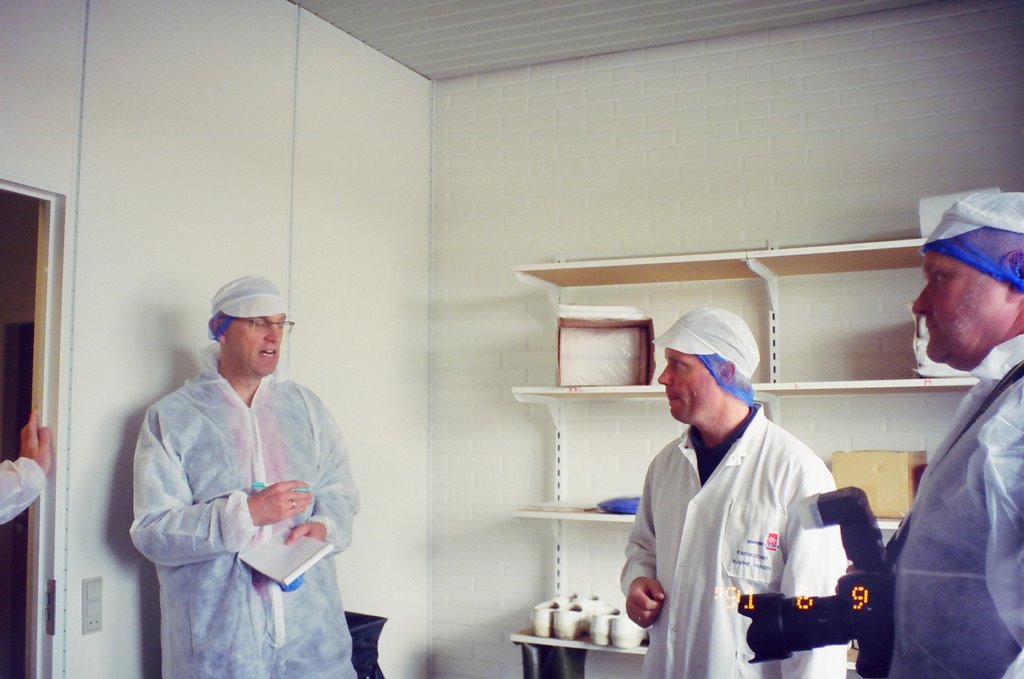
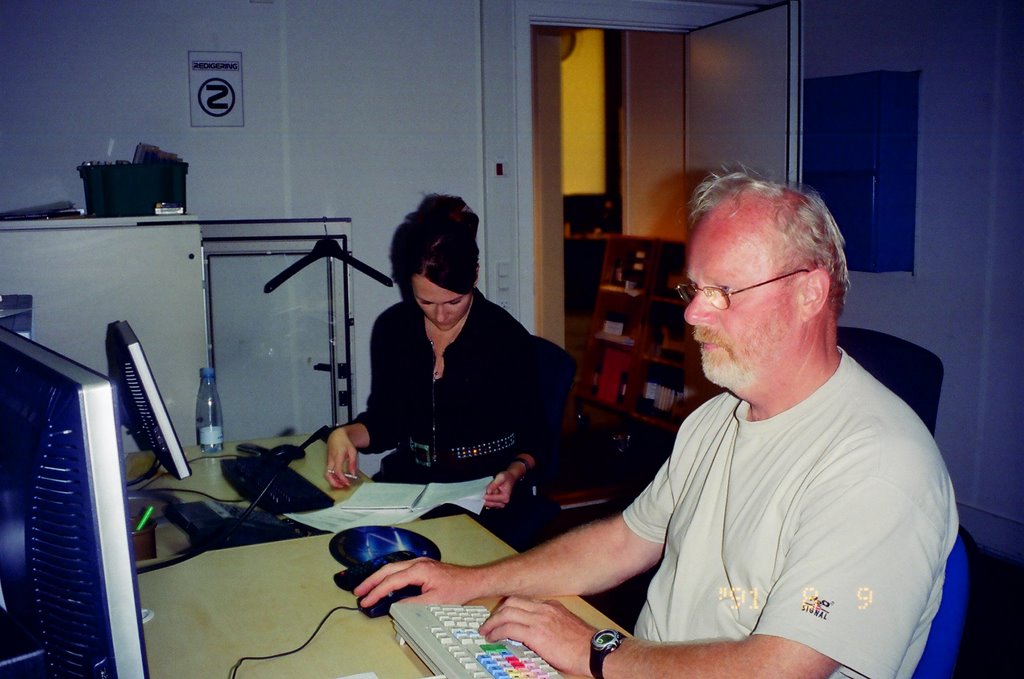
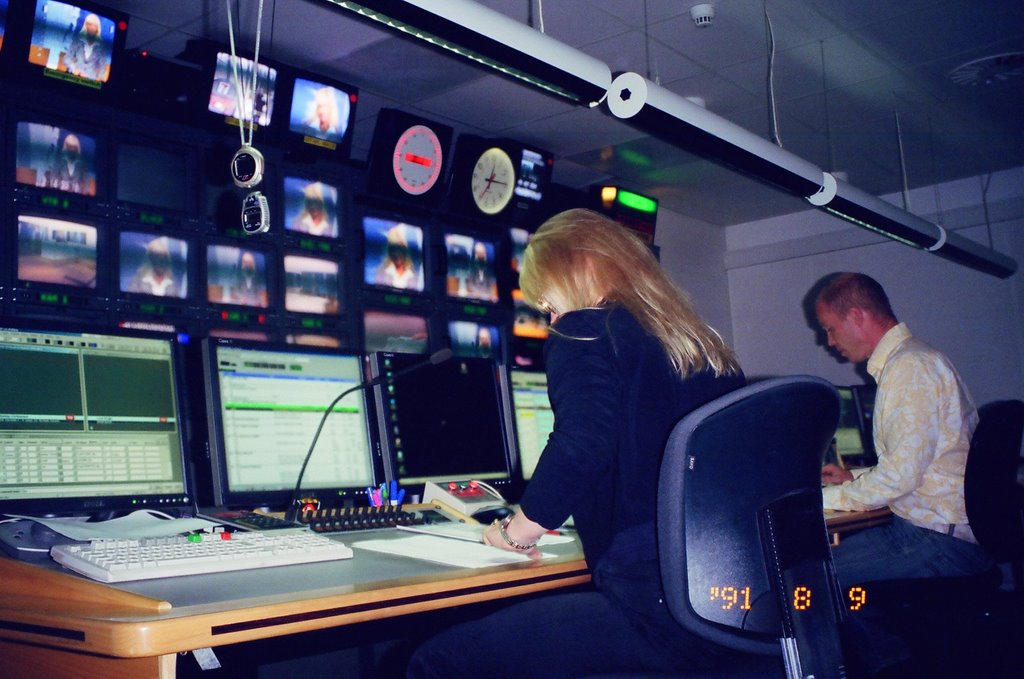
TV Syd serves the southern region of Denmark – called South Jutland. I spent a day at their office observing how they work and that’s how the pig story happened. I was assigned to go with the team of Dorte Vinther (both in picture) and cameraman, Arne Andreasen. Dorte had yawned during the morning meeting and was thereafter referred to as “the sleepy reporter.”

The thing I noticed first about their office was the silence. Nobody was screaming down phone lines, nobody was barking on their cell phones, indeed, cell phones were not even ringing and all was truly quiet on the southern front. For the story we had to drive from Kolding (pron. Kolling) to Grindsted. TV crews there don’t have separate drivers – Arne drove, filmed and edited the pictures.

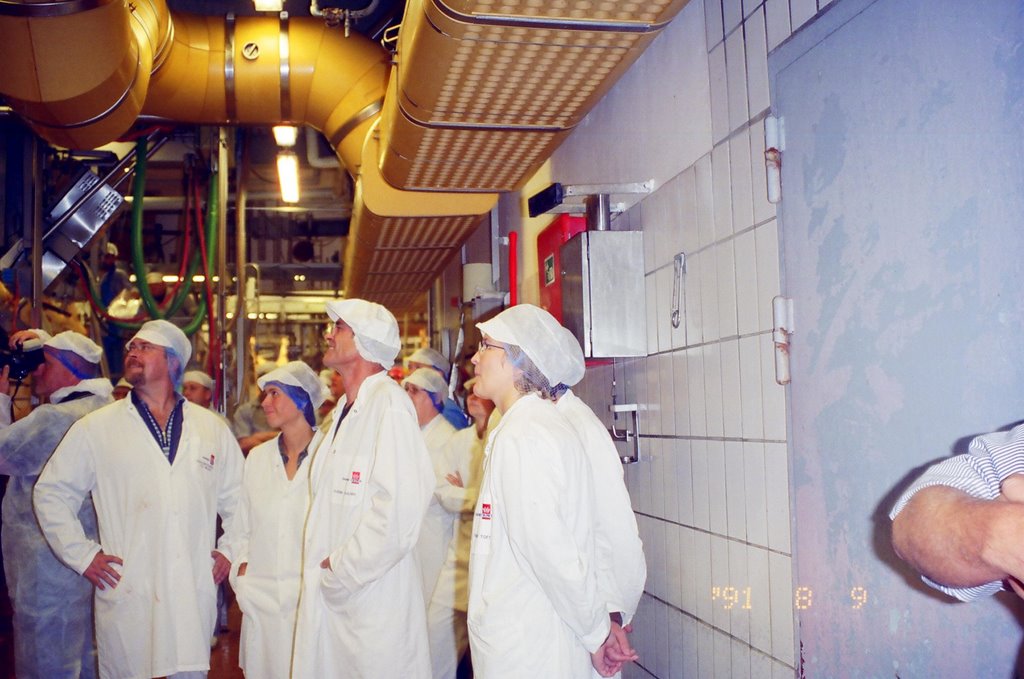
Once there, we had to wear space suits like these before going into the factory where Arne and Dorthe got down to business while I got down to staring.


Arne shot for about 30 minutes and then Dorte began her interviews. The story about the imminent closure of this plant had been done before so she did a soft story on what people were feeling on the day it actually happened.

The union leader, Kent Kaltoft was interviewed outside the plant. He said, "Of the 700 workers, 500 already have a job. But I'm not going to stop till the last person finds a job."


Here in India we keep our equipment in the office. But at TV Syd, all the equipment remains in the ENG (electronic news gathering) van. It’s equipped with chargers and monitors and everything else required in handling a breaking news story. Just jump into this thing and hit the spot. Here, Arne puts everything back in place.

Back in the office Dorte begins to write her story in the newsroom. The picture of Tintin looks down upon the place. Why is it there? Because according to the news head Ernst Moller, “hes the best reporter in the world!” That is true.

Once the script is done, the edit begins.


These are pictures of the production control room. Everything that happens in the studio is controlled from here. The plant's closure became the top story that evening.

And that’s the way it goes.

Monday, November 06, 2006

HOW TO MAKE BACON

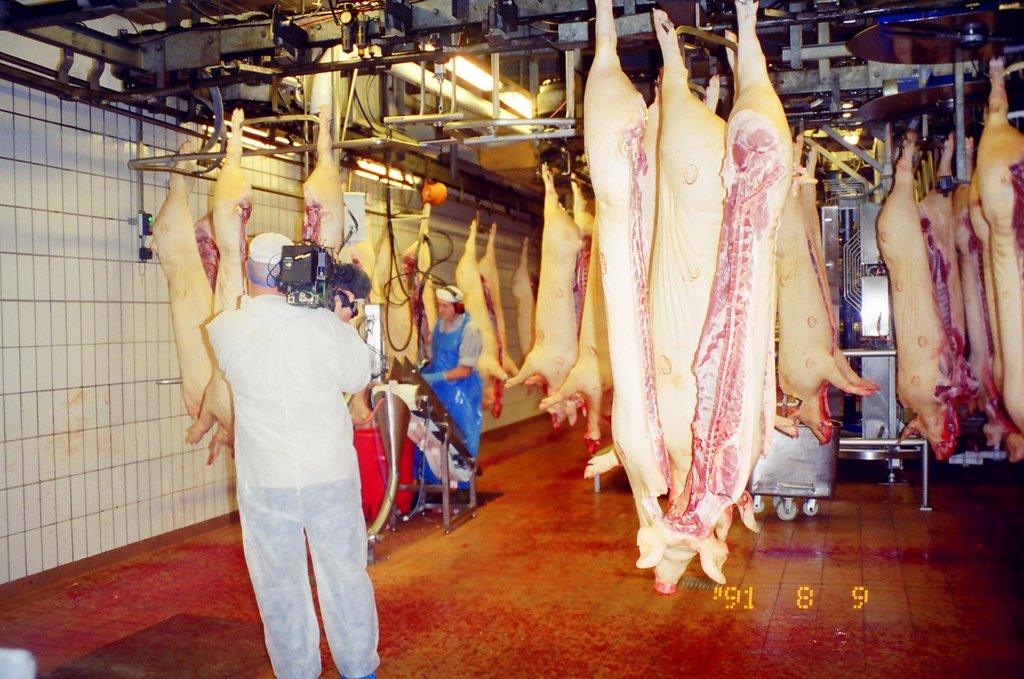
Don't think me macabre for taking pictures of pigs being slaughtered. I just happened to be there. The process was fascinating and I must admit I'm not really big on animal rights. The eyes don't moisten. So anyway, here it is - a photo essay. And if you care about pigs and other four-legged friends of man, skip this one.

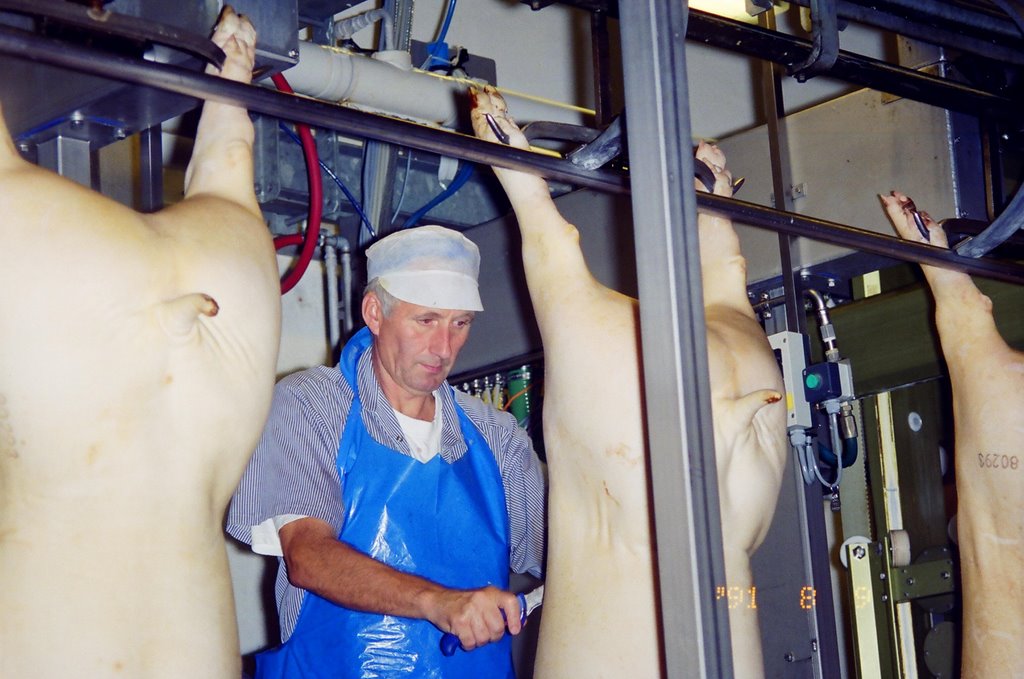
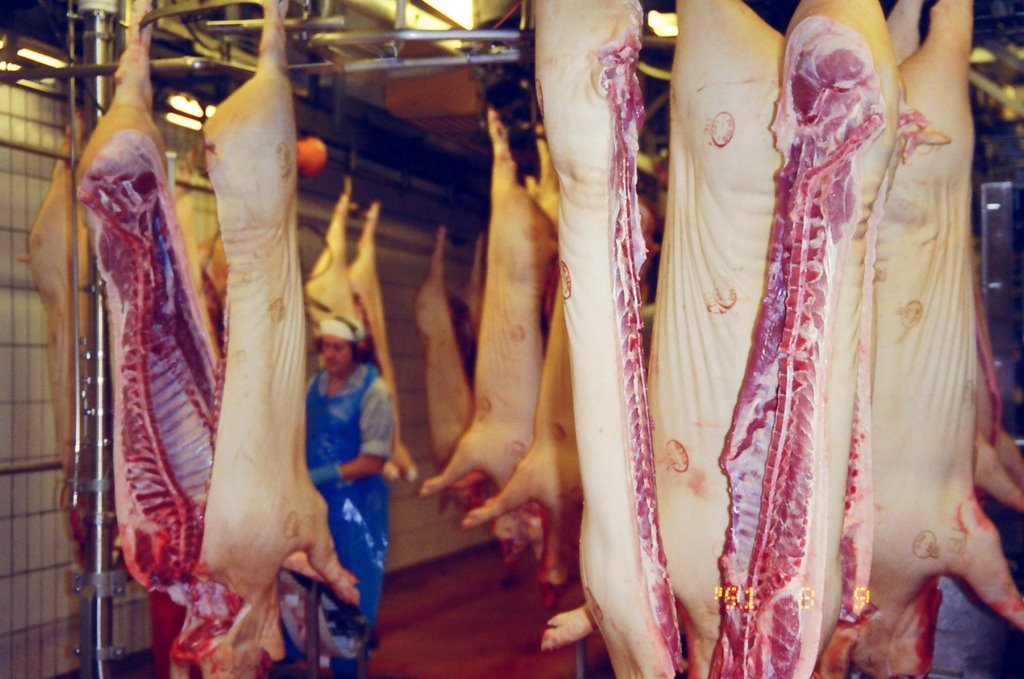
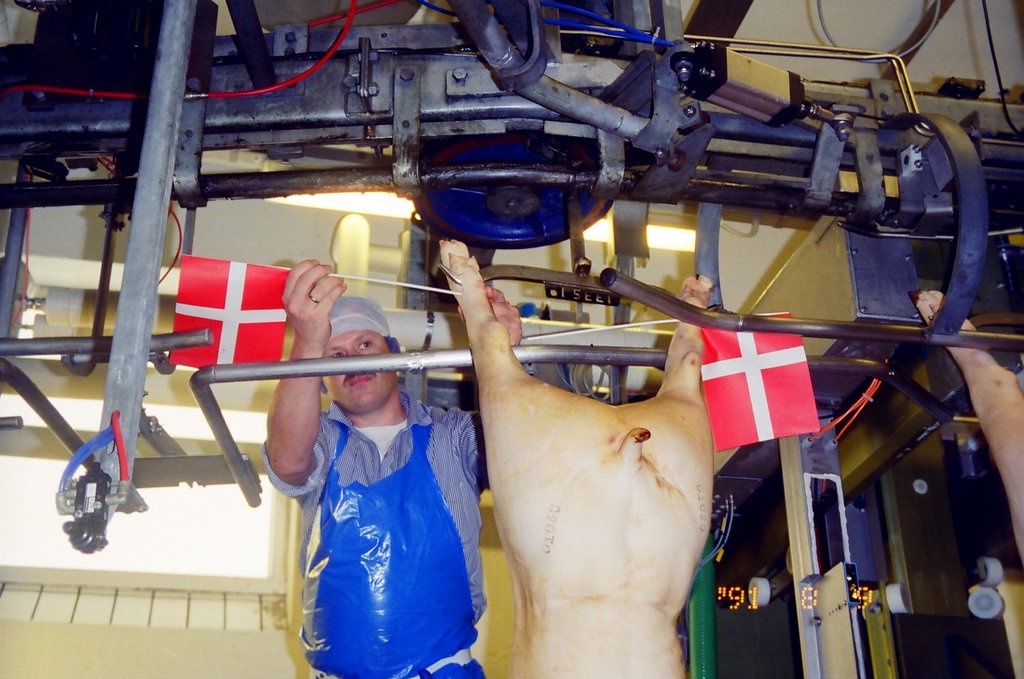
These pictures were taken at the Danish Crown factory in Grindsted, Denmark. The plant was shutting down because it was too small and it was no longer viable to run it. The pigs are gassed in a chamber just ahead of this one. Here they enter the assembly line where man and machine go to work to remove the innards. This is how it ends up as bacon and ham at the breakfast table.


A worker makes the first cut.


There are quite a few stages and each worker or machine yanks out a specific part from inside the pig. Theres blood all over the floor and thats not the scary part. Instead, its the knives in the workers hands. I kept thinking, what if one of them went berserk one morning? (Like that morning.) But workers in Denmark are not frustrated. More on that later.

This is pretty much the last stage of the inside-clearing job. As you can see, theres almost nothing there!

Now, the Danes love using their flag. Everyone has a flagpole in their lawn and if its someones birthday the flag goes up. Little flags even go into the birthday cake and all over stores in Denmark you will find all kinds of everyday things with the flags design, like, notebooks, pens, pencils, postcards and of course flags. So it was only appropriate that the last pig that came out of the assembly line went through proudly with the Danish flag in it.

It was an emotional day for the employees at Danish Crown in Grindsted. They had worked side by side for many years and as the last pig rolled out a wave of nostalgia swept over them. But everyone was still smiling. Unemployment is so low in Denmark (about 3%) that only a minority of the nearly 700 workers here had not yet found another job.

Sunday, November 05, 2006

CARTOONS COST MONEY


The tiny country of Denmark has unfortunately been remembered in the last year for the notorious Prophet Mohammed cartoons. The controversy erupted again a year later when the youth wing of a right-of-center party was caught on tape drawing cartoons during a drunken bash. Companies like Robert Damkjaer Ltd. have been badly hit because of these needless doodles. They are exporters of meat and 80% of it went to Muslim countries. But their products were boycotted and almost a year after the controversy only about 60% of their business has revived.


Company owners reportedly still have good relations with their buyers in the middle east but under pressure from local mullahs and imams, people there are unable to carry on business with the Danes.

FOOD GLORIOUS FOOD


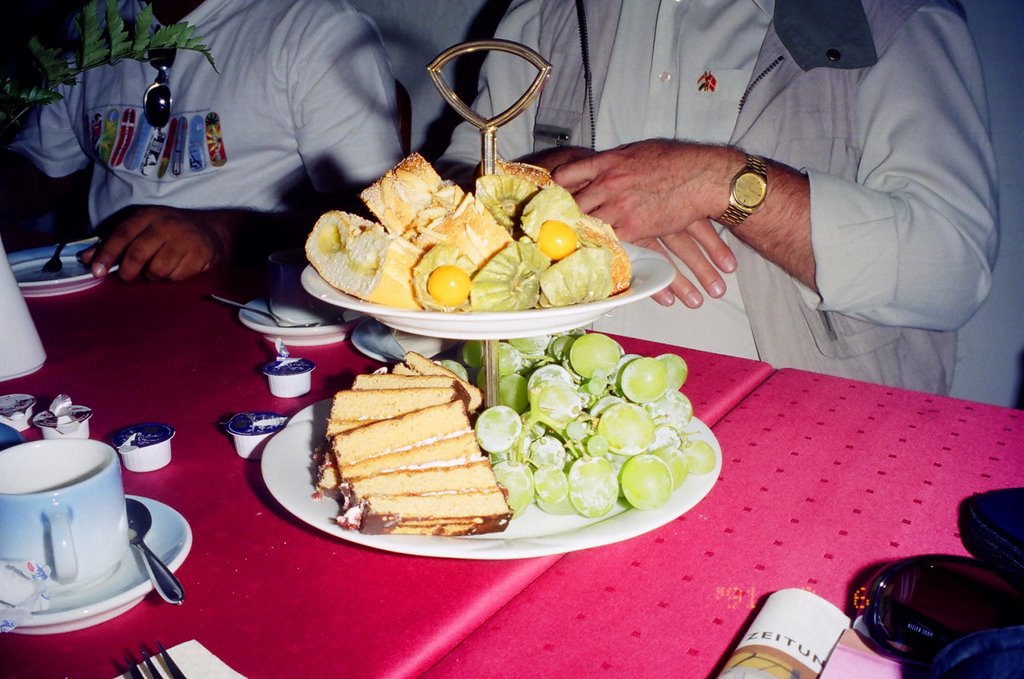
Delightful Danish pastries. More delicious photographs when I find the time.

Wednesday, November 01, 2006

SADNESS

In the three-and-a-half years that I have been working as a journalist, I have never - not once - been able to reach a government officer on the landline. Not once.

This is EXACTLY how it goes.

"Hello, could I speak to Mr. XYZ."

"Yaar pesarade?"
(Whos speaking?)

You are put on hold while your name and designation are told to the person you want to speak to and of course that person does not want to speak to you and never has the grace to come on the line. Then you are informed...

"Saar meeting le irkaar."
(Sir, is in a meeting.)

"Okay, when will the meeting get over?"

"Teriyaade medem"
(Don't know, medem.)

"Okay, give me his mobile number please."

"Teriyaade medem" or "Permission illame kudaka mudiyaade medem" (Without permission I cannot give it to you... Medem)

Okay stupid F &$#*$#&!!!!

"Okay, when should I call back?"

"Naaliki....Inniki, Saar roombu busy."
(Tomorrow... sir is vurrry busy today.)

Then you can call tomorrow and you will be told all these same things again. Then try it the day after and you will find they do not care to even come up with a different lie. This will carry on till you get fed up. Till YOU get fed up because they don't tire of the exercise.
This means, you can't get simple information or cross-check it by speaking to the 'right' people. The only way to gain access to these people is to hob nob with them. I think many journalists see this PR exercise as a part of their job and are happy to build sources this way to acquire contacts and more importantly mobile numbers. It helps to go through with it sometimes because these are the benefits. But I'd rather go home and read a book.

Alas, my holiday has ended.