Monday, December 04, 2006

KOLDINGHUS

In the centre of the city of Kolding, stands the castle of Koldinghus (pron. Kollinghoos). On this site once stood a fortress built by the Danish King - Erik Glipping in the year 1268 - meant to guard the border between the Kingdom of Denmark and the Duchy of Schleswig (in Germany). The fortress was rebuilt as an unfortfied castle in the mid-16th century at which time the King often stayed at Koldinghus. In the 1720s the castle was again rebuilt but by then the members of the royal court were only infrequent visitors and the castle was allowed to fall into disrepair.

In 1808 some Spanish auxiliary troops, stationed there in the Napoleonic wars stoked the fire in one of the hearths so fiercely that the castle itself burnt down. Reuilding work was not started until as late as 1890.
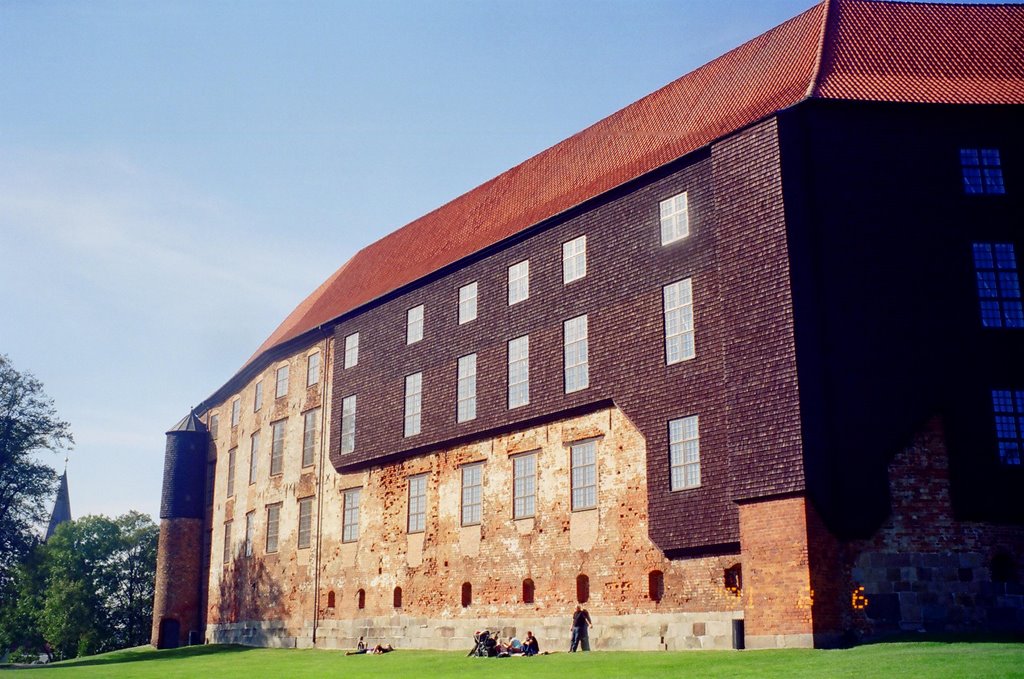


The rebuilt castle (above) today draws plenty of visitors. The architects who restored it are Inger and Johannes Exner. Scandinavian design is truly classic and minimalist, employing material in its natural form to achieve both function and style. The castle has been restored in keeping with that tradition. Indeed, the reconstruction is modern and seems incongruous at times – contrasting sharply with the weathered red brick walls, although, it does not diminish by way of aesthetics.



There is a magnificent view (below) from the top of the Great Tower. (Great Tower known as 'Heroes Tower' was added around 1600.)
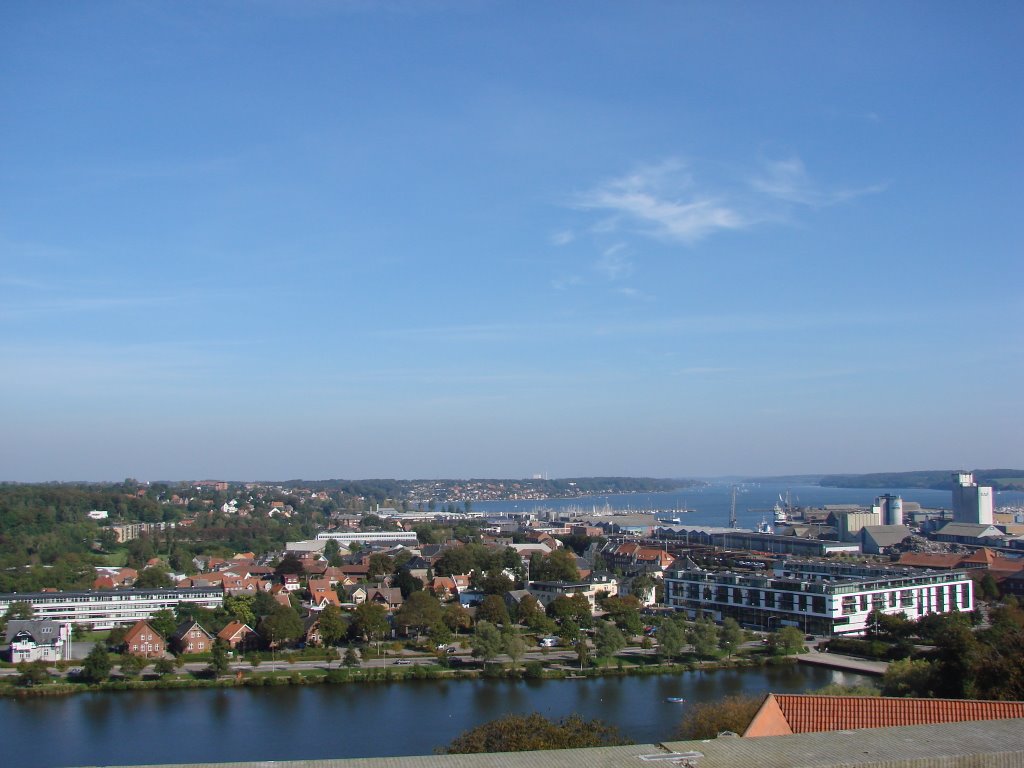

This is where you park your car, where the stables once were.
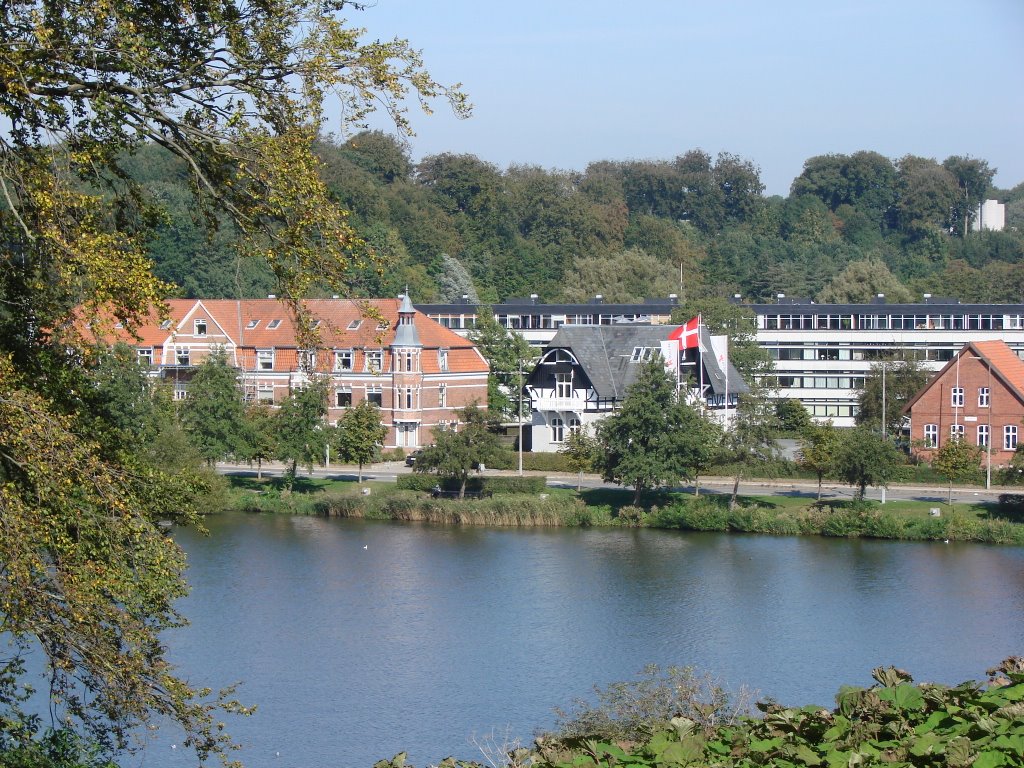

Right next to the castle is a river where you will always find a boat. This particular boat (sorry, no picture) has to be kept ready at all times for the Queen. If the Queen were to arrive at the castle and wanted to cruise down the river, then she should never be disappointed and for that aim to be fulfilled the boat remains docked in this river perennially.

The Danes incidentally are quite crazy about their monarchy, following their lives and loves as closely as any monarcho-phile in, lets say, Britian. I asked an agricultural teacher, Jørgen P. Jensen why they loved their monarchy so much and he said, “I think its because they are quite sensible people.” Down to earth for sure, because when we were in a place called Gråsten (pron. Grosteeng) where the Queen has her summer home, people say, you can actually run into her, shopping for groceries in the neighbourhood supermarket.

Tuesday, November 28, 2006

SSSHHHH.... IT'S A VVIP EAR

(Photo Courtesy: Pratik Shah)

The VIP tribe of this country is a self-serving, smug one. If you live in Chennai and happen to drop in at 'Coffee' near the Music college, look for this PWD order painted on the wall.

Saturday, November 25, 2006

SHUT UP PLEASE, THANK YOU.

I hate noise. I can't stand it when people talk loudly and constantly interrupt me but I really hit the roof when people use their car horns. And God help me, if a bus or a truck is hooting away. I burst an artery. And when those bloody ambasadors - that symbol of power in India, comes along honking away with impunity, I just want to shed tears - shed tears at his stupidity and his arrogance and my own pathetic helplessness. What can I do to make people shut the F *** up? I feel so helpless.

(Even as I type this, some jackass on a bike has gone tooting down my road. May he run into a pole.Oh god! And now Onyx is here. What their workers do to keep the city clean is negated completely by the noise and air pollution their trucks release.)

There is a vast army of half-witted, insentient noise-polluters who have invaded the roads rendering common sense a rare and priceless commodity in India.

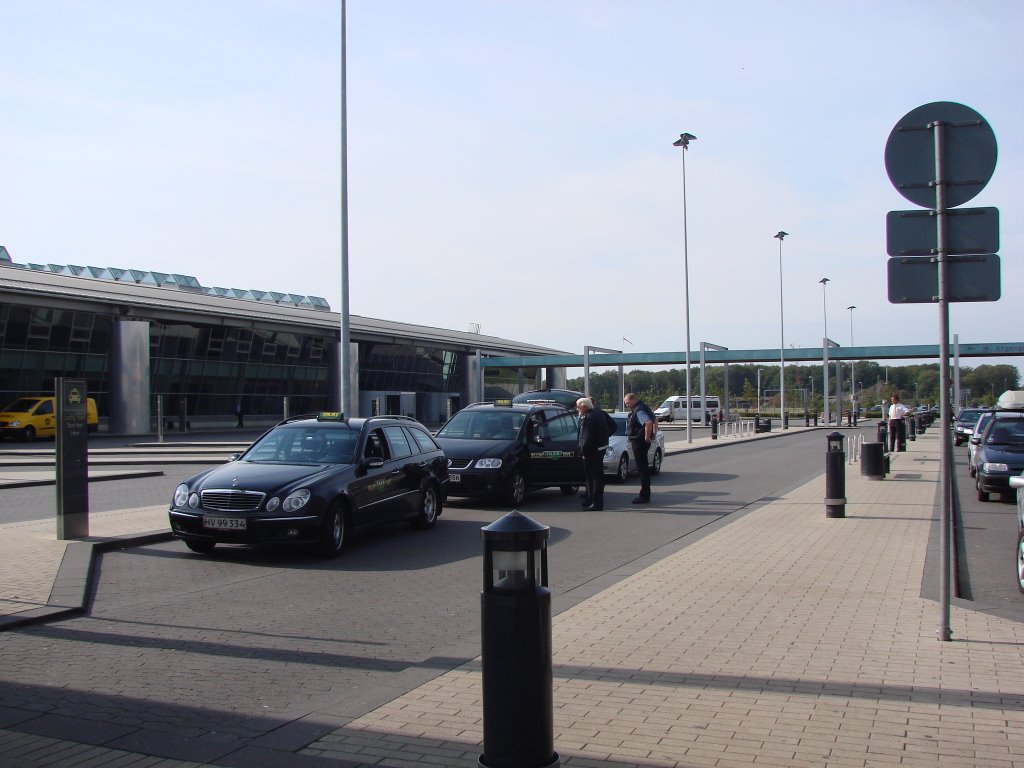
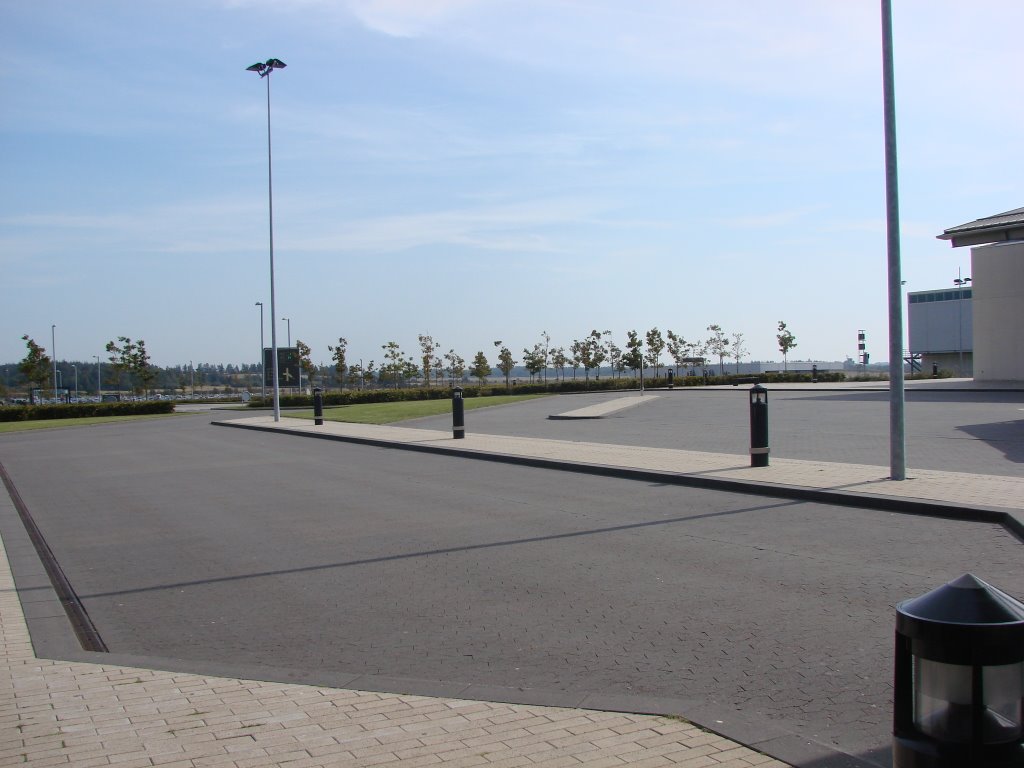
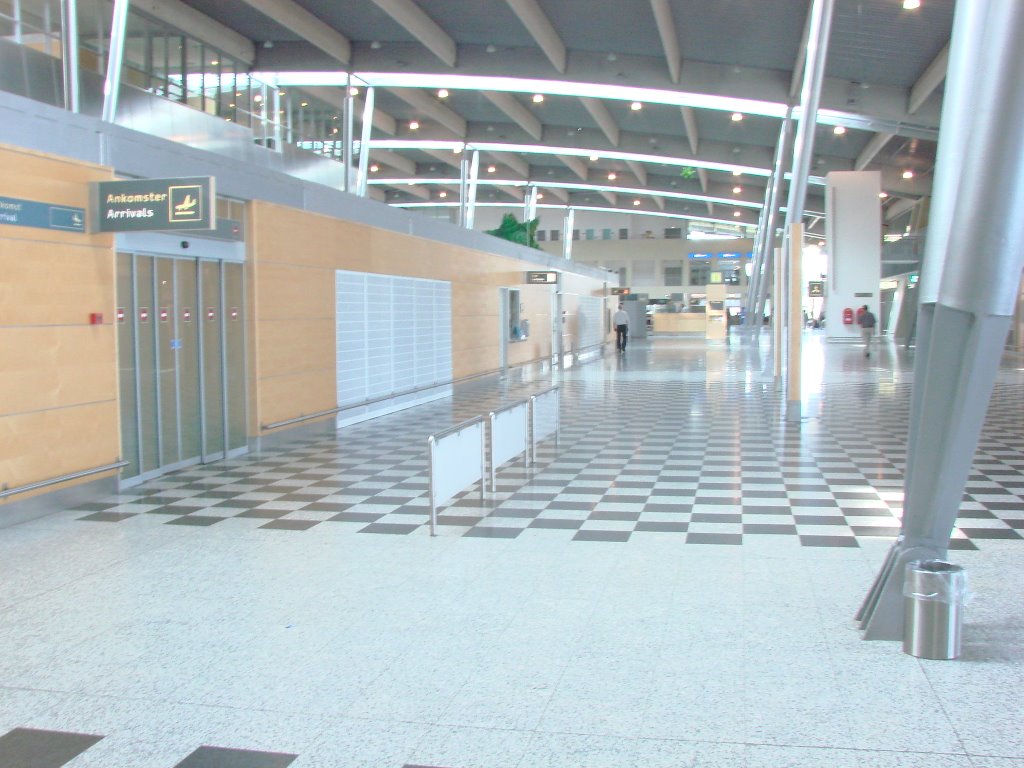
Thats why, when we first landed at the Billund airport (below) in Denmark, we could've easily assumed that the country was in a state of Emergency and all residents had been told to stay indoors and shut up. Everything was so lovely and quiet and empty. (Look at the last snap of the arrival lounge. Not a soul in sight!) Thats how it always is. I had a feeling things were going to go well. They did. I didn't see or hear a rude driver for 40 days and I will need a separate blog to start writing about how I was glowing with good health.


But seriously, what can we do, to make people aware that there is such a thing as noise pollution? That people use their horns ridiculously more than they need to. I have a good track record on the road having avoided dogs, cows, goats, cyclists and pedestrians deftly for nearly 10 years now and all this with only the gentle nudge of the horn in the rarest of rare circumstances. So why can't everybody else shut up??????!!!!!!! Waaaaaaaaah... Waaaah.

Friday, November 24, 2006

Monday, November 20, 2006

SKAMLINGSBANKEN

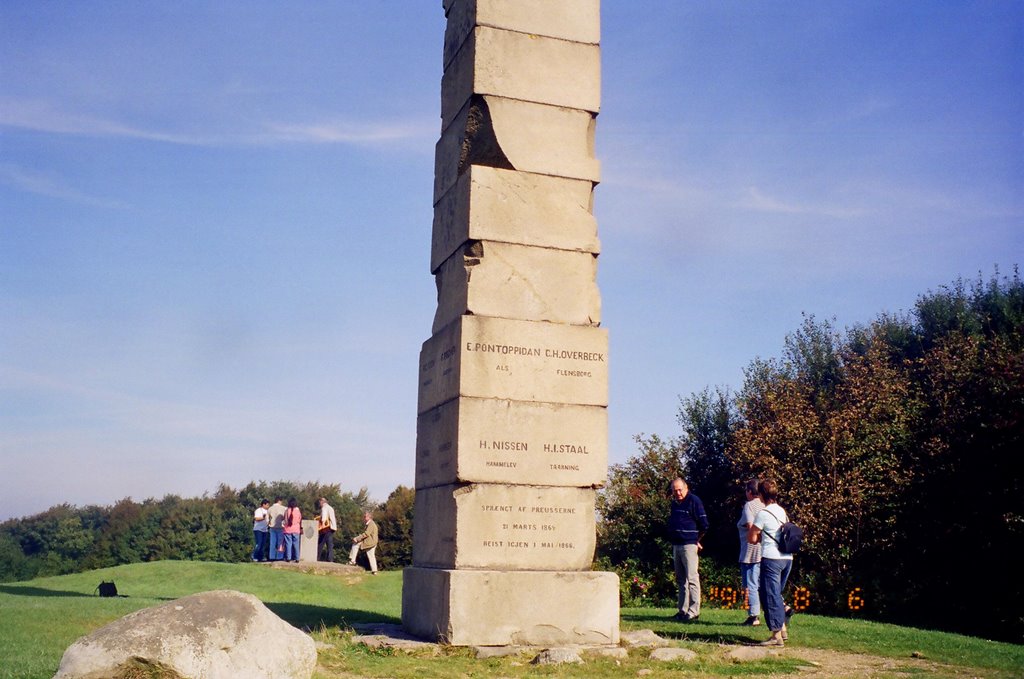
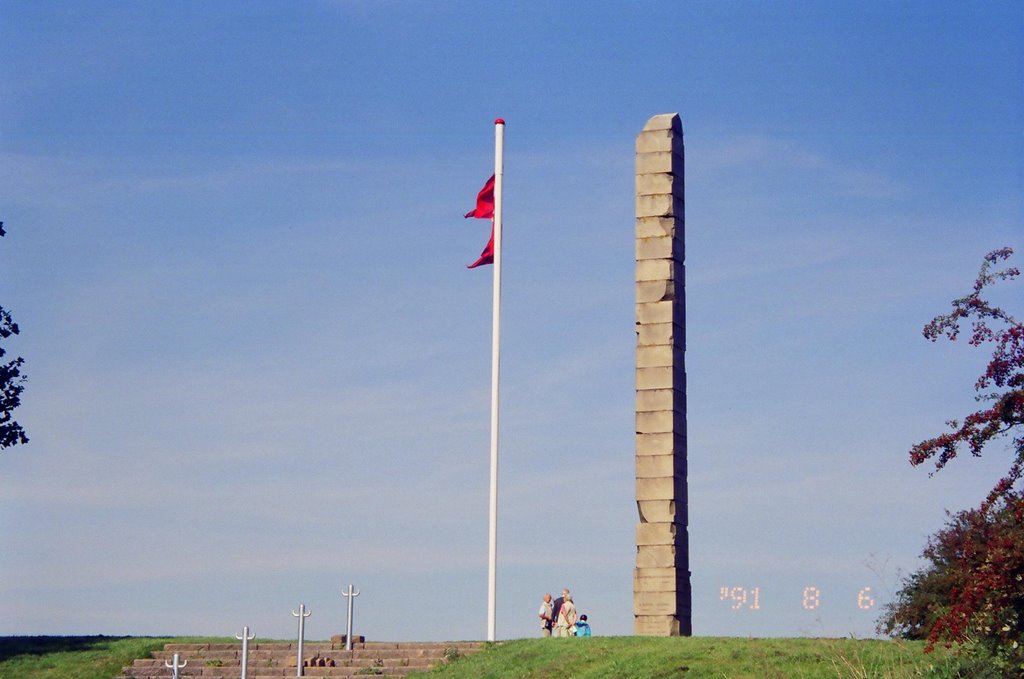
Denmark is flat country – so flat, that the second highest point – Skamlingsbanken is all of 370 ft high. But it offers a lovely view of southern Denmark and you can spend a quiet, refreshing morning there…. like we did, complete with a picnic basket and soda that topples over a lot.


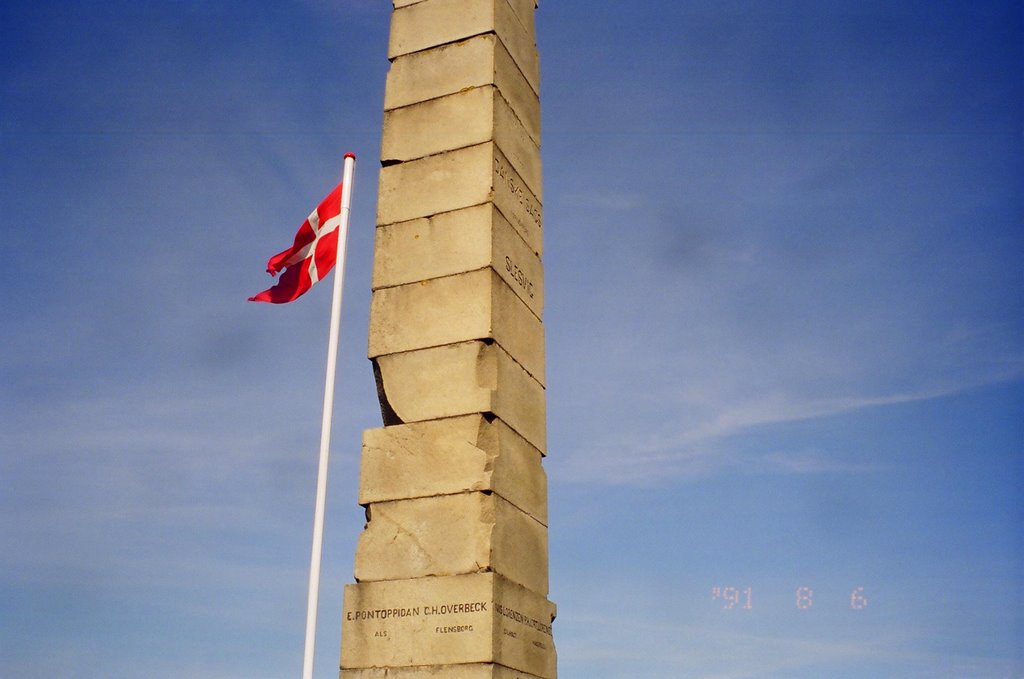
Right on top of the hill (bank is an old Danish word for hill) stands a tall obelisk – a memorial erected to commemorate the Danish nationality and way of life. It was erected at a time when the Danes were trying to fight off German aggression on the southern front. But in 1864, the Germans led a successful invasion and captured the south of Denmark and one of the first things they did was to blow away the stones of this symbol that their captives took great pride in. But villagers living around the area collected the stones and rebuilt the obelisk. The Germans left southern Denmark in 1920 after a plebiscite and have not staked their claim since. But it left behind a minority of Germans and Danes on both sides of the German-Danish border.


Today of course things are calm but Danish parents will still not send their kids to German schools or German parents to Danish schools for that matter, and, the older generation would still frown upon a German-Danish marriage.

There is a large Danish minority in the north German town of Flensburg where Danes like to drive down to do their shopping. People pay such high taxes in Denmark that its cheaper for them to drive down to Germany and do some monthly shopping there. Especially if they’re buying the famous Flensburger Pilsener also called Flens.


Back to Skamlingsbanken – and the great fluttering red flag next to the obelisk. Denmark’s national flag called the Dannebrog (old Danish for “The Danish cloth”) is red with a white cross that is not exactly in the center but a little to the left.

Its one of the oldest flags in the world. Legend has it, that during the Battle of Lyndanisse, in present day Estonia, it descended from the heavens at a crucial juncture, resulting in a Danish victory and given the Danish reverence for their flag, it goes without saying that the flag should flutter proudly next to the restored obelisk.

A MORAVIAN AFTERNOON

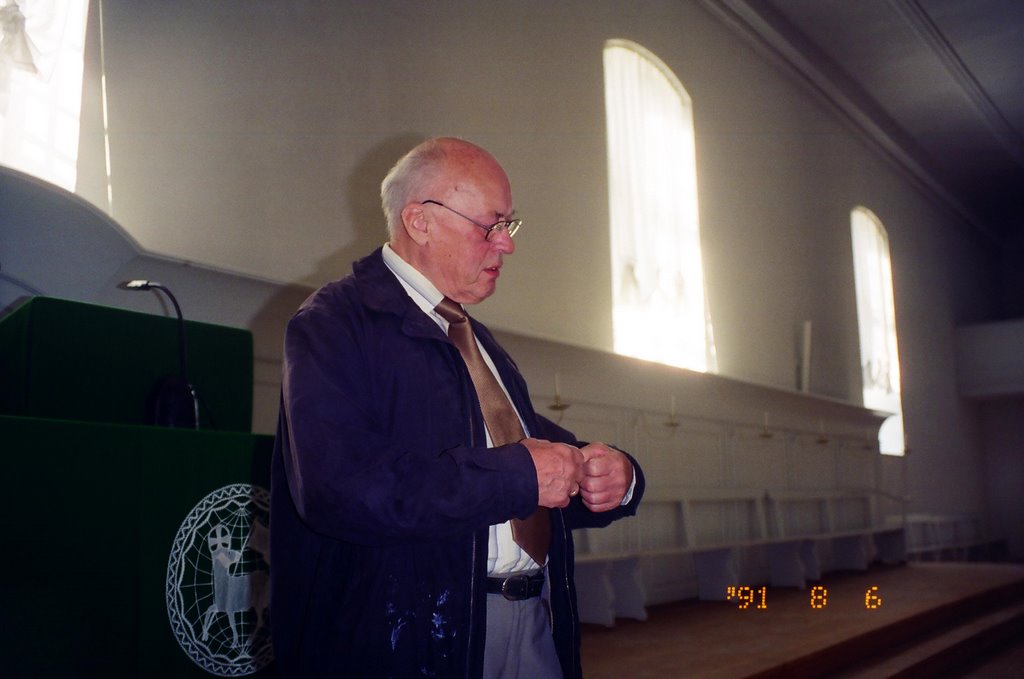
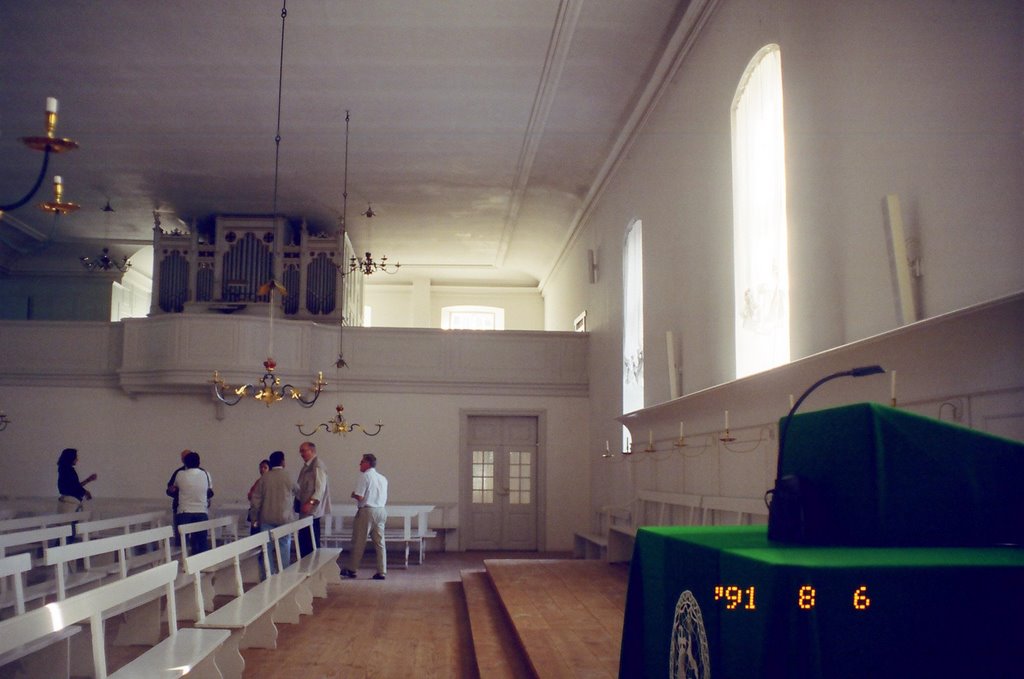
Its great to record a holiday like this. I can’t remember anything of previous holidays and thanks to the blog, I’ll never forget this one. So heres another little something from an afternoon spent at a Moravian Church with priest Lorenz Asmussen (below).


First a grab from Wiki: The Moravian churches form a modern, mainline Protestant denomination with a religious heritage that began in 15th-century Bohemia (now in the Czech Republic). It is sometimes also known as the Unitas Fratrum or Unity of the Brethren, or as the Bohemian Brethren.

Moravians were some of the earliest Protestants, rebelling against the authority of Rome more than a hundred years before Martin Luther.

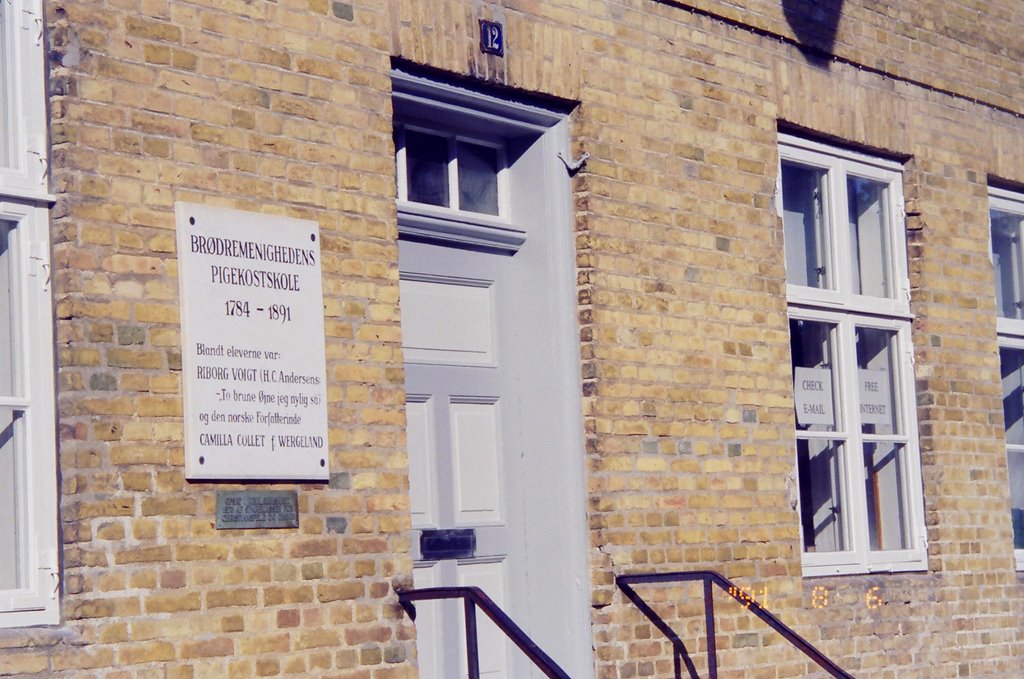
Christiansfeld – in South Denmark is the only Moravian town in Scandinavia and the youngest town in Denmark. It is named after King Chrstian VIIth who requested the congregation to build the town in 1772. Build it they did, and so well that in 1975 the town received an award for its distinctive style of straight streets and beautiful buildings.


Our walk began at the church square by the well, which is the center of the town. From there the measuring of the town was started, when it was founded.

Inside, the church hall is all white, devoid of altar or pictures. The Moravian church has spartan interiors because they believe that elaborate art and décor are only a distraction. Another interesting departure from other churches is that the organist does not have his back to the congregation but faces it.


The Moravian graveyard is known as “Gods Acre” or “church of the dead” with the sisters buried to the right and the brothers to the left. All the gravestones are exactly the same as a symbol of all being equal and alike after death. Here the graves have been preserved since 1773. Interestingly, a Moravian funeral will not involve the telling of stories about the deceased by relatives and friends. Instead, as Moravians age, they start to document the story of their lives on their own and they remain a rich treasure for posterity.


Monday, November 13, 2006

EELAM DREAMS IN DENMARK

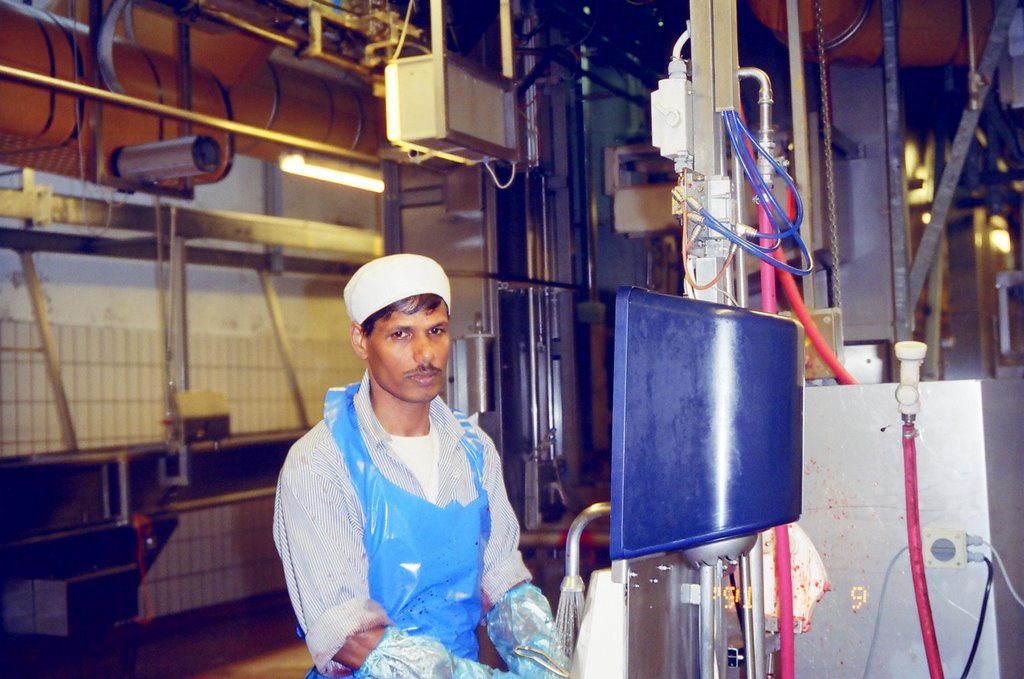
There were nearly 30 foreigners working at the Danish Crown plant in Grindsted. Many from Vietnam and a few from Sri Lanka – like Kandiah Kankanidhi (in picture). Kandiah is from Achchiveli in Jaffna and he fled the war in Sri Lanka in 1985. He landed in Tamil Nadu and lived in Purusuwalkam briefly before seeking asylum in Denmark. He lives in Grindsted with his wife and two boys aged 4 and 10. He still has two brothers back in Achchiveli and is able to send a considerable sum of money back home. He was making nearly 170 Kr. per hour, which is around 1360 Indian rupees. (People work 35 hours a week in Denmark.)

Kandiah is satisfied with his life but dreams of going back home. “I want to go back some day. I want the future generations of my family to remember Tamil. If we get freedom, I will definitely go back.”

I felt sorry for Kandiah - thousands of miles away from his homeland, holding onto the pipedream of a free Eelam.

Kandiah won't have a problem finding another job. Sri Lankan workers are generally valued for their hard work. Besides, Denmark, with a population of around 5.5 million could do with as many hands as possible.

WATCHING MY WORK

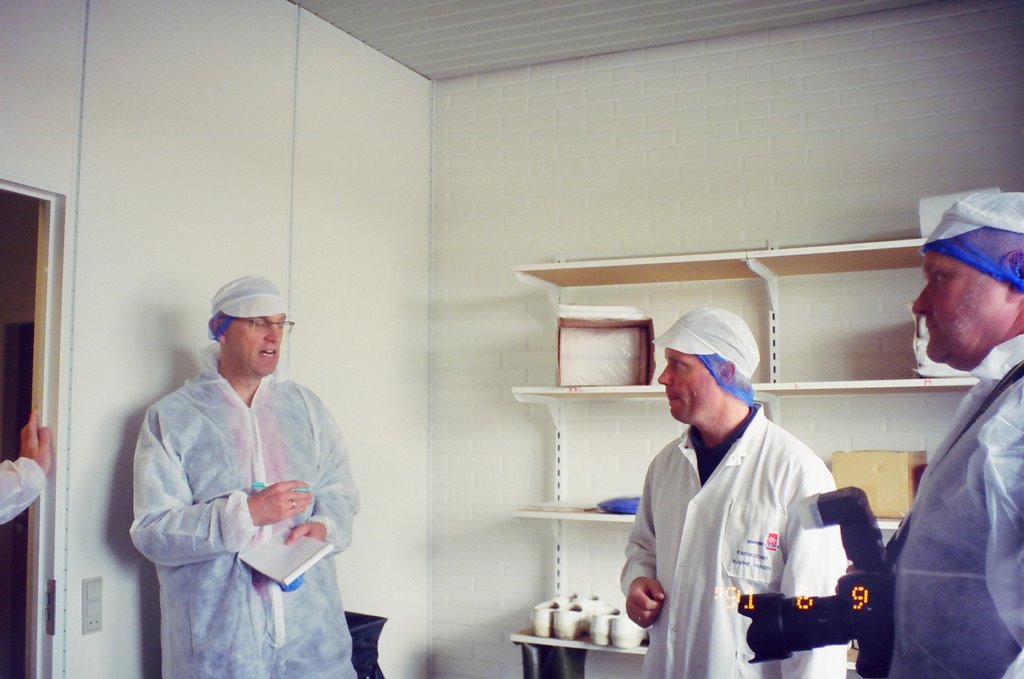
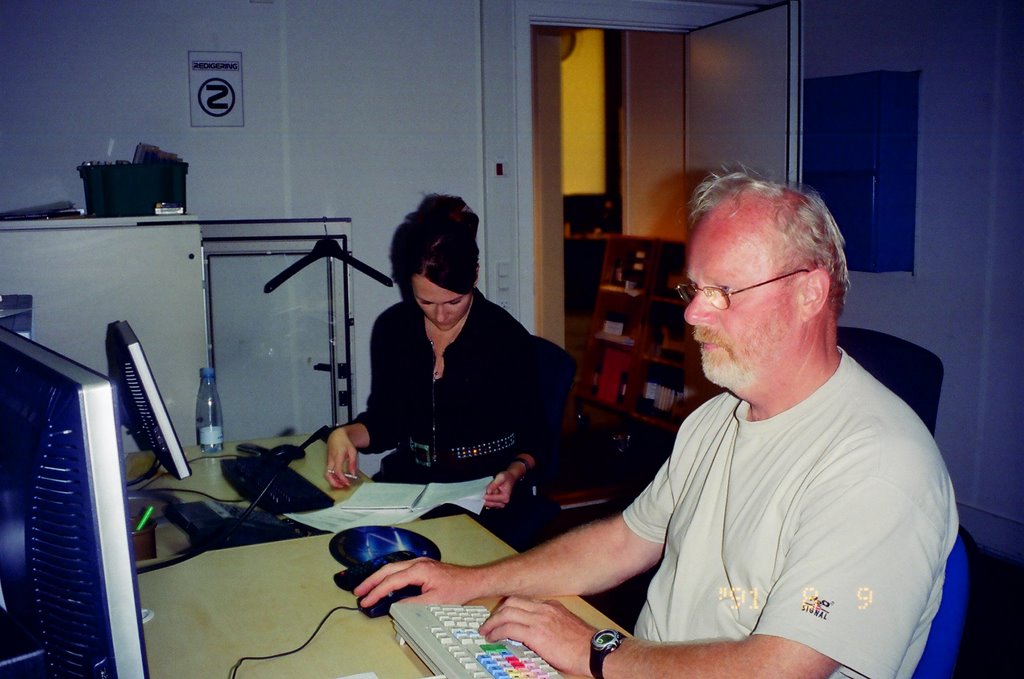
TV Syd serves the southern region of Denmark – called South Jutland. I spent a day at their office observing how they work and that’s how the pig story happened. I was assigned to go with the team of Dorte Vinther (both in picture) and cameraman, Arne Andreasen. Dorte had yawned during the morning meeting and was thereafter referred to as “the sleepy reporter.”

The thing I noticed first about their office was the silence. Nobody was screaming down phone lines, nobody was barking on their cell phones, indeed, cell phones were not even ringing and all was truly quiet on the southern front. For the story we had to drive from Kolding (pron. Kolling) to Grindsted. TV crews there don’t have separate drivers – Arne drove, filmed and edited the pictures.

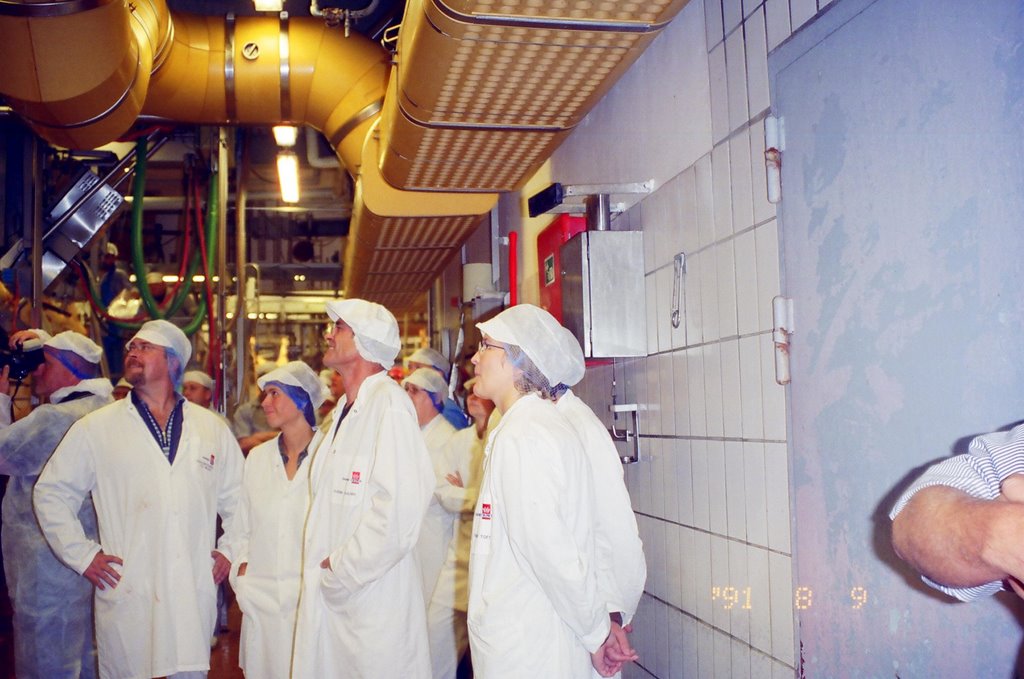
Once there, we had to wear space suits like these before going into the factory where Arne and Dorthe got down to business while I got down to staring.


Arne shot for about 30 minutes and then Dorte began her interviews. The story about the imminent closure of this plant had been done before so she did a soft story on what people were feeling on the day it actually happened.

The union leader, Kent Kaltoft was interviewed outside the plant. He said, "Of the 700 workers, 500 already have a job. But I'm not going to stop till the last person finds a job."


Here in India we keep our equipment in the office. But at TV Syd, all the equipment remains in the ENG (electronic news gathering) van. It’s equipped with chargers and monitors and everything else required in handling a breaking news story. Just jump into this thing and hit the spot. Here, Arne puts everything back in place.

Back in the office Dorte begins to write her story in the newsroom. The picture of Tintin looks down upon the place. Why is it there? Because according to the news head Ernst Moller, “hes the best reporter in the world!” That is true.

Once the script is done, the edit begins.


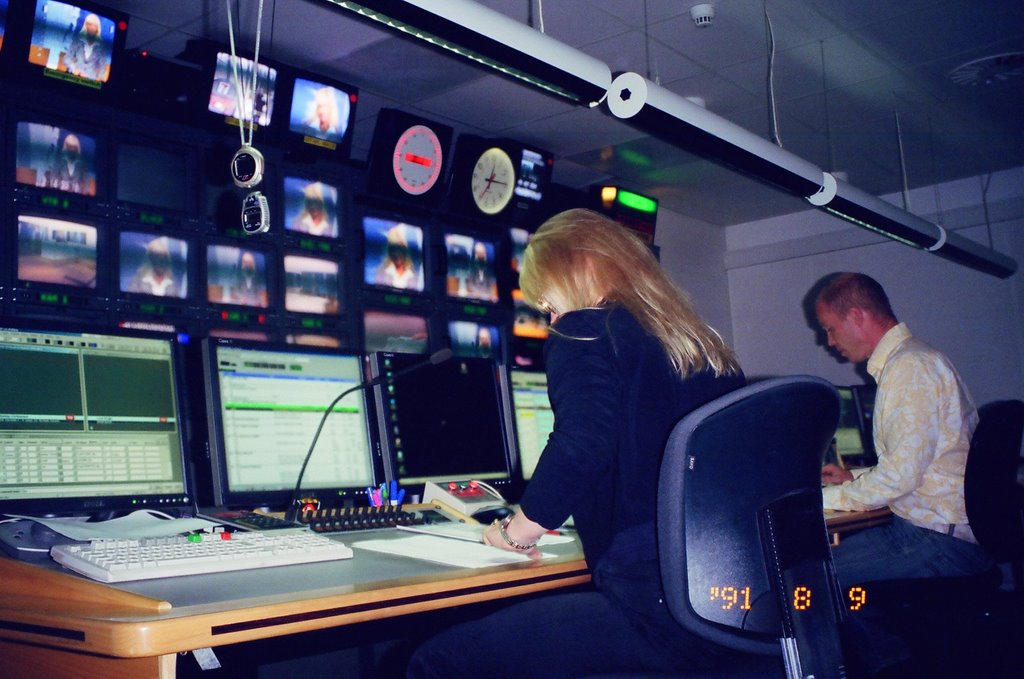
These are pictures of the production control room. Everything that happens in the studio is controlled from here. The plant's closure became the top story that evening.

And that’s the way it goes.

Monday, November 06, 2006

HOW TO MAKE BACON

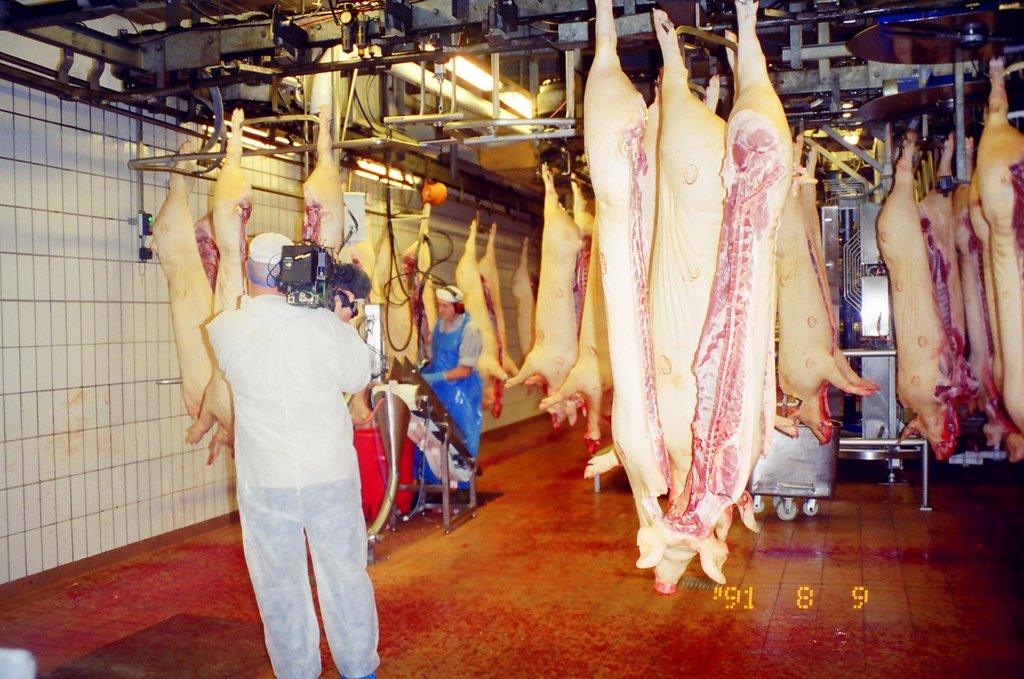
Don't think me macabre for taking pictures of pigs being slaughtered. I just happened to be there. The process was fascinating and I must admit I'm not really big on animal rights. The eyes don't moisten. So anyway, here it is - a photo essay. And if you care about pigs and other four-legged friends of man, skip this one.

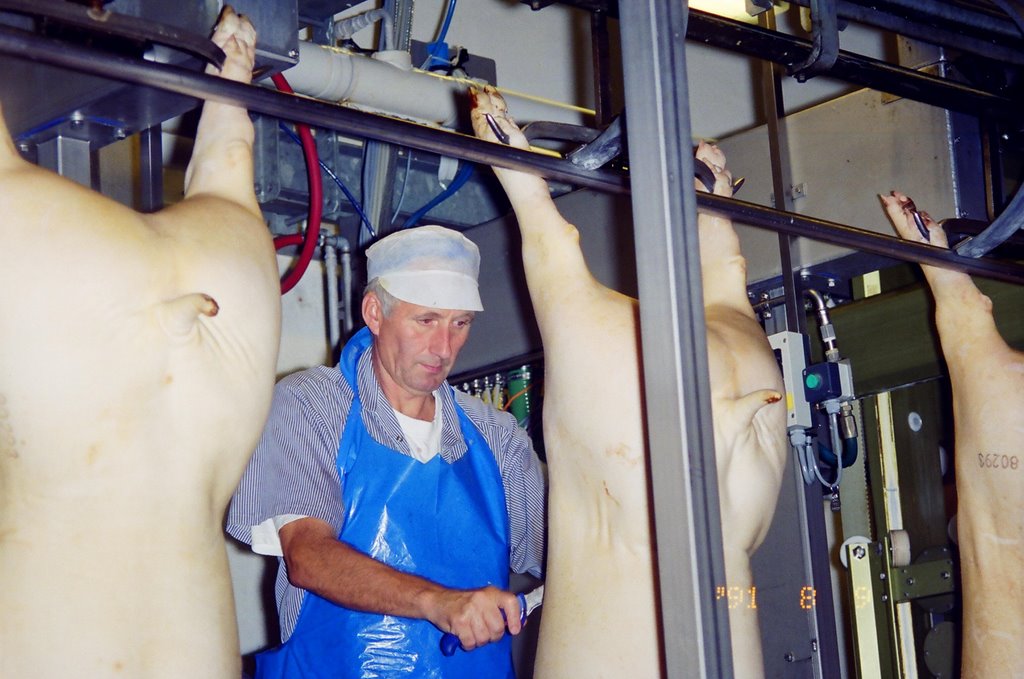
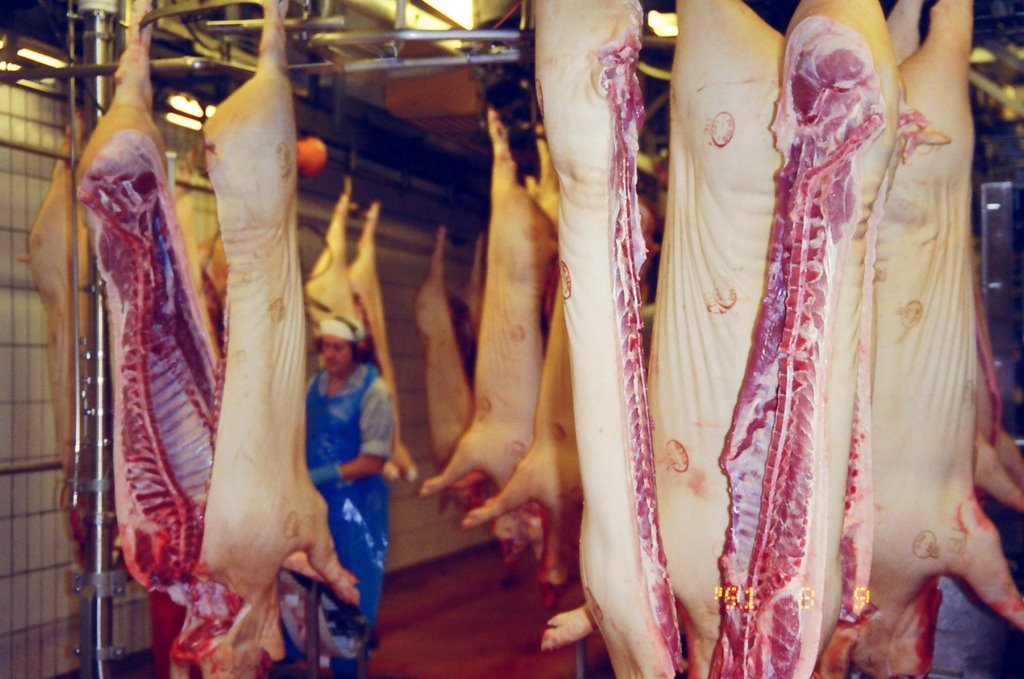
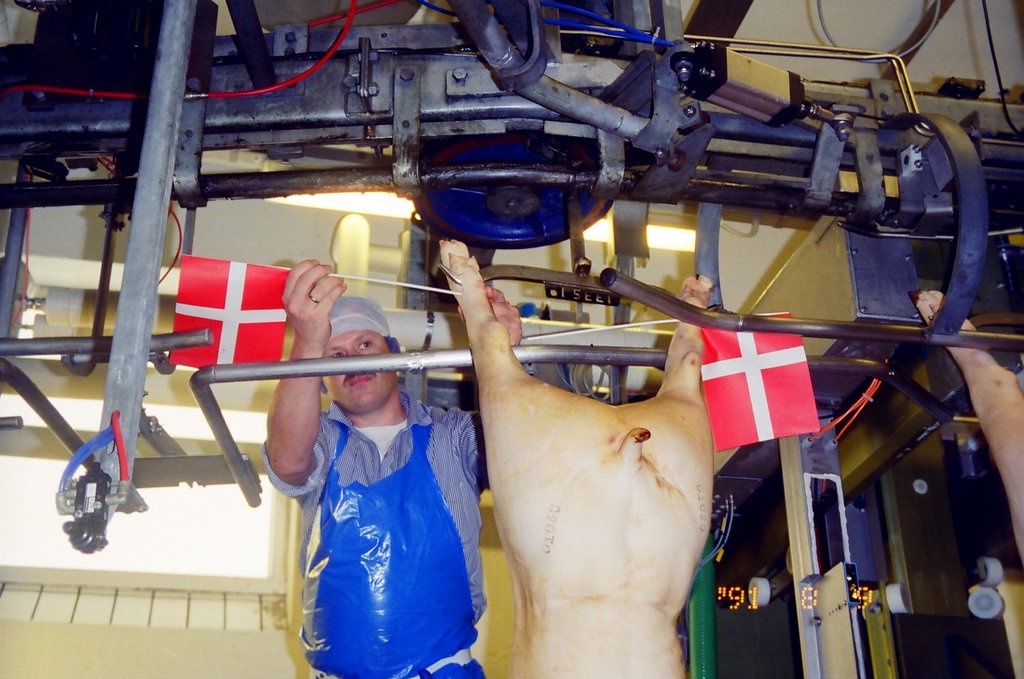
These pictures were taken at the Danish Crown factory in Grindsted, Denmark. The plant was shutting down because it was too small and it was no longer viable to run it. The pigs are gassed in a chamber just ahead of this one. Here they enter the assembly line where man and machine go to work to remove the innards. This is how it ends up as bacon and ham at the breakfast table.


A worker makes the first cut.


There are quite a few stages and each worker or machine yanks out a specific part from inside the pig. Theres blood all over the floor and thats not the scary part. Instead, its the knives in the workers hands. I kept thinking, what if one of them went berserk one morning? (Like that morning.) But workers in Denmark are not frustrated. More on that later.

This is pretty much the last stage of the inside-clearing job. As you can see, theres almost nothing there!

Now, the Danes love using their flag. Everyone has a flagpole in their lawn and if its someones birthday the flag goes up. Little flags even go into the birthday cake and all over stores in Denmark you will find all kinds of everyday things with the flags design, like, notebooks, pens, pencils, postcards and of course flags. So it was only appropriate that the last pig that came out of the assembly line went through proudly with the Danish flag in it.

It was an emotional day for the employees at Danish Crown in Grindsted. They had worked side by side for many years and as the last pig rolled out a wave of nostalgia swept over them. But everyone was still smiling. Unemployment is so low in Denmark (about 3%) that only a minority of the nearly 700 workers here had not yet found another job.

Sunday, November 05, 2006

CARTOONS COST MONEY


The tiny country of Denmark has unfortunately been remembered in the last year for the notorious Prophet Mohammed cartoons. The controversy erupted again a year later when the youth wing of a right-of-center party was caught on tape drawing cartoons during a drunken bash. Companies like Robert Damkjaer Ltd. have been badly hit because of these needless doodles. They are exporters of meat and 80% of it went to Muslim countries. But their products were boycotted and almost a year after the controversy only about 60% of their business has revived.


Company owners reportedly still have good relations with their buyers in the middle east but under pressure from local mullahs and imams, people there are unable to carry on business with the Danes.

FOOD GLORIOUS FOOD


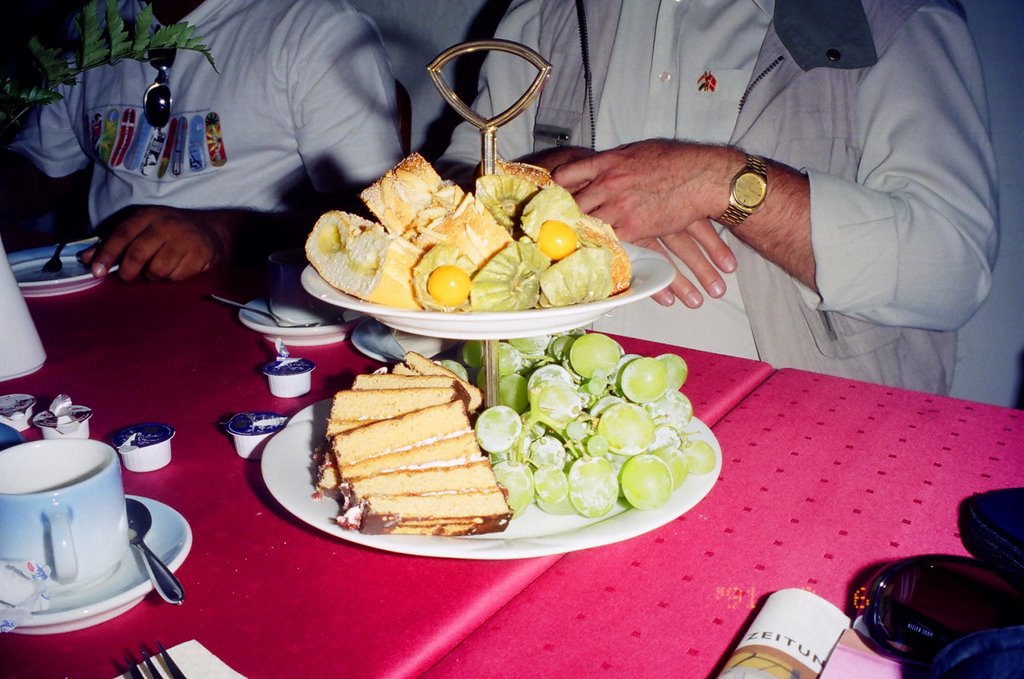
Delightful Danish pastries. More delicious photographs when I find the time.

Wednesday, November 01, 2006

SADNESS

In the three-and-a-half years that I have been working as a journalist, I have never - not once - been able to reach a government officer on the landline. Not once.

This is EXACTLY how it goes.

"Hello, could I speak to Mr. XYZ."

"Yaar pesarade?"
(Whos speaking?)

You are put on hold while your name and designation are told to the person you want to speak to and of course that person does not want to speak to you and never has the grace to come on the line. Then you are informed...

"Saar meeting le irkaar."
(Sir, is in a meeting.)

"Okay, when will the meeting get over?"

"Teriyaade medem"
(Don't know, medem.)

"Okay, give me his mobile number please."

"Teriyaade medem" or "Permission illame kudaka mudiyaade medem" (Without permission I cannot give it to you... Medem)

Okay stupid F &$#*$#&!!!!

"Okay, when should I call back?"

"Naaliki....Inniki, Saar roombu busy."
(Tomorrow... sir is vurrry busy today.)

Then you can call tomorrow and you will be told all these same things again. Then try it the day after and you will find they do not care to even come up with a different lie. This will carry on till you get fed up. Till YOU get fed up because they don't tire of the exercise.
This means, you can't get simple information or cross-check it by speaking to the 'right' people. The only way to gain access to these people is to hob nob with them. I think many journalists see this PR exercise as a part of their job and are happy to build sources this way to acquire contacts and more importantly mobile numbers. It helps to go through with it sometimes because these are the benefits. But I'd rather go home and read a book.

Alas, my holiday has ended.

Friday, October 06, 2006

CORNY BUT FUNNY

I went into peels of laughter after dinner today. Just before picking up her plate, my Danish host Esben Ihle asked his wife Helle, "Are you finish?"

Her reply, "No, I'm Danish."

I laughed so hard I knocked my head on the chair next to me. I find many similarities between Danes and Indians and one of them, perhaps the most important one, is that we laugh at the same things.

Monday, October 02, 2006

THE DANES ARE NOT SURPRISED

On the first evening in Haderslev in south Denmark, I went to my host Christian Juhl’s mothers home. It was a linguistically-challenged affair. Noone there knew English and I didn’t know a word of Danish. My energy was spent mid-way through the meal after all the animated acting involved in communicating what I was trying to say. I gave up and sat in silence eating Gammeldags hvidkal – a mash of cabbage and cream (quite nice). But the family – Christian Juhl, his sister Rita, her husband Gunnar and their mum Annalise continued to speak in Danish. I thought Christian must have been telling very interesting tales because Rita was drawing in her breath every few minutes.

The following day I met more people making sharp intakes of breath, every few sentences. The Danes must be easily surprised I thought. But its only now at the end of the first week here that I realise its their characteristic way of speaking. Spoken words are followed by a gulp of air.

Now I don’t rush to ask what the matter is when I hear a “whu”. Its just air making its way into a Danish throat.

Monday, September 25, 2006

FANCY CAKE

I'm turning my 'Reporter's Diary' into a little holiday notepad over the next few weeks. I can't be bothered to start another blog just for this and I think it will be nice to write things down so I don't forget. I wish, I wish I had done this on earlier vacations. I will be adding pictures as soon as I can. I'm carrying an old camera thats giving me hopeless pictures so the minute I can start bumming photos from my friends they'll be up here.

I dislike flying. I loathe airports and I think nobody should use them unless they are flying. Its definitely the worst way to begin a holiday. Anyway....

At the Frankfurt Airport my friend ordered a "fancy cake". True to her vegetarian roots (pun unintended) she asked the salesperson if it had "beef gelatin" in it. Even I have not heard that one before but he laughed so derisively at the idea, I think it killed her appetite.

I am happy to say that since then things have gone very well. More follows.

Saturday, September 09, 2006

TELEVISED ANGER


Recently Arjun Singh was at IIT to inaugurate a new hostel block. But being the villain in the reservation saga, students conducted a 'spontaneous', 'flash' protest. Promptly the media was called. (Protests, dharnas, fasts and demonstrations these days seem to take place only inside a frame.) The frantic calls by a few students forced me and a cameraman into the car heading towards IIT. Three students received us at the gate and called their mates to tell them we had arrived and to be "ready".

That pissed me off. But I said nothing. Then when we reached the venue of the "protest", much to my chagrin, the students started asking me what to do. "Should we sit or should we stand? Should we march or should we stay here? Should we call more students or is this enough? Should we burn the banner or shouldnt we?"

Thats it! Stop! I lost my cool. I blame the media as much as I blame the students for asking me these questions. There are lots of unethical practices that go entirely unquestioned these days, starting with making people shout slogans for the camera, or directing them to do things they would not have otherwise done. Its pardonable if its a feature story and sometimes you need to 'direct' people into doing certain things - like make an author read his book while shots of him are taken, or make a chef toss up the noodles for the camera. Thats allowed. But if its news, its simply unpardonable. These students obviously dont know any better either. I said, "This is not a film and i'm not a director. Do what you have to do or don't do anything at all. I frankly don't care."

Then to make matters worse and ruin my mood further, the students turned out to be a divided house with some overenthusiastic ones getting carried away with the idea a protest and others warning them of dire consequences. It was the last straw. There was no way this lie was ever going to be on air. But just to say, televised protests are very often done like this.

Wednesday, September 06, 2006

GIGGLES MAKES ME SMILE


In a remote corner of the 'Giggles' bookstore sits a delightful lady called Nalini Chettur. Shes totally isolated from the negativity flowing in the world around her, as she sits there, indulging her first and only true love - books. When I went to meet her, she was reading Ogden Nash's 'Candy is Dandy' with such thought-provoking verse like:

In the world of Mules
There are no rules.


33 years ago, Nalini started 'Giggles' for a giggle, as she likes to say. Inspired by Helen Hanff's '84, Charing Cross Road', Nalini was offered a space inside the Taj Connemara Hotel. Over the years, the hotel has been shrinking that space and thats how Giggles has ended up becoming the "biggest little book shop" with all of 100 square feet. There are over one lakh titles crammed into its incredible smallness. Books are stacked from floor to ceiling with one narrow sinew that can only indulgently be called the aisle and you have to be pretty little yourself to visit the biggest little bookshop.

Worthies like William Golding, Michael Palin, Ranil Wickremasinghe and Amitav Ghosh are part of the long list of people who have visited her store.

Nalini loves books and goes through every single one that comes to her store. Thats why when she talks about a book she imbues it with a special quality. No computers for her. Her entire inventory is in her head. Her delight in a book is infectious and she immediately arouses your interest and awakens the imagination.

Im having a difficult time trying to capture the charming character of 'Giggles' and its owner - exactly why Nalini thinks not everyone who has a book in them should write. So ill leave it here. But im a sworn Giggler now.

Monday, August 28, 2006

MISPLACED INDIAN PRIDE


Why are Indians so averse to criticism??? I finally found the story that has pushed me to write this post. It was a ridiculous, ridiculous piece on ‘Slum tourism in Mumbai’ from a channel that exhorts us to ‘Feel the News’. I feel sick.

The two Indian anchors practically bullied two foreign tourists invited to their studio, for walking through the squalor of the slums of Dharavi and stripping its residents of ‘dignity’ and being totally ‘insensitive’ to these real ‘people’.

(They took the moral high ground that Indian tour operators were making money off India’s poverty.)

But frankly, who are we to talk about dignity and insensitivity? If we were so sensitive, we’d be thinking of ways to get foreign tourists to help these people lead better lives with their dollars, not abuse them for wanting to see the reality of India and for gods sake - stop lying to the world - it is a reality!

The beleaguered male foreign tourist said, “I agree that there might be some insensitivity in going through their slums, but these people were actually happy to see us. They were happy to talk about the industry in their slum and show us what they were manufacturing.’ Its certainly more than what most Indians have time for so what are we complaining about??

The female tourist was more combative. She said, “Of course, I’m here to see the slums. I want to see how people live. That’s why you travel.” Whats wrong with that?

The story ran a sound byte of some average Mumbai lady saying, “I don’t want others to see the dirty side of my city, Mumbai. That’s certainly not the side I want the world to see.”

I think its clasically representative of a misplaced pride that many Indians have. There is a certain rejection of the realities of India and a selective choice of things we are proud of. Real pride is when you accept these bitter realities not pretend they don’t exist.

Another instance of this misplaced pride is the hue and cry over the treatment meted out to the 12 Mumbai passengers detained by Dutch authorities for suspiscious behaviour. Admittedly, we live in unhappy, paranoid times but the Dutch authorities don’t call in fighter jets just to scratch a racist itch.

Such misplaced pride. Show the world your slums. Atleast it might bring in tourist money that you can use to improve the slums – the festering eye-sore you are so ashamed of but find no creative solutions to improve.

In an interview on the protests in Pakistan over the death of Baloch leader, Nawab Akbar Khan Bugti, Pakistan foreign ministry spokesperson Tasneem Aslam, pretty much told India to mind its own business. She said, “Let India not worry about the protests in Pakistan. Let them concentrate instead on its flooding dams, its dying farmers and its malnourished children.” We will, when we aren't so busy trying to sell the world a half-truth.

Friday, August 18, 2006

DOES THE AL-QAEDA EXIST IN INDIA?

This was an interview I did with the security expert B. Raman days after the US warning that India could be on Al-Qaeda's radar. B Raman is a retired bureaucrat and has been a former member of the National Security Advisory Board (2000 to 2002) and the Special Task Force on revamping the intelligence apparatus in the country.

Does the Al-Qaeda have a presence in India?

As far as I know there is no presence of Al-Qaeda as an organisation in India. It is an exclusively Arab organisation because Osama bin Laden does not admit non-arabs for the sake of his own security. He hires only those people whose loyalty he is certain of. But there are a number of other organisations that are associated with the Al-Qaeda in the international Islamic front through the United Front of Jihadi organisations of the World formed by him in February 1998. Four of them are very active in India - the Lashkar e-Taiba, Harkat-ul-Mujahideen, Harkat-ul-jihad-al-Islami and Jaish e-Mohammed. These four are associated with Al-Qaeda.

After 9/11 when America attacked Afghanistan the command and control of Al-Qaeda were considerably disrupted. At that time Osama bin Laden asked LeT to take over responsibility of co-ordinating the work of the international Islamic front.

Also, since April this year Osama bin Laden has started taking more interest in India. He made a broadcast on April 23rd where he projected global jihad as a conspiracy of Christians, Jews and Hindus against Islam. So since April he has included Hindus as well.

To answer your question - Al-Qaeda itself does not exist in India, but it has links with several organisations and individuals here.

What was the immediate provocation for him to include the term 'Hindus' in his April broadcast?

It happened immediately after George W. Bush's visit to India. He made a broadcast through an audio tape released through Al-Jazeera. There he said that Bush has allowed himself to be pressurised by the government of India to exercise pressure on Pakistan to stop assistance to Jihadis in Kashmir. So the immediate provocation is the close relationship between India and the US.

Al-Qaeda is becoming an ideology. So does it become just as dangerous that they have links here, even if they dont exist in India?

Al-Qaeda is an ideology which they have borrowed from Pakistan - what they call international Islamism, where they say that the first loyalty of a Muslim is to his religion and then only to the country of which he is a citizen. They claim, Muslims do not recognise national frontiers - so they have the right to make jihad anywhere where Muslims are in danger and their human rights are being violated.

Previously Al-Qaeda was content to act through organisations like LeT, Harkat-ul-Mujahideen etc. They had left it to them - they just provided money, arms and ideas. Since April the Al-Qaeda has taken a more direct interest in India.

Indian Muslims have kept themselves away from the Al-Qaeda and a small number supports groups like the LeT. As a result Indian muslims are not under suspicion - for example a Pakistani Muslim can't get a visa easily to go to the US and Europe. They can't transfer money easily - even through legitimate banking channels it takes a long time because enquiries are made, whereas Indian Muslims are not yet under suspicion - they have kept away from Al-Qaeda. Osama bin Laden is very keen to organise another major terror strike against the US. So he is looking for people who have not come to the adverse notice of the western intelligence agencies and thats why they are trying to recruit Indians - not only for terror against India but also for terrorist operations in the West. Bin Laden and Al-Qaeda think they can travel much more easily. For example, Bilal al Hindi - a Muslim of Gujarati origin (he was a Hindu Gujarati convert to Islam from East Africa and has been arrested in the UK) was sent to the US because he would not be viewed with as much suspicion as a Pakistani Muslim.

Then will bin Laden find his human resource here?

Well, one has to make a distinction between radicalisation and pan-Islamisation. The radicalisation of Indian Muslims started after the demolition of the Babri Masjid in Dec. 1992. Earlier you had communal riots but there was never an act of jihadi terrorism. The first act on Indian territory outside Kashmir took place after the demolition of the Babri Masjid. While they became radical they were not supporting the Al-Qaeda. If Al-Qaeda is to have a base here, it has to have some support from Indian Muslims. Till April this year they did not have support unlike in some parts of south east Asia where you'll find Osama bin Laden caps and T-shirts being sold openly. But in April, when Bush came there were a number of demonstrations in Bombay, Delhi and Lucknow. I read in newspapers that in Bombay people shoulted pro-Osama slogans. Its a very small number but there is that small number that is getting attracted to his pan-Islamist ideology, whereas, previously they were just radicalised. They did not look upon it as part of a global movement. Their problem was with the government at the centre and the state. Now Al-Qaeda is trying to make them feel that they are part of a global movement.

Monday, August 07, 2006

THE MEEK ARE STUCK IN TRAFFIC


I should’ve written about this a long time ago. Its not ‘newsy’ anymore, but because it still makes me angry to drive past the DGP’s office in Chennai, I’m going to put it down.

In a traffic island in the middle of the road stands the tall statue of thespian Sivaji Ganesan. With its unveiling on July 21st, Karunanidhi has ticked off another item from his long list of (slightly dubious) poll promises.

The location of the statue was contested in court because it violated the Tamil Nadu government’s own undertaking before the Supreme Court that they would not erect any structure (temporary or permanent) that would obstruct movement of traffic. The Madras High court directed the state government to seek the SC’s permission on the location of the statue, but declined to stay its unveiling.

And then in the most brazen display of the governments contempt for the common mans problems and violating their own undertaking, they conducted the unveiling ceremony right there in the middle of the road, blocking off traffic on the arterial Kamaraj Salai while office leaving traffic was forced through the parallel but much much narrower road that runs just along the beach.

I tried to speak to a few people who were crawling along in traffic and was disgusted to find that people just don’t feel angry. Silently like lambs being led to the slaughter they negotiated their way, crawling along where they would’ve been zipping down the beach road. Yet, stop and ask them a question and the responses ranged from… ‘no… it is ok’ to ‘the traffic is not that bad’ to people just walking away! Rudely!

The meek shall not inherit the earth if they get stuck in traffic.

And today two policemen stand guard in front of and behind the statue. Surely, in a city where a serious robbery can take place in the chief ministers own neighbourhood, and the police to public ratio gets more disproportionate all the time, police resources can be put to better use than guarding dead heroes.

Wednesday, August 02, 2006

CHENNAI SUPPORTS LEBANON

'Physicians for Peace', 'Peoples Union for Civil Liberties' and other peace organisations are meeting this evening to protest against Israel's senseless bombing of Lebanon. The protest starts at 5:30 pm this evening near the Gandhi Statue on the Marina Beach.

Meanwhile, read this open letter from an Arab girl to President Bush.

Thursday, July 27, 2006

QUICK UPDATE

I finally shot 'Youth Unplugged' at PSBB in Nungambakkam and the kids there were a riot of energy. Towards the end it descended into a shouting match, and, I was forced to grab the microphones out of their hands. But all in all, a high-energy affair full of passion.

Anyway, just wanted to tell all the anonymous nobodys out there that you can't comment on my space anymore. Reveal thyself and you can pass.

Monday, July 24, 2006

YOUTH UNPLUGGED

'Youth Unplugged' is a show where school students debate issues that concern them, or atleast, should concern them. Im planning to do one on 'censorship' and 'ethical spending'. Do mail me if you'd like to participate or know someone who does. Remember, this is for school students only. I'll be shooting on Tuesday, 25th July.

Wednesday, July 12, 2006

CURTAINS UP ON THE CODE

The Madras High Court has allowed the screening of The Da Vinci Code, calling its suspension, a violation of freedom of speech. A heartening judgment indeed. More importantly, Justice Prabha Sridevan observed, ‘It would be dangerous to suspend the screening of the film, if petulant groups of self-appointed persons demanded so even after it had the approval of the Censor Board of Film Certification.’ You can read the operative portion here.

Wednesday, July 05, 2006

TAMING THE BULL

I was not well enough to work but neither was I ill enough to stay in bed. In such a sorry physical state, I went over to meet Amrutha Radhakrishnan, at her home in Tambaram on a damp, rainy day in Chennai. But the preoccupation of sickness lifted rapidly as she started narrating her story to me. It was shocking and moving. She said, “At the beginning of this year my cup of joy was overflowing… today its empty. We might be out on the streets soon.” Over the next two hours, she narrated the financial tragedy of how she, her husband and two little children were cheated out of nearly one crore rupees by the stock trading firm, Indiabulls Securities.

The story of her battle to get her money back is convoluted and difficult to narrate. (You can read about it
here.)

But the reason I’m writing about this is because Amrutha’s story is remarkable. She has been fighting a long, arduous battle against this corporate giant and she has finally won. But the fight has been exhausting, frustrating and heart-breaking. She went to everyone for help – police, lawyers, media, NSE, SEBI and of course Indiabulls. Some helped, some promised to help, some were indifferent and Indiabulls tried to shut her up.

But she didn’t keep quiet. In fact, she lent her voice to other ordinary investors like her. Today more than 50 of them have managed to get back their money because she fought so hard for them and she herself is finally smiling all the way to the bank again.

However, it has all happed because, through this extremely difficult time, with two young children and a looming financial crisis, Amrutha never gave up. It was not an option. She has been resourceful, energetic, dignified and gracious. She thought of me when she got her money back and I was delighted. I salute her spirit.

Tuesday, June 27, 2006

DA VINCI ... LATEST

Subramanian Swamy, President of the Janata Party, economics whiz and accused in many defamation cases, has impleaded himself in the Da Vinci Code case in Tamil Nadu. His argument is that the DMK government’s move violates Article 19 (a) of the Constitution which guarantees the freedom of speech and expression.

P.S: Rajesh - please be brief.

Friday, June 23, 2006

BOO THE BAN

Are Indian Christians more Christian than the Pope and the Vatican? They have tolerated the 'Da Vinci Code' but these guys can't. On the other hand when Jayalalithaa had said a few years ago that the Pope had no business to criticise the functioning of a democratically elected government, the same group of faithful were the first to take offense. Whats worse this time is even Muslims have shown some fake solidarity in the hope that the the favour will be returned when its their turn.

(Please dont say banal things like there are moderate voices too.... thats a given. I KNOW....Thank God!)

There are a few minority pressure groups close to the DMK who have forced the government to take this absolutely gutless decision. Fear law and order problems? Then get your police force to tackle it not buckle and ban.

Despite the Andhra Pradesh High Court upholding the right to free speech and expression, theatre owners in Hyderabad are not taking the risk of releasing the film because they fear violence. The case is being heard in a court in Tamil Nadu also. Lets see what this court says. We interviewed a few people outside Sathyam theatre and one guy said, "If it hurts the sentiments of a community, then its good that the film is banned." To him I wanted to say... Dont like it? Dont watch it. Simple. The choice is YOURS.

(Of course, the only reason the movie should be banned is because I hear its a CRAP film! I haven't seen it... Remember? Its banned!))

Wednesday, May 24, 2006

'COVER'ING A NEWS STORY

Here in India, in our jargon its called 'cover journalism' - the type of journalism where you accept cash (or freebies) for stories. So, journalists could be slipped an envelope or 'cover' containing cash and he/she will take care of the rest. There are lots of journalists who are very accepting of this sort of thing.

The American military has institutionalised 'cover journalism' - especially in Iraq. Following is a very brief excert from a New York Times article.

The most critical portion of the report concerns the military's creation in 2004 of an entity called the Baghdad Press Club, in which Iraqi journalists were paid if they covered and produced stories about American reconstruction efforts, such as openings of schools and sewage plants.

Saturday, May 13, 2006

THE SUN RISES


HI all....Thanks for the comments to the previous post and apologies for not being able to reply. The new government is firmly in place and Vijaykanth has won afterall. The swearing-in ceremony was a disaster held in the nauseating heat of an indoor stadium bursting beyond capacity. Sun TV's pre-eminence was on display with their cameras getting the best positions and live coverage of a horribly organised event. Im not too excited about the DMK coming to power and obviously neither is Jayalalithaa. She has gone to the extent of saying that handing over power to the new government is like garlanding a monkey. I dont know about monkeys but what concerns me is the DMK's hold over the media and its ability to blot out all critical points of view. Tamil daily 'Dinakaran' is owned by them and its cut-throat pricing of 1 rupee is seriously threatening the existence of papers like the Dina Thanthi. SUN TV of course, continues to beam down propaganda and Dayanidhi Maran's ownership of the Telecom Ministry will cause even the most daring neutral channels to pause and think.

Friday, April 28, 2006

WHO IS WHO?

Poor actor Vijaykanth, founder of the fledgling DMDK, is taking on two Dravidian juggernauts who are adept at the art of sabotage. Take for example the fact that in backward Virudhachalam, from where he is contesting, there are three other 'independent' candidates also called Vijaykanth! These candidates have been propped up allegedly by the DMK and PMK. Remember that on an electronic voting machine there are only party symbols not the party names. Vijaykanth (the real one) has only recently received his, which is a drum. But as he goes around Virudhachalam asking people to vote for the drum, three other Vijaykanths will be at work asking people to vote for a 'Banana', 'Ring' and 'Television respectively. Put yourself in the place of an illiterate voter..... all pretty confusing. It might be a muffled drum beat indeed.

Thursday, April 13, 2006

BANGALORE BURNS


Drunken mobs attacking helpless policemen, burning police jeeps and buses, pelting stones and attacking the media ... but actor Raj Kumar's passing away had little to do with it. It was just the occasion and a great opportunity. The establishment's tenuous grip on law and order is exposed everytime a mob comes face to face with authority. Girish Karnad, one of Bangalore's more famous citizens placed the blame entirely at the doorstep of the Kumaraswamy government. No doubt they did botch it up. Directing and re-directing thousands of people to different venues is like sending a bunch of elephants in heat down a labyrinth. But isn't it unfair to blame it all on the government? Where, oh where, is responsible citizenship? I spluttered with rage when I saw Bangalore youth attacking everything in sight and then grinning like madmen into the camera, stripping the funeral of any dignity. But then again, such occassions are perhaps the only time when the vast majority of the lower middle class and the poor can hit back at the system. The occasion becomes the excuse to attack the same system that on an ordinary day in Bangalore denies the numerical majority of their dignity. Its the rare moment when they are on top.

PS: Another perspective - sometimes busting things up is plain good fun!

Sunday, March 19, 2006

REPORTER'S BLOCK

I have finally finished scripting the story on the chaos in medical and technical education in Tamil Nadu. Big thanks to all of you who left messages and contacts here. But to be honest with you, I'm not happy with the final product. (It goes on air sometime between 9 and 10 pm on 'India This Week' today - 19th March, though, I'm probably not doing a good job of promoting it!)

Its been a difficult story to write what with trying to describe the myriad problems of higher education with its complex network of government and private institutions. TV is not a very information-friendly medium, so I'm afraid that the viewer will either be bored or befuddled by the twists and turns of the Common Entrance Test (CET) first being scrapped, then being restored, then the legislation scrapping CET being scrapped, then challenged... If I have lost you, the reader, by now, the viewer may have shifted to VH1 paragraphs ago.

I tried not to detail too many twists and turns, but there in the details, lay the devil, and, without it there was perhaps no story. Anyway, its an important story to tell because it's high time the Ministry of Human Resources Development seriously started thinking about introducing only ONE single test, like the SAT, going by the chaos on campus here. So if you do watch it.... I hope you find it engaging.

Monday, March 13, 2006

WHAT AILS TECHNICAL EDUCATION?

I'm working on a story about technical education in Tamil Nadu - trying to look at flaws in policy-making (reservation for instance) and the affect of privatisation in the engineering education. The idea stems from the recent violence on the campuses of deemed universities and the TN government's move to scrap the Common Entrance Test of TNPCEE as it is better known. If you guys have any ideas, suggestions, opinions or better still experience of studying in one of these institutions do write in to me at alaphia@gmail.com. I'm also looking to interview students and parents so if any of you are currently studying and are willing to speak on camera do leave a number. My deadline is 16th evening - yes 3 days from now!


Friday, March 10, 2006

LOOKING BACK IN ANGER


A big thank you to all those who wrote in to find out how I was doing.

I won't get into the details of that night of vandalism on the SRM campus here, but I will say one thing - there are some seriously dangerous and delinquent officers in our police force.

The Superintendent of Police (SP) of the Kancheepuram district A Amal Raj sprang upon my cameraman, snatched our camera, broke it and then stole the tape. (It was returned to us after we complained to the Director General of Police.) But the frustrating agony is that nothing is being done to punish this man! Absolutely NOTHING!

1) The police have refused to register an FIR.
2) They have arrested two people (local goons who assaulted me) but they could well be fall guys because I have not been given a chance to identify them.
3) Revenue officials are conducting an enquiry into the affair because it involves a police officer. But, so far, I have received no phone calls from the said revenue officials. Considering i'm the 'victim', shouldn't I be in the picture somewhere?

If this is the way they treat journalists then I really do shudder to imagine how the common man must suffer at their hands. The police can do so much but they do so little. It tires me out now to constantly understand 'the system' and be more sympathetic to the pulls and pressures of working in government. Frankly, whats the point of understanding?

I dont think its too idealistic to say that if you want to be corrupt you will, if you want to abuse your power you will. However if you want to be clean but poor - you can.

Saturday, February 11, 2006

BOARD OF CONTROL FOR COMMERCE IN INDIA


The whole issue of copyright over cricket score SMSes is a “trial balloon” floated by the BCCI, according to a source, and the firm that has taken mobile phone companies to court is a front. The essential argument made by this firm (Marksman Marketing Services Private Limited) is that if there are audio rights and video rights why cant there be textual rights? So the BCCI is testing the waters to see if the courts will allow rights over text. It will obviously mean more money for the Board of control for cricket (or commerce) in India. Heres a gist of what both sides are saying – For all practical purposes, lets just call them – BCCI and Mobile Co.’s

BCCI: Scores constitute ‘hot news’ that I as the owner of a match can exploit.
Mobile Co.’s: Its hardly ‘hot’ because there is a delay in transmission of the SMS by atleast 4 minutes and Sec.13 of the Copyright Act has not been amended to include any concept of ‘hot news’.

BCCI: There is a shelf life to the news and by giving latest updates you are commercially exploiting my information.
Mobile Co.’s: Rubbish! Its not ‘your’ information and we get the news from TV so the scores are already in the public domain.

BCCI: It is an intellectual property
Mobile Co.’s: A cricket score is NOT intellectual property!

BCCI: If mobile phone companies make a tidy sum giving these updates, why should I – the owner of the event forego the right?
Mobile Co.’s: It’s a value-added service in larger public interest. We create the SMS so why should we pay you!

And so on and so forth. . . This is unchartered territory even in highly sophisticated sports marketing and the matter is likely to go all the way up to the Supreme Court resulting in a landmark judgment.

Friday, January 27, 2006

'WE THE PEOPLE' IN CHENNAI

'We the People', hosted by Barkha Dutt is being shot in Chennai this Sunday, 29th Jan. The topic is 'Is Chennai conservative?' If you'd like to participate please mail audience@ndtv.com, with all your contact details and what you do. (This does not guarantee participation since there is an outer limit) Not surprisingly we've got lots of confirmations from people with liberal views. So it will be great if you're actually someone who supports a dress code and conservatism. In case the mail bounces... just mail me. :)

Monday, January 23, 2006

ANNA UNIVERSITY – FADED GLORY


The Vice-Chancellor (VC) of the Anna University has banned cell phones on campus. So of course it cannot be used it class (a rule students WANT to obey) but it cannot even be used after class anywhere on campus. And, if you are even found in possession of one it is immediately confiscated. Now, in a protest letter to President Kalam, students write, “We are being frisked humiliatingly – an ignominy normally reserved for terrorists.”

The VC has also introduced a highly unpopular dress code. He thinks that by placing a blanket ban on cell phones and forcing people to dress a certain way he is introducing a greater degree of professionalism into college functioning. But little of all this he practices himself. He turned up half an hour late for my interview without intimating me of the delay. His arrival was preceded by a servile peon who carried in two of his cell phones while he walked in a little later with the third. And despite Anna University being a green campus, he zips around in his spanking, air-conditioned TATA Safari while some students have to walk nearly half a kilometer under the blazing sun just to get some lunch.

The letter written to the President is being circulated to gather signatures. It is written straight from the heart and shows the vice-chancellor in very poor light. The VC therefore is desperate to get hold of the letter. His office called and asked me for a copy and they were told kindly to go to hell.

But beyond the dress code and cell phone ban and harassment, students allege that there has been little academic advancement over the years. They say the syllabus has not been updated, labs lack proper equipment and the faculty does not spark their imagination. A moribund academic environment and the Talibanisation of the social and cultural climate on campus is the real Anna University today where the product just does not match the brand.


Thursday, December 29, 2005

ON A DEVASTATED ISLAND - AN ANCIENT TRIBE SURVIVES

Everything about the Andaman and Nicobar islands can leave the Indian mainlander staring with wide-eyed wonderment. For most journalists it was a similar experience - learning how these remote and largely inaccessible islands function, how their ancient tribes live and of course discover the endless beauty of its shores and what a world away these tiny dots in the ocean are from anything we see on the mainland. Vishnu Som, the Associate Editor (Defence) at NDTV was among the first journalists who landed in Car Nicobar after the December 26th tsunami. Here is his account of what he saw, what moved him and what became of one of the world's oldest tribes – the Shompen.


From Heaven to Hell: The Great Nicobar Story

By Vishnu Som Associate Editor (Defence), NDTV

Ever had the feeling of the ground sinking under your feet? It's a strange feeling, the earth gently quivering, not quite an earthquake, but not quite normal either. On Great Nicobar Island, India's southernmost landmass, nothing was normal. Ever since the magnitude 9 earthquake struck, just 40 kms away from where I was reporting, everything had gone topsy-turvy.

Late one evening, as I prepared for a live standup report from Cambell Bay, a small township on the northeast of the island, the ground started shaking again. Should I run, was this a major aftershock ... was another Tsunami just around the corner? Great Nicobar felt like a sinking ship, except that there were no lifeboats. In fact, there was nothing and no one really knew what to expect next. On the one remaining road which connected Campbell Bay and the tiny airstrip the Japanese had built during the Second World War, there were families of crabs, dozens of them, scurrying around. Inside the nearby Coast Guard headquarters, now partially under water, there was only one resident. A crocodile.

The waters of the Bay of Bengal were now just 20 feet away from us. If the waters rose even one foot more, the road would be under water and the only link to the airstrip would be severed. Not that it really mattered. Planes couldn't operate onto the airstrip at night. Rescue would not be possible. But the most frightening reality of Great Nicobar wasn't the aftershocks, or the crashing waves. It was the fact that there were no dead bodies, no over-filled hospitals, no stench of death and devastation and no illness. Those who had survived were in a handful of relief camps. Those who weren't there were dead, their bodies somewhere out there in the ocean, never to be recovered.

The knowledge of death brings with it a sense of closure. For the first several days after the Tsunami, many of those who made it to the relief camps lived with a sense of hope. Sure, their loved ones were missing but who was to say that they were dead?Thousands of people from the Andaman and Nicobar Islands are still missing. They have not survived. It's a reality many survivors on the islands have no choice but to slowly come to accept .

Elsewhere on the island, a remarkable story of surviving the odds. The Shompen, perhaps the most isolated tribe in the world date back between 30,000 and 70,000 years. Unlike some of the other tribes in the Andaman and Nicobar chain, the Shompen have conscientiously avoided any contact with `civilization,' content in living off the thick jungles which form the core of the island.Very little is known of the tribe. They are extremely shy, scurrying into the jungles at the sound of helicopters. Armed with poison-tipped spears, the nomadic Shompen hunt wild boar and fish in rivulets which run through the island.

The Shompen may have survived 70,000 years but had any of the 200 tribals survived the wrath of the Tsunami? I joined commandos of the Indian Navy in trying to find out.A day earlier, the first signs that at least some members of the tribe may have made it. Two naval pilots had spotted a Shompen dwelling in a densely forested area along a narrow rivulet. Today, it was time to verify the survival of the tribe.

With the jungles on the island too thick to land a helicopter, I was winched down into a narrow opening and joined by a young commando, a Lieutenant from the Navy in hiking to the Shompen village."Be careful where you tread. This undergrowth is infested with snakes and scoropns. Stay clear of the rivulet, there may be crocs" I was warned. As I hiked along the slippery, muddy slopes alongside the rivulet, falling to my knees every fifty metres or so, I spotted the Shompen village - 6 small thatched structures built on stilts at least 15 feet high and 3 smaller enclosed pens nearby. Wading across the rivulet and climbing the thick slope on the opposite side, we reached the dwelling.

There were no Shompen.

This was a deserted village. Or was it?"They're here said Lieutenant K U Singh. And they're watching. They're probably a 100 metres away from us looking on at us from somewhere there" he said pointing to the thick forests which ringed one side of the village. And sure enough, the signs of the tribe having survived were all there. Smoke from what looked like a cooking utensil, freshly cut fruit, footprints in the mud and wild boar in bamboo cages under the Shompen huts. Soon, it was time to leave. No one really knew about the behaviour patterns of the Shompen and there was every possibility that they could attack. In any event, our goal was not to disturb the tribe, only verify their survival through a natural disaster of unimaginable proportions.

The next day, my last on Great Nicobar, was perhaps the ultimate reality check, an opportunity to view the island from the air, and gauge the true extent of the topographical damage.The Navy flew me along the coastline. Within minutes we were at Indira Point, the southern-most point of India. The lighthouse at the southern tip of the island was ten feet under water, the 16 people who worked here, presumed dead. They had no chance. The Tsunami waves struck the lighthouse less than 5 minutes after they were triggered by the earthquake.

But it was the Western coastline of the islands where the fury of the Tsunami was most evident. Every few kilometers, there were dagger-like blows into the jungles along the coast, sea water making its way upto three kilometers inland, parts of the island completely cut-off, now islands by themselves. However, there was one silver-lining. The parts of the island worst hit by the Tsunami were also the least populated and that really was the saving grace on Great Nicobar. Only 7,500 people lived on the island. 567 are thought to have died. Only 27 bodies have been found, of which just 10 have been identified.

For me as a journalist, the Great Nicobar story was not just about death and suffering. It was also about survival, courtesy a few good men, soldiers of the Indian Army, a few Coast Guard Officers, transport pilots of the Indian Air Force and helicopter pilots of the Indian Navy.Two stories stands out.

Within days of the Tsunami, two Navy pilots flying a tiny Chetak helicopter off the deck of a destroyer rescued a remarkable 170 people from a settlement to the south of Campbell Bay. On each trip, their helicopter could not carry more than 2 survivors but that didn't deter them. They kept flying for more than 5 hours non-stop, landing more than a 100 times in order to bring trapped islanders to safety.

Elsewhere, a young Major of the Indian Army felt that those who survived the disaster may have lost everything, but shouldn't feel that they have lost their dignity. And so, he ordered his soldiers out of their barracks and made them camp outside in the open, while survivors were put into the soldier's barracks and given three proper meals a day.No one knows what is going to happen to Great Nicobar. Most of the settlers who were brought here in the late sixties have lost everything. Most families worked on betel nut and coconut plantations which have been devastated by the giant waves. It takes between 12-14 years for these trees to grow back to their full height. Earning a living off these plantations is just not a possibility.

And then there's the fear factor.

Tremors continue to be felt on the island and the coastline has receded sharply. Sea water levels remain higher than normal. All settlements will have to move further inland, a process of resettlement which may take years.Great Nicobar was a tropical paradise. Warm seas, a stunning coastline, a laid back life. Today, it seems to have gone back a century. A handful of settlers, a handful of soldiers and ofcourse the ever-present Shompen.

(Vishnu Som was the first journalist into Great Nicobar Island and the first to independently corroborate the survival of the Shompen tribe.)

Wednesday, December 28, 2005

DAUGHTERS OF THE WAVE, WALK ON


This is a piece I wrote for the first anniversary of the tsunami. I was given all of three days to shoot this story and with almost a month of rain and floods, I had little time to research what was really going on in the tsunami-affected areas. I employed three strands in my story to give viewers a big picture – that the men turned lazy, that women are pulling their weight with help from banks and donor agencies and a strong culture of self-help groups, and that the grief for individual families is still very raw and fresh. Its been re-written in parts to make it a print script. Here it is.

Across Tamil Nadu's tsunami-ravaged coast-line some scenes are common – women gathered in groups – some are weaving baskets, some others are making soaps, somewhere else they’re making dolls, yet another group is making slippers…. the list is long and the road has been hard. But many of these women of the tsunami have shown that the path to salvation is through self-help.

When Palamma returns with her large metal carrier – you know shes been at work selling fish. She didn't make much money today but shes grateful that her familiar routine has been restored. This routine has returned after months of struggle. The fishermen were first beset by a fear of the ocean, then they were happy to live off generous NGO and government doles. But their inaction was making Palamma and many fish-sellers like her - desperate. So she and the other women in the hamlet started applying pressure on the men. Palamma says, “We told them not to be scared and to overcome their fears. We said, the tsunami wasn’t going to come again so they should start their regular fishing and then slowly things began.”

The collector of Nagapattinam, Dr. J Radhakrishnan, a man responsible for reducing the turnaround time on restoring livelihood says that Palamma’s hamlet of Nambiar Nagar set off a trend. “'When the catch came and it was so huge the word went around to the other hamlets. The catalystic role played by the women in that hamlet was perhaps very critical for the other hamlets to realise the bounty available in the sea for them to follow suit and then it caught on like fire and people went fishing... this is one area where I am very thankful to the fisherwomen.”

But fishing activity is going through its annual lean season again and today in most villages you’ll find groups of men at street-corners playing cards.

But a once highly insular fishing community has learnt one very hard lesson – the importance of an alternative livelihood – another skill that can sustain them. Women have shown the lead by coming together in these self-help groups to learn new skills and men are now seeing its virtues.


Sister Lily Pushpam from an NGO called the Daughters of Mary Immaculate has been training self-help groups (SHG’s) for the past 12 years. We met her as she was beginning training with a new group of women. She says the burden of the times is shared unequally. She observes, “Men actually have become lazy because after the tsunami NGO's and voluntary organisations have given enough materials....so their mentality today is to ask of whoever comes from outside. They ask for money or materials. The first question is always - what are you going to give?”

But womens groups are also more successful because of their higher credit-worthiness and SHG’s in Nagapattinam have already saved upto 6 crore rupees! It's real empowerment for people like Kavitha. She had been a housewife till the tsunami forced her out, because it killed her husband. After learning printing she makes about 2700 rupees a month – enough to sustain her young son and her. She prints bags that carry the brand name of the products made by the women of Nagapattinam – 'Alai Magal' or 'daughter of the wave'. Then Kavitha's along with the products of hundreds of other groups travels to a specially set up market called ‘Rural Bazaar’ and also to exhibitions in different cities. Through the bazaar one group has even received an order of candles worth 5 million rupees from Netherlands. But the scenario is not entirely optimistic. The difficulty lies in finding and sustaining markets for these products. The district administration has come out with a brochure on all the available products but even they are nervous about the challenges. Dr. J Radhakrishnan says, “What we are worried about is the capacity of these SHG's to manage the requirements of the market once they attain the quality.”

If you want to help you should visit a store called ‘Tsunami ka dukaan’ that has opened recently in Pondicherry. (Its very close to Goubert Avenue. Ask for an art gallery called ‘Aurodhaan’ and they’ll direct you.) The process of the governments disengagement from rehabilitation can only begin once people start patronizing such stores. This enterprise shown by the victims has had both monetary and psychological benefits. Its helped soothe traumatized minds where hope and despair can be easy bedfellows.

I found that the people most desperately searching for a new reason to exist are parents who lost all their little children to the tsunami. One such couple is Selvi and Vijaykumar. The couple lost all their five daughters to the tsunami. But life throbs inside Selvi again. She was one of 50 women who underwent a surgery to reverse an earlier sterilization operation. Only four women have been able to conceive so far and Selvi is one of them. But having this baby will be very different for her. Her husband remains slumped in mourning, a strong smell of alcohol surrounds him, he speaks reluctantly and his face contorts with grief at the mention of his five girls. The name of ‘Sneha’, his favourite daughter, is etched across his heart. He says, “I just drink to forget….i loved Sneha because she was just like a boy. Very boisterous and playful. No matter what time I came home, she’d be awake, waiting for me. She would only go to bed after I bought her a little trifle.’

Vijaykumar has contemplated suicide very often. But somewhere deep inside he does hope to be holding his sixth child soon. Palamma hopes to be making more money once the lean season gets over and the women who are diligently employing their new skills are hoping their products will continue to inspire clients. For now, if you're looking for hope, you'll find it in Nagapattinam.

THINKING ALOUD

Viewers often accuse the media of jumping from story to story without telling them enough about anything and without doing enough follow-ups. It’s a valid criticism. Then, why I wonder, is the market not dictating terms to news-channels? Why isn’t there a greater need for independent documentary film-makers who can bring in the analysis and follow-ups that the viewers are looking for?