Thursday, August 18, 2005

WILL ABSTINENCE EVER BE SEXY?

The UNICEF recently organised a workshop to create awareness amongst young people on HIV and AIDS. The participants were students, journalists musicians and radio jockeys - essentially people in a postion to spread the message and hopefully influence change.

At the workshop a DJ from Washington D C, George Collinet, said, "The first message we need to send out is abstinence."

"But is that a realistic message in these times?", I asked him.

He replied, "We need to make abstinence sexy. Thats the challenge."

Cyrus Broacha, supremely funny MTV VJ, was there too. I asked him if he agreed with George's point of view. In characteristic Cyrus style, he said, "Whoever said we need to make abstinence sexy has been drinking. Abstinence is good... all the girls I knew practiced it. But nobody is going to listen if you preach to them!"

If George manages to make abstinence sexy someday he would have pulled off the impossible. And that will be great. But for now I think i agree with Cyrus.

Thursday, August 11, 2005

ODE TO GOOGLE

Its a forward going around, but i cant resist mentioning it here. Look no further for testimonials to the greatness of google. Just type the word "failure" and see what you come up with!

CHAPPELL SPEAK

Covered yet another bland cricket story - the Indian cricket teams return from Sri Lanka. An obviously irritable Greg Chappell gave monosyllabic answers even as the press tried hopelessly to eke out a fresh angle to write a story on a team that is nauseatingly over-reported.

Example:

Q: "Mr. Chappell, what is the realistic time table you have set for yourself and this team for a turnaround."
Ans: "Yesterday"


Q: "Mr. Chappell, what are the early lessons learnt from this tour?"
Ans: "Bat better, bowl better, field better."

Some TV channels had this live!!!


Friday, August 05, 2005

HAZARDS OF TV NEWS


One of the hazards of television is that you hear the best quotes when the camera is not rolling. Let me give you one small example. I was waiting for the grand-daddy of blogging, Kiruba, at the reception area in his office. He strode in and we introduced ourselves. The first thing he told me when he heard my name was, "The advantage of having an unusual name is that you can get it as your own domain name." Spoken like a true-blogger, i thought. But where was my camera? On my cameramans lap, with the lens cap on, as he sat there on a sofa, in the lobby of the offices of Sify.

Another hazard is that unless you happen to be in the right place at the right time, you lose your best visuals. A mob stoning police vehicles makes for gripping television. But its a spontaneous act again. So the visuals you'll probably have to settle for are shots of shards of glass lying around on the road, smashed wind-screens and people standing around. Which is why, a film-maker recently remarked, "watching television news is like watching faces in my window." And shes right! Just a lot of mid-shots with people, people, people, people, people. The television is on mute all the time in front of me in the newsroom at work. Very, very, very rarely does what im seeing make me sit up and take notice.

Friday, July 22, 2005

TOTAL INJUSTICE WITHOUT THE JUSTICE


The Madras High Court is one of the oldest in India, but today it has other dubious distinctions to its credit. One of them is that it has the highest number of pending cases. Every year nearly one lakh cases are filed but bizarrely there are not enough judges to settle disputes!

(Ever noticed how the burgeoning population of the country never seems to spill into government vacancies!)

But getting back to the Madras High Court... it has a sanctioned strength of 49 judges but the system groans, stumbles and totters along at half strength with only 24 judges.

Now, you must be wondering - is it that difficult to find somebody to play judge?! No, its not very difficult. Its not very difficult to find someone qualified and erudite to arbitrate. But what is difficult is to find men and women who will not be partisan, who will be fair and who will uphold the loftiest ideals in the Indian constitution.

It would be stating the obvious to say that the independence of the judiciary is a myth. But what is less trite is the disturbing extent to which political parties are now able to extend their sphere of influence. That is why it has taken so long to fill these vacancies. Most lawyers in the Madras High Court will tell you that the public is suffering while the political parties play ping-pong.

This is how it works - any lawyer with a practice of 10 years behind him/her is eligible to become a judge. A collegium of three high court judges draws up a list of nominees. That list is then sent to the Law Ministry. The Intelligence Bureau gets into the act and does a background check on these men and women. If a stench has not started to emanate, the list is forwarded to a collegium of five supreme Court judges. They finalise the list and then it goes back to the law ministry and lastly onto the president after which the judges are finally appointed.
Political parties can throw a spanner into the works at any time during this process. Right now, both the DMK and the AIADMK are unhappy with some of the names on that list. Both sides want names of people on that list, who will toe their line. So they've been stalling it by raising objections.


Meanwhile, the system of justice delivery is slowing down drastically. It is groaning under the heavy burden of cases that are filed everyday. It is proving redundant. Jail sentences finish before bail applications are taken up for hearing. People move out of their homes before a property dispute can be settled with the landlord. More crimes are committed before a conviction can be given for the first one.

K R Tamizhmani, President of the Madras Bar Association, acknowledges that an already weak system has been made weaker. He says of the present crisis, "The system functions on the faith a common man has in it...that faith is now shaken...it may be ruined shortly."

Tuesday, July 12, 2005

QUIET PLEASE... THANK YOU


Prime Minister Manmohan Singh was recently awarded an Honorary Degree of Doctor of Civil Law by the Oxford University. In his acceptance speech, he spoke in glowing terms about the legacies of the Raj and the blossoming Indo-British partnership.

Here is an excerpt.

Of all the legacies of the Raj, none is more important than the English language and the modern school system. That is, if you leave out cricket! Of course, people here may not recognise the language we speak, but let me assure you that it is English. In indigenising English, as so many people have done in so many nations across the world, we have made the language our own. Our choice of prepositions may not always be the Queen's English; we might occasionally split the infinitive; and we may drop an article here and add an extra one there. I am sure everyone will agree however, that English has been enriched by Indian creativity as well and we have given you R K Narayan and Salaman Rushdie. Today, English in India is seen as just another Indian language.


We have given the world R K Narayan and Salman Rushdie, as the Prime Minister rightly pointed out. But what do we do with our Venkiah Naidu and the BJP? We would love to give them to someone... anyone. When it comes to slaying with the jaw bone Venkiah Naidu has no equal. A few reporters caught him at the airport for a sound bite on the issues the BJP plans to raise in the next Parliament session. I was cuing the tape in the office but not really paying attention till he said that one of the issues would be the the PM's speech at Oxford. He said, "What does the Prime Minister mean by praising the British? We want an explanation on this!"

This gripe came out in exactly the sort of english the Prime Minister was referring to - an english entirely our own. In fact, now so much our own, that Venkiah Naidu has forgotten why and how he came to be speaking it in the first place. The BJP flounders again.

Friday, July 08, 2005

ASK AND YOU SHALL RECEIVE

On the 6 month anniversary of the tsunami, a friend and me found ourselves in Cuddalore. He bought a packet of sweets and started handing them out to kids we saw along our stroll through one of the temporary shelter colonies. The kids were happy at the sudden appearance of this gift.

But the elders were a slightly different kettle of fish. One old lady scoffed at the little toffee and asked what it was expected to do for her empty stomach. She took it nonetheless. A couple of men sitting around in the sun raised their hands asking for some. Old ladies were directing kids to approach us and demand their share of the goodies.

Something about all this asking, for a small, insignificant toffee was vulgar and despicable. And not one thank you…just a lot of grabbing because it was free.

As we were leaving one woman raised a child up to the car window so that we would bestow our largesse on him as well. But by then we were too disgusted to display any.

I have read reports glorifying the fishing community as one that is resilient and proud. Resilient yes, proud… definitely not. The community in this village struck me as an idle bunch of freeloaders. Its probably what their kids might learn too.

Is dignity and pride a preserve of those who have enough? I really dont know.


Thursday, July 07, 2005

GOLDEN GOOSE RESEMBLES WHITE ELEPHANT


When they played the national anthem at the end of the inaugural ceremony of the Sethusamudram project, i felt cynical... unlike most other times, when i have to liquidate that lump in my throat. Union Minister T R Baalu and his friends, have set the wheels in motion for a project that could be environmentally disastrous and economically unviable. Yet, they (the politicians) all stood on that stage, indifferent, ignorant and silent.

The Sethusamudram Ship canal project envisages the dredging of a 167 kilometre long, 12 metre deep, 300 metres wide channel in the sea. This channel will connect the shallow waters between the Gulf of Mannar and the Palk Straits. The Gulf of Mannar is a bio-reserve with some very rare species of marine life and corals. With the churning of the ocean bed, biologists fear the marine park will die. But the environment was never on any political partys agenda so its hardly surprising that the MoEF has given the project the green signal.

So forget the environment, lets talk money. Maritime specialists warn that this project could be one big white elephant. Ships are getting bigger and 60 to 70% of the traffic coming to the region is still likely to go around Sri Lanka because the channel is too small to accomodate them.
But, sources say, T R Baalu is not in the mood to listen. Within the system, orders have been sent down the line for everyone to shut up. If you're wondering why, the answer is not far to seek -- Votes. Elections. Politics. Environmental activist, T Mohan says, "Such a huge project means contracts and kickbacks....politicians just get to expand their sphere of influence."

Through a sucessful media campaign political parties over the years have established the Sethusamudram project in peoples minds as something of a goose that lays golden eggs. They have been told it will provide jobs, industrialise southern TN and galvanise the economy. And since the turnaround time on the project is so vast, even if it flops miserably, the people who were in power and had once made tall promises will not be around to provide any answers.

Wonder what the politicians on stage were thinking of when the national anthem played.


Thursday, June 02, 2005

IS IT THE BEGINNING OF THE END?


I have been flirting with the Andaman and Nicobar islands for about two years now. I thought the chemistry would never die and that I'd always leave the islands longing for more. But the affair has ended. The romance is over. The islands are drowning in a morass of corruption
and red-tapism of a particularly depressing kind. And this corruption unfortunately spells disaster for the Nicobari tribals - the indigenous, mongoloid natives of the southern group of islands.


The Nicobarese today are a traumatised people. All their plantation land has been destroyed and half their community wiped out by the tsunami. But instead of nurturing whats left , the government is further tearing apart their social fabric. For instance, the Nicobarese have for centuries lived in large, extended joint families called 'tuhet'. But the government, in its mainland wisdom, has built nuclear units for them. A majority of them have not yet been given tools. A Nicobari without tools is like a programmer without a computer. So with so much time on hand and absolutely nothing to do, the Nicobarese, natural lovers of drink, are boozing themselves silly. Their coconut plantations are not going to regenerate for the next 6 years atleast. The government will try to teach them something new, but it might be as futile as teaching an old dog new tricks. The next few years will test the resilience and survival instincts of the Nicobarese. If we let them make their own choices, they might survive, but if the administration continues its intrusion into whats left of their way of life, we'll probably end up destroying a centuries old tribe, forever.

Tuesday, May 03, 2005

LOVE FROM TOKYO

Its a story i didn't/don't understand. Why is a dark, ordinary-looking, OLD, scanty-haired, Tamil-speaking man popular in Japan??!!! Meeting a group of denizens from the above mentioned country didnt provide any insights.
Young Meura, in his early 20s, says a bit simplistically, "Rejni meuvie is vedy, vedy fahn... ". Englightening.


Moments later he does the moves from 'Baba' and shows off Rajni ring-tones on his mobile along with four of his mates with whom he'd come down to try and catch the first day, first show of 'Chandramukhi'.
Rajni mania went through the roof in Japan when an initiative of the NFDC (National Film Development Corporation) to launch 'Muthu' there turned out to be a roaring success. Ever since vast legions of Japanese fans have been gyrating to the tunes of Rajni "meuvies".

There are some sober ones too, like Buddhist monk, Hase Kawa. He's been to Chennai 8 times to try and catch a glimpse of the super-star but failed every single time. He accepts that with a Zen-like calm. His latest trip has also been unsuccessful and he will soon go back to his monastery. He may have a prayer on his lip, but he's likely to have a Rajni song in his heart.

Sunday, April 10, 2005

WHY DID VIVEK OBEROI DO IT?


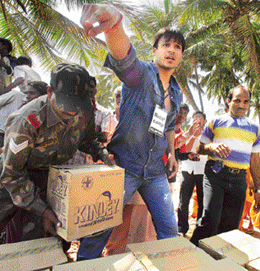
Vivek Oberoi was like an excited child when I met him in early January at Thevanampattinam in Cuddalore. Thevavnampattinam is one of the largest fishing hamlets in Tamil Nadu and Vivek Oberoi had announced that he was going to adopt the tsunami-hit village and turn it into a 21st century colony. “Nothing could prepare me for the death and devastation I saw and I really felt I should do something”, said Vivek.

He gave me lengthy, detailed answers for every question, praising the government in each one of them. “From the chief Minister’s office to the Collector’s office, everyone has been very supportive and co-operative and have given us the go-ahead for everything.”, he had said.


But three months on, Vivek Oberoi has moved out of Thevanampattinam. Jayalalithaa has insulted him in the Assembly and many people in Thevanampattinam snigger at the mention of his name.

But it must be said that his efforts “to do good”, although naïve in their eagerness did seem sincere. However, the actor has only invited the current scathing criticism upon himself by unceremoniously taking his ‘Project Hope’ to another village in Pondicherrry.

Vivek Oberoi says that he had to shift out of Tamil Nadu because the government was taking too long to finalise locations for permanent housing. “My donors were threatening to pull out. They would have put their money in Banda Aceh or Sri Lanka, if I didn’t show them something concrete soon. The Pondicherry governor called me and after just a few discussions he gave me the green signal. So the choice before me was clear – either I could help nobody or move out of Tamil Nadu and at least help somebody,” said Vivek at a press conference, explaining his exit.

Many in the administration however don’t buy that. One of them said, “All the others donors in so many other villages were ready to wait. How come his weren’t?”

It’s been difficult to catch Vivek Oberoi since his controversial exit from TN. So I cant tell you what the real reasons are but sources in the administration say that Vivek Oberoi didn’t feel like working for the people of Thevanampattinam anymore. The atmosphere had become vitiated, the people had turned against him and he didn’t want to work in that hostile environment. Vivek has often spoken of “fundamentalist elements” approaching him to milk the situation. Maybe those are the forces that ultimately forced him to leave as well.

Machcekaandi is one of the spunkiest old ladies in Thevanampattinam. She remembers Vivek fondly saying he was like “her son”. She belongs to the pro-Vivek camp because the mention of Vivek Oberoi always divides any group into two opposing camps.

Perhaps what Vivek Oberoi should have done is quietly exited from Thevanampattinam, done his work in the new village silently and avoided the media like the plague. Instead he participated in a press conference where he droned on and on about plans for his new village… this after he had just dumped Thevanampattinam.

Tuesday, March 15, 2005

TRIBAL WISDOM FROM THE MYSTERIOUS NICOBAR


It is an irony of politics that the Andaman and Nicobar islands have ended up with India. They sit on the Burma plate and the people of Nicobar look and speak more like their mongoloid neighbours in Indonesia and Thailand.


These lovely islands though are governed from Delhi through the local administration - an administration that is so lazy, even a tsunami couldnt stir it to action. Atleast thats the chorus coming out of the enigmatic Nicobar archipelago, a region that is off-limits for visitors.

On a recent (and rare) junket organised by the Coast Guard, journalists were taken to Katchal, Kamorta and Campbell Bay so that the work done by the defense forces could be "showcased". It was planned in such a way that the journalists would have little time to really interact with the local people. My understanding of this attitude was only partial. I still dont see why the military was so nervous about the trip, why they insisted on herding us into buses and taking us exactly where they wanted us to go, why an army man called a poor tribal prince, a "bloody bastard" because he was speaking up for his community.

There is no doubt about the fact that without the services of the armed forces, getting help across to these remote islands would have been impossible. That said, it seems now that decisions taken in Delhi are being forced upon the islanders, and that their immediate concerns are of no consequence because there is a plan to follow.

For instance, the pre-monsoon showers are due end of March, so all over the little islands work is on to build temporary shelters. These are houses made of tin sheets, with a tin roof and mostly no windows. They absorb heat like a sponge absorbs water. The tribals are being forced to live in these ovens, when all the time they have been demanding tools so that they can build their own traditional homes on stilts, called 'machan', But there has been no sign of the tools.
Lieutenant General Aditya Singh, the second in command for the relief work, pre-empts too much cross-examination on this point by saying, "We may have compromised because of the urgency of the situation but during the final rehabilitation plan things will be done according to the peoples demands."

One hopes that is true because the tribal people really believe that this is the best time to make their voice heard.

Meanwhile, they hope to get around their immediate problem as well. The pig is intrinsic to the culture of the tribal Nicobari. The area of the traditional 'machan' house under the stilts is reserved for the animals and the family lives above. So the tribals have decided that if they are given tools and are able to build their own homes before the rains, they're just going to put their pigs into the tin houses. Don't know if the pigs will really like that, but it will be the most expensive pig sty in this part of the world.


Friday, February 25, 2005

THE BOARD AND ITS BABUS

When the air was cleared about the Pakistani team going ahead to play a one-dayer in Ahmedabad and when it became clear that Chennai would not be on the venue menu, the strength of the sigh of relief heaved by the TV journalists here was enough to power a largish village. Cricket's cool.... its great... its fun... but only if you're a fan. Because get close to the game, especially as a journalist and it starts to smell really bad. I speak of course only of Indian cricket. I haven't covered cricket abroad. The administrative side of the game (ie. the various boards and the various busybodies in them) is unprofessional, unfriendly and their decisions sometimes, downright ridiculous. The machinations of the Board of course, have been laid bare by the television rights controversy but heres another example that bolsters the earlier thought.

I arrived at the Chepauk stadium during the India-Australia test match in '04 only to find that despite my pass they wouldnt let me in. The TNCA (Tamil Nadu cricket association) had received an e-mail from some BCCI babu in Delhi saying 'Do not allow NDTV and Star News into the stadium'. Providing a reason as part of the mail was obviously considered a waste of time.

The next step was to call my office in Delhi to tell them about this warm reception. They in turn called the BCCI and flexed some journalistic muscle. The ban stood cancelled. You cant keep the channels with the eyeballs out and expect everything to be right with the world. To date I dont know what inspired the mail. The growth of cricket in the sub-continent shares a deep relationship with the growth of television, and media relations is a huge big deal although as a concept the Board knows that. But in India, what the Board also knows is that you can treat the media like shit, and they'll still come back. Not because they want to, but because they have to. Not because various editors like to have their reporters insulted and humiliated but because the cricket nut with war paint dictates it. So the Board which is supposed to be the 'promoter' of cricket doesn't need media relations. I hope the picture is becoming clearer...

Whenever I read an article or a quote about how most sports in India are floundering because of the heavy accent on cricket, it doesnt sound like an old crib to me. It's true and with overuse has become a cliche. So i really hope that Sania Mirza lifts tennis to a mass sport and other sports throw up their enduring heroines and heroes, because if for nothing else and although in a small dose, i've had enough of covering cricket.

Wednesday, February 16, 2005

WE DESERVE INEFFICIENCY


My tsunami jottings are the product of a rusty memory... but here they will be anyway.

I had just about wrapped up the shoot at the Government Hospital in Nagapattinam when I ran into two young men wandering about with a box of syringes in their hands. Relief workers, they were. They came up to me and in conspiratorial tones said, they had just seen some dead bodies being buried on the hospital premises and requested I bring this to the notice of the hospital authorities. Since I hadn’t seen anything of the sort, I certainly wasn’t going to take these two strangers for their word. So I told them, I’d introduce them to the Regional Medical Officer (RMO) and they could make the complaint themselves. That way, id be assured that they weren’t lying and would then be able to confidently ask the RMO what the blazes was going on. But my two young friends didn’t seem to like the idea, saying they feared persecution. “You are in the press, so if you say it, nobody can harm you”, was their refrain. And a common refrain it is too. In this instance it struck me as being rather lily-livered. It gave me pleasure then to force the two into doing the job themselves.

The RMO, who, just a few minutes before, had been eagerly showing me the devastation in the hospital in the hope that it would draw the kind attention of wealthy donors, happened to be passing by. I flagged him down saying two young people wanted to make a complaint. Two things shocked me. First, the complete lack of spine displayed by the young chap… because all he could manage was some garbled account of what he had seen which ended with him asking the RMO if there was anything wrong in his disclosing it to me! And the second was the attitude employed by the officer. His first reaction was to rubbish the complaint, second was to stoutly say “nothing of the sort is happening” and the third was to simply turn around and march off. Sometimes we deserve such officers.