Tuesday, April 20, 2010

Medieval Wander in the Czech Republic


 A view of the Vltava river with the Cesky Krumlov castle on the right.
The town down below
The Cesky Krumlov tower rising out of the rock on the side of the river Vltava.
Restaurants line the sides of the river. 
The coat of arms of the German Schwarzenberg family. On the right quarter is the head of a Turk, having his eye put out by an offending raven.
A street in Latran, where the staff that serviced the castle once lived.


I was ready to chuck the GPS into the river in frustration.

We had driven south from Prague to the medieval town of Český Krumlov to see the Czech Republic’s second largest castle complex and the freakish bend of the river Vltava around it. We couldn’t figure out how to enter the town to get to our hotel in the medieval quarter of Latran. The GPS stubbornly kept sending us into a haphazard little car park on the side of a hill, to declare with finality, “You have arrived at your destination,” when we were nowhere near it.

Calling the hotel for directions was no good either. I simply couldn’t pronounce the name of the road we were on - “Objizdkova”. I tried twice and started giggling the third time. It was the equivalent of a foreigner in India trying to say “Thirukalukundram.”.

Finally, we flagged down a trio of Czech youngsters and literally begged them to tell us how to get to “Hotel Bellvue at the base of the Český Krumlov castle.

The group went into a little huddle discussing the possibilities. Then one of them said, “Turn around, take a left, go down the hill, then make a right, after the U-turn go left again, cross the bridge, turn right, then park your car, turn right and walk up the hill and finally turn left.”

“Wha…??”


Understanding that we had gone into shock, one of the guys simplified it for us. "Just look for signs to P2," he said, which turned out to be a parking lot just near the entrance to the town. Suddenly the fog had lifted. It was like being able to figure out a labyrinth by looking at it from above. Within minutes we were in our hotel, gasping agitatedly to the receptionist about our travails. "Car access is limited because this is a UNESCO World heritage site," he informed us. But it still didn't explain the absence of good signposts to the entrance to the town.

The following day however, we found that Český Krumlov, can generously reward those who persevere in trying to find it. The river Vltava twists and bends mischievously around town looping in the shape of three capital S’s. And, walking the network of cobblestone streets will both engage the eager window shopper and warm the historians heart.

The one must do thing in town though is to take a tour of the Český Krumlov castle which towers over the little town. It is a massive complex, opening up into one courtyard after another, extending all along the side of the bend in the river Vltava, at an elevation which gives the beholder the impression that the castle has somehow organically risen out of the rock.

The castle has belonged to three prominent Bohemian noble families over the last 8 centuries and each family has extended it to suit its needs. So the castle has grown longer and longer along the rim of the river like a train engine getting more and more coaches attached to it.

The oldest part of the castle was built by the Vitek family. Then the House of Rozmberk inherited it and owned it for the next 300 years upto 1602. Their stay in Český Krumlov, gave the town a big cultural, economic and political boost. The medieval quarter, Latran, at the base of the castle that draws tourists today, sprang up in large part, to service the needs of the castle. Servants, merchants, craftsmen all crowded down below while the lords lived it up, quite literally.

But even noble families have financial troubles and the castle had to be sold which is how it passed from the Rozmberks to the Eggenbergs. Almost as if their name was mocking them, the Eggenbergs, ran out of male heirs. Their abiding contribution to the guided tour of the castle is a massive and gauche chariot coated with 2 kilos of real gold, sent on a diplomatic mission to the Vatican, carrying gifts for the Pope. It was used but once. Such are the ways of the wealthy.

But our tour guide robbed this medieval version of “Lifestyles of the rich and famous” of all colour by speaking in a monotone that was flatter than a tava. She had also repeated the same information so many times that she had acquired robotic precision. The only time she looked remotely like a real person was when she blushed faintly while calling a noblewoman’s bedroom the dining room by mistake.

Meanwhile with noone to inherit the Český Krumlov castle, the Eggenbergs then sold it to the German Shwarzenberg family who held it till 1947 after which it was nationalized. The Schwarzenberg family had a most interesting coat of arms with the head of a poor Turk in the bottom right having his eye poked by the beak of an offending raven. “How can Turkey ever join the EU?”, I thought to myself.

The castle has a baroque theatre which every guide book promises is a feast for the senses but it was unfortunately closed when we went. So were all the rafting tour operators for trips down the twisting Vltava.

We sat down to a late lunch at the base of the castle, in one of the many restaurants that line the river and consoled ourselves. It was the price we had paid for beating the tourist traffic. And after the tourist throngs of Prague, it had been nice to walk through the Český Krumlov castle gardens as though we were a couple of Schwarzenbergs enjoying a walk in our private woods.

This article was published in The Indian Express on 18th April 2010.

Travel:
You cannot fly directly into Český Krumlov. You could either fly to Vienna or to Prague to get to Český Krumlov since the Schengen visa is valid in both Austria and the Czech Republic.

Aeroflot offers the cheapest rates into Prague via Moscow starting at Rs. 33,000 appx.

Air India operates a direct flight to Vienna from New Delhi starting at Rs. 36,000.

Don’t drive to Český Krumlov like we did. Just go by bus. It is cheaper than going by train and there are several operators who can bus you in. A popular option is the  ‘Student Agency’ service which operates many trips during the day from Prague. Tickets can be booked at http://www.studentagencybus.com/.

You can travel from Vienna to Cesky Krumlov in a shuttle bus service. Tickets can be booked at http://www.shuttlebus.cz/.

A lot of restaurants and shops in the Czech Republic don’t take cards. So best to carry Czech Koruna. Best months to go to Cesky Krumlov are May through August when there are lots of activities planned in town, including an International Music festival. It is best to book ahead for the rafts if you’re interested in taking to the waters of the Vltava. To book try the following website http://en.malecek.cz/Boat_rental/Kontakt/.

Hotel: We stayed at Hotel Bellvue which is very close to the Cesky Krumlov castle. It has small rooms but serves a really good breakfast to give the energy boost you will need to walk the length of the castle.

And whatever you do, don’t take heels. Only a pair of good walking shoes will see off the challenge from the cobblestones. Its not a medieval town for nothing.


Wednesday, April 07, 2010

Can An 8-Year Old Be a "Failure"?


My experience in secondary school in India makes me particularly sympathetic to victims of torture and arbitrary detention. I was in Rosary Matriculation School, on Santhome High Road, in Chennai, from UKG to 4th standard and even if someone had launched a national search for the ‘Most Miserable Child’ in the land, they’d have been hard-pressed to find one worse-off than me.

In the post below, I will rant about the humiliation heaped upon my 8 year old self and if such a thing still happens, it’s got to stop.

Like most Indian schools Rosary loved ranks to grade kids at the end of exam results. 1st, 2nd, 3rd, 4th and on and on it went reaching the bottom of the class to about 58th. Least fun way to practice numbers. However, there was a category worse than those bottom ranks. If you didn’t get the requisite 40 marks to pass, you were, rather too easily in my opinion, labeled a “Failure”. You have to love the lack of nuance.

I was in 4th standard and my fear of numbers had just set in. In the high-speed rush to go through the syllabus the teachers only kept pace with the sharpest kids in class. If you stumbled you’d be trod on by a fast-moving little regiment of nerds who like the teacher had little patience. Basically, you could get left quite far behind, dazed and confused, which is precisely what happened to me.

So far behind that for the first time in my life, at the wee little age of 8, I failed Maths. FAILED.

And immediately, I was pushed into the category of “Failures” with the speed of Alice going down the rabbit-hole.

But that wasn’t all. As if the semantics weren’t bad enough, this whole business of ‘failing’ was visually represented as well.

Rosary had a tradition where the school Principal, invariably a stern nun, went to every classroom to individually hand over each student’s report card to them. It was always a tense interaction where the class teacher nervously shifted her weight from one foot to the other and the Principal smiled a pained smile to the pupil while handing her the report card. To make this affair orderly, we had to sit along the benches according to rank with the highest rank holders starting from the first bench and flowing downward from there.

The last rows were reserved for the “failures”. With feet that weighed a million tones, I dragged my little self to the back and arranged me in the midst of the ‘Failed’. I now recall that many of the girls at the back were invariably from less privileged backgrounds – their blue uniforms having faded and shrunk, streaked with lines of white - a remnant of excess starching because their uniforms were long past their sell-by date. It was a sad, little lot.

Sister Teresita, a goggle-eyed terror, was the Principal that year. It has just occurred to me that she should have spelt her name “Terrorsita”. Hyuk Hyuk. Anyway, she came in and distributed the report cards, while maintaining a stiff smile throughout. I may now be imagining this, but I thought I received the cold stare of a dead cod. Nehru would have cried.

For this humiliation and also simply because I wasn’t as good as the other kids, I went through all my years in school setting the bar very low. I only wanted to pass Maths. I didn’t want to sit at the back again and I didn’t want nosey uncles and aunties asking me how much I had got in “Max”. I just wanted to pass. So I took the focus away from wanting to do well to figuring out how I could pass.

Improving the school system will require an overhaul of gargantuan proportions. But we can begin by getting rid of labels such as "Failure" and other discriminatory practices which sometimes parade as discipline. If this nonsense is still on at Rosary, its got to stop.

Monday, March 29, 2010

Interview With Director of 'Afghanistan: On the Dollar Trail'

 Paul Moreira in Monte Carlo in 2007 receiving an award for his documentary on Iraq - "Agony of a Nation".
  
 Introduction:
680. That was the number that set investigative journalist Paul Moreira on the road to Kabul. At the 2008 Donors Conference in Paris, USAID made the claim that they had built 680 schools in Afghanistan. But it didn’t sound like the truth to Paul Moreira and he decided to check it out himself.

Moreira’s documentary, ‘Afghanistan: On the Dollar Trail’ is the result of his investigation into whether these schools were ever built. The film also contrasts the misery of ordinary Afghans, with the corrupt political class when Moreira stumbles upon the Walt Disney end of Kabul where people are building Cinderella-castle style homes.

Paul Moreira has built a career out of his investigative skills. In 1999 he launched an investigative show on Canal Plus TV and in 2006 he set up his own TV company - Premières Lignes based in Paris. His first investigative documentary about Iraq, ‘Agony of a Nation’, was awarded ‘Best Documentary’ at Festival International de Télévision de Monte-Carlo’ and ‘Best Investigative Documentary’ at Festival International du Grand Reportage d’Actualité.’ 

I interviewed him via email.
Q1. Why did you choose as the starting point of your film, the Donors Conference held in Paris in 2008 where nearly 21 billion USD was pledged to rebuild Afghanistan’s infrastructure and institutions? Did the claims made at the conference strike you as hollow?

I did not know exactly if I would use anything from the Donors conference in Paris. But I still went with a camera, just in case... I knew I wanted to go to the root of why the insurgency was gaining such momentum and support among the population. I knew money was definitely an issue. I suspected there would be a lot of spin going on too. I was right. Beyond what I could imagine. 

There were 300 journalists, all separated from the conference by a security apparatus and a wall. We were all following the conference on an internal TV network. Every one was there, agencies, TVs, papers... frustrated! No access. Then Hamid Karzai (Afghan President) and Bernard Kouchner (Foreign Minister of France) came out to announce a new injection of funds in the Aga Khan Hospital in Kabul (by the way, one of the only donor created institutions that works fine...). After the announcement, all the journalists were literally rushing towards Karzai, asking the question every one wanted to ask -Corruption, where is the money going? I remember Karzai was elbowing his way back to the other side of the wall. Due to the crowd of reporters around him he couldn’t and had to answer some of these questions before security guys reset a safety zone between him and the press.

Then there was the communication of USAID. The man responsible for Afghanistan was there, Mr Yates -  soft spoken, good manners, very friendly. I did an interview with him and the only figures he gave me were on the number of schools USAID had help build anew or refurbish: 680 schools. I just told him I would do a reality check on that. "Vous êtes le bienvenu" (“You’re welcome”), he answered in a perfect French. But I never saw him again and I couldn’t get him in front of a camera once on the field - Especially after I discovered the schools were not easy to find.

You can read the entire interview on the International Affairs Review website where it was published on 28th March 2010.
 

Thursday, March 11, 2010

When Its Israel-Palestine – Everything is Political

A few days ago I attended a panel discussion at the London School of Economics on the Goldstone Report – a fact-finding mission established by the UN Human Rights Council to investigate the Gaza War.

I got to the Sheikh Zayed Theatre early and was squeezed behind a long table with people on all sides. The event was obviously so keenly awaited that LSE wasn’t giving anyone the luxury of spreading out wherever they liked. It was a packed house.

Interestingly, this meant that people on opposite ends of the political spectrum were sitting uncomfortably close to each other. And engaging though the panelists’ speeches were the responses from different corners of the audience were equally interesting.

The speakers included Professor Christine Chinkin who was part of the mission headed by Judge Richard Goldstone and Colonel Desmond Travers, retired from the Irish Armed Forces and also part of the mission. The Israeli side was represented by Ami Ayalon – former head of the Shin Bet, Israel’s Secret Service, former commander-in-chief of the Navy and former member of the Knesset. Ayalon incidentally, faced the threat of arrest under universal jurisdiction if pro-Palestinian groups had sought an arrest warrant. Representing the Palestinian view-point was Karma Nabulsi – a lecturer at Oxford University and Director of Civitas– a project that establishes civic structures for Palestinian refugees and exile communities. It was moderated by Lakhdar Brahimi, veteran UN envoy and advisor.

My aim is not to give you a full account of who said what but to tell you something about the attitudes in the room and how this conflict from thousands of miles away can enter a room anywhere and poison the air.

However, to explain this, I have to tell you about the fabulously hypocritical assertions made by Ami Ayalon. He began with the solemn assertion that ‘War is horrible. If we don’t understand it, we understand nothing. There is no ideal war.’ He made it clear that he had been against Operation Cast Lead in Gaza.

With that opening he switched to the subject of the Goldstone report. Rather, having accepted the invitation to a panel called specifically to discuss this report, he arrogantly asserted that in fact, he didn’t want to talk about it. He said, “We have to take a decision in this room – discuss Goldstone or discuss peace. We can’t do both.” Huh?? Why not?

Mocking the work of people who use civil rights and international law in their arguments (all the other panellists), he dismissed them saying they used the language of “blame and guilt.” So, he said there was no need to talk about the report because he wanted to introduce a new dictionary, by using the language of “responsibility”. That’s what the Goldstone report does by the way. Places responsibility and on both sides.

But more insensitivity followed. He declared, “We should not look for justice. We have to look for fairness and honesty.” Difference please? Then he said that we can’t look at the past but “jump far ahead into the future and imagine peace.” What??? Wasn’t Israel created because it was in the very distant past a homeland of the Jews???

He then began his favourite chapter when he said he knew nothing about international law but he knew Hamas and Muslim fundamentalism and proceeded to tell the room how the Palestinian idea of victory was now reduced to seeing Jewish blood spilt on the streets.

It is no ones argument that Hamas is peace-loving. It has proved to be as ruthless in its use of Palestinians as human shields and suicide bombers. But. BUT, what is really depressing listening to men like Ayalon and seeing his supporters clap vigorously after his dumb speech is that they have taken the position of being blind to the ruthlessness, brutality, hypocrisy and racism of their own side. Question it and you’ll be accused of everything from naivety to anti-semitism and terrorism. None dare question the right of Israel to kill, maim, bomb, burn, destroy, block, steal, grab and annex.

But I digress. Returning to the politics of the room…. So while Ami Ayalon was banging on about all this, Karma Nabulsi initially responded with smirks, then allowed herself to laugh and occasionally shook her head in a way that suggested she was thinking, “Oh…. you cruel, cruel fool.”

Nabulsi came on and made an elegant speech about why we need international law and that Israel was clearly not achieving peace by force so it should try achieving it by obeying the law for a change. That international law is not international politics is a very hard argument to make anyway, and in front of that crowd, it was obviously met with much scoffing and skepticism.

Then during the Q and A, Ayalon rudely looked at his watch when Brahimi asked a long question. Nabulsi at one point bodily turned away from the whole panel because she found (I presume) Ayalon’s comments ludicrous. Then the moderator who was reading out written questions from the audience couldn’t pronounce one writer’s name correctly. She stumbled saying, “umm…I think it a kaidi…al-kader..” And someone in the audience laughed and said, “Al-Qaeda.” Would such an inappropriate “joke” about a Jewish name be accepted? Certainly not. But it was boldly and shamefully made by someone in the crowd. Also most of the written questions were pro-Israeli. Was it a smart strategy to crowd out negative discussion of Israel, I wondered?

At the end of the discussion a white woman with frizzy hair wearing a badge which said, “Free Palestine” stood up and started shouting at the top of her voice that Ami Ayalon had blood on his hands. I couldn’t catch what she said because she was outshouted by others in the room. One staunch Israeli supporter yelled, “Go get your head tonsured.”

I walked out with the skin on my face feeling hot. I reckon both sides left feeling more entrenched in their positions which unfortunately defeats the purpose of discussions. But such is the intractability of the Israel-Palestine conflict. You can’t even discuss it neutrally in a nice comfortable theatre thousands of miles away.

Saturday, February 20, 2010

What to do in Bath in 48 hours? Everything.


The Roman Baths are below street level. The rising steam from the hot water spring gives it tremendous mystique. The Romans built a very sophisticated bathing and spa complex around it. During Roman times men and women would bathe naked in this pool. I can't imagine they didn't get up to some mischief.
  
The fan-vault ceiling of the Bath Abbey which stands right next to the Roman Baths. It has a gift shop which sells the most wicked fridge magnets. I bought one which says, "Fridge Pickers Wear Bigger Knickers."

The Royal Crescent - a grand sweep of semi-circular symmetry built many centuries after the Roman Baths. This was the fashionable end of town during Jane Austen's time. The best time to see the Crescent is in the morning when the sun is directly across it in the sky. It lights up this honey-coloured show-piece of Georgian architecture.

 I had a wonderful time at the Fashion Museum in Bath. They have some really interesting sections like the one on the evolution of women's underwear and this one on English dress. What I still don't understand however, and I'm serious here, is how you can sit with a stiff frill on your bum?

When you go to Sally Lunn's restaurant in Bath to eat the world's best bun, remember to nip down to the basement for a quick peek into their kitchen museum.

Of all the empty seats in all the world, the woman with the whooping cough had to occupy the one opposite ours. We were on an early morning train to Bath in England, eager to get near its famed hot spring. Having just rid myself of flu germs, the last thing I wanted was to be bathed in hers.

If we were Romans visiting 2000 years ago we would have inscribed a curse on a strip of pewter and tossed it into the hot water, praying to the Goddess of healing, Sulis-Minerva, to pre-empt disease.


The only thing we could do really was jump off the train in relief when it pulled into the Bath Spa station. We crossed the new shopping mall and within less than four minutes we were standing in the heart of Bath, outside the entrance to the Roman temple and spa complex.


While the city centre still throbs because of what the Romans built nearly 2000 years ago, all around it are the layers of the centuries. We sought out the 20th c. by diving into a Costa for a bit of coffee and cake.


We took an hour to warm the insides waiting for the doors to open at 9.30. Straightaway, I grabbed the free audio guide for its interesting section with Bill Bryson’s observations and was eventually disappointed that he didn’t make any wise-cracks.


Unlike many Roman towns that came up around a fort, Bath developed because of its religious and ritualistic significance thanks to the hot spring. Today we understand the science behind the hot water but you really have to envy the powerful grip it must’ve had on Roman imagination - a dark green pool of steaming H2O curing all kinds of aches and pains. That’s why they erected a large temple and sprawling spa complex around the hot spring which continues to bring up nearly a million litres every single day at a toasty 46 degrees celsius.


The audio guide gives you so much freedom to explore at your own pace that we didn’t feel like joining the tour guide. In any case, he was so brusque with me that I lent him a cold shoulder instead of my ear.


The most entertaining section of the complex is the little museum which houses the Roman objects that were found in the spring. The Romans wished for all sorts of favours and blessings but the more colourful amongst them, threw in a fair number of curses as well, inscribed in Latin, which were later found at the bottom of the pool for the entertainment of future generations.


One guy complained, “Dacimedes has lost two gloves. He asks that the person who has stolen them should lose his minds and his eyes in the temple where she appoints.” Tough crowd!


From the Roman baths we hopped across to the Bath Abbey, which is much younger at about 500 years. We did a quick walk through gawking up at the pillars that merge with the ceiling by bursting into what look like Chinese palm fans. Its really quite beautiful but having woken up at 5.30 am that morning visions of a soft bed kept distracting us.


We decided to pack in one more thing before we retired and sought out the Pulteney Bridge. This is only one in four bridges in the world with shops on either side of it. It makes a pretty picture but being on the bridge itself felt like being on any other road in Bath. Underwhelmed, we decided it was time to check in to our B&B.


On Sunday morning we left the Roman bit of Bath behind to discover its Georgian end. This is the bit with the grand, honey-coloured buildings and where Jane Austen’s characters flitted and flirted. At that end of Bath you can quickly forget the Roman spa and I began to realize how much Bath is like Madonna. It has constantly reinvented itself.


After the Romans left, the Middle Ages, like the Middle Ages will, saw the spa complex go to ruin, till it was revived again in the 18th century and became the place to see and be seen for fashionable England. Jane Austen lived there briefly and rather unhappily and you can pick up fragments of her life around town as well as at the Jane Austen Centre. The owner of our B&B, warned us that it was the “Disney version for the American tourists” but I learnt a thing or two nonetheless.


We just walked and walked on Sunday checking out the beautiful Royal Crescent – a massive semi-circular building and the neighbouring Circus – a great big circular residential block. Bath’s Georgian architecture imitated the Italian Palladian style with its strict use of symmetry – all perfectly elegant as well.


We kept our last stop for the evening for the oldest house in Bath home to the Sally Lunn restaurant. Sally Lunn was allegedly a refugee from France who came to England nearly 300 years ago. She is credited with creating one of the most delicious buns I have ever tasted. Ever. When you tear off a piece, its like tearing off bits of cotton candy. Utterly and completely satisfied, we boarded the 8.30 train back to London with a bag full of buns, making it the oddest bit of shopping I have ever done.


Collapsing in my seat, I pulled out my list of ‘Things to do in Bath’ and found that 48 hours later, I could check off almost everything.


Trip Planner:


There are plenty of trains to Bath Spa station from London Paddington station. The train ride is an hour and a half. Tickets can be booked at http://www.thetrainline.com/. You can even do a day trip just to see the Roman baths. It is well worth staying in the UK for an extra day for it.


Where to Stay:


Bath is a really small town and you can get to all its attractions on foot. If you’re really exhausted taxis are cheap. This means that you don’t really have to stay in the middle of town near the Roman baths. Hotel prices can be quite expensive. We stayed at the Grove Lodge – a B&B off the London road which is a 20 minute level walk from the Roman baths. It is an excellent Georgian villa with tastefully decorated, spacious rooms and large bathrooms. The owner, a former teacher Isabel Miles offers a great vegetarian breakfast and good local advice on sight-seeing. 85 GBP a night. www.grovelodgebath.co.uk


When to go:


The best time is when it becomes warmer. But going in the winter ensures that you are not navigating throngs of tourists.


This piece was published in The Indian Express on 21st February 2010.

Tuesday, February 16, 2010

Wish Me! I’m Five Years Old Today!


Five years ago, I was a reporter with NDTV in Chennai and I had just covered the biggest story of my career – the Indian Ocean tsunami. Reporting on the tsunami from the ravaged coastline of Tamil Nadu had been fraught with a muddle of emotions – shock, sadness, pride, joy, despair, hope, anger and frustration. I was full of stories and the medium of television wasn’t enough to tell them.


I wanted to empty every corner of my soul and put it down in words. So I asked someone to teach me how to start this blog. The title ‘A Reporter’s Diary’ was hurriedly chosen and I settled down to the business of jotting.


I began with the tsunami but soon started writing about everything else. The personal side of my work for NDTV found expression here. The formal interview with Richard Gere was for them, but that he had torn his trousers was discussed here. The formulaic he-said, she-said of political coverage was for them, the outrage and the disgust over much of it was for here.

Sometimes when I go back and re-read some of that ranting and raving, I cringe. My choice of words feels embarassing and I can also see some earlier prejudices quite clearly.

But the process of writing has been incredibly therapeutic. It gave my impotent rage, from being a reporter in India, a much-needed release and improved my writing in the process.


To my complete surprise, you guys actually seemed interested in reading about it! And when you left comments, trust me, I felt and continue to feel thrilled. Some of you of course cursed me out and said I was shit, but I cunningly disabled anonymous comments. But all your legit comments became so interesting to me that often I found myself thinking harder about what I was going to write on this blog than put on air. (Future employers, please ignore.)


So today I want to say a big “Thank You.” Really. I love writing and I love that you read it. There was stiff competition for 'Most Loyal Reader' between my dad, other members of the family and Sathej, but in the end Sathej won because he is not related to me and therefore not obliged to read this blog and because he leaves more comments. Please take a very large slice of the cake above, Sathej. Thanks to everyone else as well. Sorry I can’t mention you all by name but I like you for stopping by.


The life-span of this blog also made me reflect on my own life during this time. Its been a terrific half decade. I’ve survived some awful decisions, made better ones, moved three continents, met brilliant people, felt humbled, met my life partner, felt elated, got a new family, definitely gained a few pounds, gone back to school, sank all my savings, emerged with wonderful friends, lost a debit card and travelled. I’ve also had several bad hair cuts and a bite from an unknown insect at night but I won’t bore you with that.


It seems as though more happened in the last five years than in the previous 25. (Stop trying to work out my age!). Through this time, this blog’s been my constant companion reflecting my life and my latest interests.

 
So happy birthday Blog and thanks for everything!


Wednesday, February 10, 2010

5 Easy Steps to Build Lovely Museum (like Musee D’Orsay)

Everything within touching distance at Musee D'Orsay

View of the main hall as you enter Musee D'Orsay


Step 1: Take old, unused railway station.


Step 2: Find lots of money to convert it into museum.


Step 3: Invite talented architects to get job done.


Step 4: Select famous painters like Van Gogh, Cezanne, Degas, Manet, Monet etc. and put all their work under one roof.


Step 5: Keep all art-work within touching distance. Allow people to feel they are looking at fantastic human creations and not Crown Jewels.


Your museum is now ready for inauguration. Open and Enjoy!

Thursday, January 28, 2010

Its Never Us. Its Always Them.

A month after I’d moved to London I was stopped on the high street by a TV reporter for a vox pop.


“Have you ever faced any harassment in public spaces in London?” he queried, as a wooly microphone descended from on high.


“Nope. Can’t say I have.” I replied.


“Well, I guess you’ve been lucky so far,” he added.


I moved on but pondered his question. Why had he asked me that? Was it not safe for women? What happened here after dark? What kind of harassment was it? How serious?


A few months later, I can answer some of those questions and oh how different my reply to that reporter would’ve been. The thing that’s happened between now and then is that I’ve been to Southall. A lot.


Southall, if you’re familiar with London is the big Indian Punjabi neighbourhood. Get off the train there in the morning and the smell of frying onions will come wafting gently by. The Southall Broadway is lined full with shops selling glittery Indian clothes, pressure cookers, Bollywood CDs, kadhais, cheap plastic toys and all other essential items.Theres not much pavement space left after the make shift masala corn seller, the Kashmiri chai guy and the jalebi man set up stall. Women in sarees wearing monkey caps, shaped more like whipped cream toppings than head gear, hand out leaflets advertising palmistry or astrology.


In the last two decades, since the civil war in Somalia in 1991, a lot of Somalis have also settled in this neighbourhood. Today, tall burkha clad black women and Somali men are an equally common sight on the main street as are Sikh men in turbans and women in salwar kameez.


Southall is a gritty, working class neighbourhood – a bubble at the western end of London with the unfortunate feel of a ghetto about it. Theres not much by way of tourist attractions here and even if you love Indian food, there are plenty of great options elsewhere in London. So it remains a little secluded outpost that if suddenly transferred wholesale to Amritsar, would look and feel much the same, so alienated does it appear from posh central London 10 kilometres to the right.


Into this rich mix, throw in the disgruntled, sexist, chauvinistic, angry young man and you’ll see what I mean about the harassment on the street. Young women can’t walk around in Southall without inviting attention that could range from long, hard, shameless staring to lewd comments and nasty abuses.


Its happened to me so often that now I grit my teeth while I prepare to pass a group of men on the street, shocked and relieved if they say nothing. But when they do and I’ve confronted men who have, they become so abusive that it makes me think I’ve tapped into a well-spring of anger against everything that comes rushing up at the slightest sniff of a challenge.


Given this personal history, I was particularly amused while chatting with the British Asian man who came home to fix our boiler.


“Do you live around here?”, I asked.


“Southall,” he replied. “Do you know it?”


“Yeah.. I shop there,” I said.


“Good for Indian spices and stuff in'nit?” Then suddenly becoming a little defensive he added, “It used to be a really nice neighbourhood but things have become really bad since the Somalis started coming.”


I groaned invisibly. This man had clearly forgotten that plenty of people have blamed him and his parents for all of Britain’s problems, yet there he was doing it all over again to someone else. I wanted to tell him that the very many times I have been stared at, harassed and abused in Southall, its never been by a Somali man, but always South Asian men.

Yet its never us. Always them.


Wednesday, January 06, 2010

Because I Thought of Chicago....


The best time to go up the John Hancock tower in Chicago is an hour before sunset. We went up at 6 pm this summer, walked along its four sides taking in the views of endless Lake Michigan, the downtown sky scrapers and the flat Chicago suburbs. Then a little before sunset we settled down at a nice corner table with some coffee to watch the sun sink over the ‘Windy City’. For half an hour as the sun goes down, painting everything orange, pink and eventually black and when the twinkling lights come on across a neat urban grid, you feel like you just watched a large living thing change its clothes in front of you.

Sunday, December 27, 2009

"Thoooo", Says the UK Border Agency


The snow flakes fell steady and gentle from the grey skies. The streets were devoid of the usual throng of people and cars. As I pushed on against the wind, my shoes cold and wet in the snow, I had an uneasy feeling about what lay ahead.


My client, Nazira (name changed) pushed her baby buggy along in the slush, her knuckles and hands going white from the cold. I gave her the extra pair of gloves I happened to have with me; their purple and black stripes adding a touch of the absurd to her otherwise sober dress –brown salwar kameez, a white jacket and a pale green shawl. I wondered how she managed to weather the cold in that.


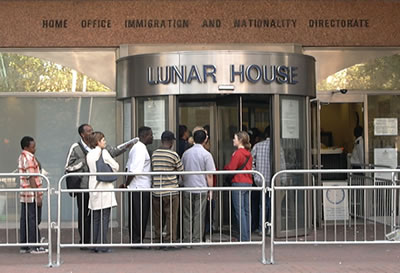
We had travelled a long way across London to get to our destination - Lunar House - home to the offices of the UK Border Agency (UKBA). It is an uninviting place at the best of times and on this dark morning it rose up like a Castle of Doom.


I had to make the journey with Nazira to the UKBA because she didn’t know how to navigate public transport in London. The plan was to accompany her into the building, as far as I was permitted and eventually leave her with an interpreter. Nazira’s mission was to claim asylum in the UK because Pakistan was no longer safe for her.


I had written a research paper in college on immigration to the UK and the honest-to-God truth is that its policies seemed designed to keep out Blacks and Asians. Lunar House, I knew, had a very dusty ‘Welcome’ mat; the word barely discernible; trampled upon by the thousands who came each day, and who it seems were often only grudgingly given entry into the UK.


So I was actually quite curious about what it would be like inside this notorious and famous building.


I knew within 20 minutes.


Asylum seekers are directed to a separate floor and Nazira was escorted up in the lift by a staff member while I was asked to take the stairs. I met her upstairs and we went through another round of security screening. The UKBA had a nice assemblage of races on display. A South Asian male officer went through our bags while a Caucasian male chatted with two women – one Black, the other Caucasian. They were discussing dry skin and how to moisturize it in the winter.


At the end of the screening, I approached their desk because Nazira doesn’t speak much English, and politely informed them that I was accompanying Nazira who wanted to make an asylum claim.


“Who are you?”, the Black woman shot back.


“I’m her case worker from a voluntary organization.”


“Do you have any identification?”


I didn’t because I hadn’t intended on staying with her. But since she asked me I showed her the only thing I had.


“I have a driver’s license.”


“Are you American?”


“No, I’m Indian.”


At this point, the White woman, who had been standing like a boarding school matron to the left of the desk, felt the need to butt in.


“Do you have a work permit?”


“Yes.”


“Hmm… strange. I wonder how that happened,” she said, being unnecessarily sarcastic.


They don’t like pesky representatives of asylum seekers because it forces them to be restrained. Not surprisingly, both women had it in for me. All veneer of professionalism was dropped and before me emerged two ordinary morons with extraordinary powers.


The Black woman said rudely, “I want you to stand back so that we can talk to her (Nazira).”


“Alright, but she needs an interpreter.”


“Yeah, we’ll have one but you go stand back. I don’t like who you are.”


I was outraged but unsure of how to respond to this verbal assault. I feared they would take it out on Nazira. But so stinging was the effect of her words that I laughed dramatically while repeating her words, saying, “You don’t like who I am? Ha!”


However, with no ID, I was forced to step back and let Nazira take over.


She was given a shitty ride. They attacked her in their fluent English without calling an interpreter while she mumbled feeble responses to them in whatever English she could muster up. They discredited her story openly and eventually told her to go wait in a queue for an interview. I don’t know what happened after that because the white male officer was dispatched to physically intimidate me into leaving the building.


Lunar House had spit me out in 20 minutes. The heat of my anger made me oblivious to the miserable cold outside. I walked back hotly to the train station to make the long journey back to the other side of town. It was as if all the adorable things about Britain – Marmite, Bobbies, double-deckers, Quality Street, Mini Coopers and afternoon teas – had all gone up in one big mushroom cloud of smoke.


One week later:


Nazira made her claim and will be called for an interview in January. My life is good and fine again and the perspective is back. They were two morons in a country of about 60 million.


Now where did I keep those chocolate Digestives?