I have finally finished scripting the story on the chaos in medical and technical education in Tamil Nadu. Big thanks to all of you who left messages and contacts here. But to be honest with you, I'm not happy with the final product. (It goes on air sometime between 9 and 10 pm on 'India This Week' today - 19th March, though, I'm probably not doing a good job of promoting it!)
Its been a difficult story to write what with trying to describe the myriad problems of higher education with its complex network of government and private institutions. TV is not a very information-friendly medium, so I'm afraid that the viewer will either be bored or befuddled by the twists and turns of the Common Entrance Test (CET) first being scrapped, then being restored, then the legislation scrapping CET being scrapped, then challenged... If I have lost you, the reader, by now, the viewer may have shifted to VH1 paragraphs ago.
I tried not to detail too many twists and turns, but there in the details, lay the devil, and, without it there was perhaps no story. Anyway, its an important story to tell because it's high time the Ministry of Human Resources Development seriously started thinking about introducing only ONE single test, like the SAT, going by the chaos on campus here. So if you do watch it.... I hope you find it engaging.
Sunday, March 19, 2006


Monday, March 13, 2006
WHAT AILS TECHNICAL EDUCATION?
I'm working on a story about technical education in Tamil Nadu - trying to look at flaws in policy-making (reservation for instance) and the affect of privatisation in the engineering education. The idea stems from the recent violence on the campuses of deemed universities and the TN government's move to scrap the Common Entrance Test of TNPCEE as it is better known. If you guys have any ideas, suggestions, opinions or better still experience of studying in one of these institutions do write in to me at alaphia@gmail.com. I'm also looking to interview students and parents so if any of you are currently studying and are willing to speak on camera do leave a number. My deadline is 16th evening - yes 3 days from now!
Friday, March 10, 2006
LOOKING BACK IN ANGER

A big thank you to all those who wrote in to find out how I was doing.
I won't get into the details of that night of vandalism on the SRM campus here, but I will say one thing - there are some seriously dangerous and delinquent officers in our police force.
The Superintendent of Police (SP) of the Kancheepuram district A Amal Raj sprang upon my cameraman, snatched our camera, broke it and then stole the tape. (It was returned to us after we complained to the Director General of Police.) But the frustrating agony is that nothing is being done to punish this man! Absolutely NOTHING!
1) The police have refused to register an FIR.
2) They have arrested two people (local goons who assaulted me) but they could well be fall guys because I have not been given a chance to identify them.
3) Revenue officials are conducting an enquiry into the affair because it involves a police officer. But, so far, I have received no phone calls from the said revenue officials. Considering i'm the 'victim', shouldn't I be in the picture somewhere?
If this is the way they treat journalists then I really do shudder to imagine how the common man must suffer at their hands. The police can do so much but they do so little. It tires me out now to constantly understand 'the system' and be more sympathetic to the pulls and pressures of working in government. Frankly, whats the point of understanding?
I dont think its too idealistic to say that if you want to be corrupt you will, if you want to abuse your power you will. However if you want to be clean but poor - you can.
Saturday, February 11, 2006
BOARD OF CONTROL FOR COMMERCE IN INDIA

The whole issue of copyright over cricket score SMSes is a “trial balloon” floated by the BCCI, according to a source, and the firm that has taken mobile phone companies to court is a front. The essential argument made by this firm (Marksman Marketing Services Private Limited) is that if there are audio rights and video rights why cant there be textual rights? So the BCCI is testing the waters to see if the courts will allow rights over text. It will obviously mean more money for the Board of control for cricket (or commerce) in India. Heres a gist of what both sides are saying – For all practical purposes, lets just call them – BCCI and Mobile Co.’s
BCCI: Scores constitute ‘hot news’ that I as the owner of a match can exploit.
Mobile Co.’s: Its hardly ‘hot’ because there is a delay in transmission of the SMS by atleast 4 minutes and Sec.13 of the Copyright Act has not been amended to include any concept of ‘hot news’.
BCCI: There is a shelf life to the news and by giving latest updates you are commercially exploiting my information.
Mobile Co.’s: Rubbish! Its not ‘your’ information and we get the news from TV so the scores are already in the public domain.
BCCI: It is an intellectual property
Mobile Co.’s: A cricket score is NOT intellectual property!
BCCI: If mobile phone companies make a tidy sum giving these updates, why should I – the owner of the event forego the right?
Mobile Co.’s: It’s a value-added service in larger public interest. We create the SMS so why should we pay you!
And so on and so forth. . . This is unchartered territory even in highly sophisticated sports marketing and the matter is likely to go all the way up to the Supreme Court resulting in a landmark judgment.
Friday, January 27, 2006
'WE THE PEOPLE' IN CHENNAI
'We the People', hosted by Barkha Dutt is being shot in Chennai this Sunday, 29th Jan. The topic is 'Is Chennai conservative?' If you'd like to participate please mail audience@ndtv.com, with all your contact details and what you do. (This does not guarantee participation since there is an outer limit) Not surprisingly we've got lots of confirmations from people with liberal views. So it will be great if you're actually someone who supports a dress code and conservatism. In case the mail bounces... just mail me. :)
Monday, January 23, 2006
ANNA UNIVERSITY – FADED GLORY

The Vice-Chancellor (VC) of the Anna University has banned cell phones on campus. So of course it cannot be used it class (a rule students WANT to obey) but it cannot even be used after class anywhere on campus. And, if you are even found in possession of one it is immediately confiscated. Now, in a protest letter to President Kalam, students write, “We are being frisked humiliatingly – an ignominy normally reserved for terrorists.”
The VC has also introduced a highly unpopular dress code. He thinks that by placing a blanket ban on cell phones and forcing people to dress a certain way he is introducing a greater degree of professionalism into college functioning. But little of all this he practices himself. He turned up half an hour late for my interview without intimating me of the delay. His arrival was preceded by a servile peon who carried in two of his cell phones while he walked in a little later with the third. And despite Anna University being a green campus, he zips around in his spanking, air-conditioned TATA Safari while some students have to walk nearly half a kilometer under the blazing sun just to get some lunch.
The letter written to the President is being circulated to gather signatures. It is written straight from the heart and shows the vice-chancellor in very poor light. The VC therefore is desperate to get hold of the letter. His office called and asked me for a copy and they were told kindly to go to hell.
But beyond the dress code and cell phone ban and harassment, students allege that there has been little academic advancement over the years. They say the syllabus has not been updated, labs lack proper equipment and the faculty does not spark their imagination. A moribund academic environment and the Talibanisation of the social and cultural climate on campus is the real Anna University today where the product just does not match the brand.
Thursday, December 29, 2005
ON A DEVASTATED ISLAND - AN ANCIENT TRIBE SURVIVES
Everything about the Andaman and Nicobar islands can leave the Indian mainlander staring with wide-eyed wonderment. For most journalists it was a similar experience - learning how these remote and largely inaccessible islands function, how their ancient tribes live and of course discover the endless beauty of its shores and what a world away these tiny dots in the ocean are from anything we see on the mainland. Vishnu Som, the Associate Editor (Defence) at NDTV was among the first journalists who landed in Car Nicobar after the December 26th tsunami. Here is his account of what he saw, what moved him and what became of one of the world's oldest tribes – the Shompen.
From Heaven to Hell: The Great Nicobar Story
By Vishnu Som Associate Editor (Defence), NDTV
Ever had the feeling of the ground sinking under your feet? It's a strange feeling, the earth gently quivering, not quite an earthquake, but not quite normal either. On Great Nicobar Island, India's southernmost landmass, nothing was normal. Ever since the magnitude 9 earthquake struck, just 40 kms away from where I was reporting, everything had gone topsy-turvy.
Late one evening, as I prepared for a live standup report from Cambell Bay, a small township on the northeast of the island, the ground started shaking again. Should I run, was this a major aftershock ... was another Tsunami just around the corner? Great Nicobar felt like a sinking ship, except that there were no lifeboats. In fact, there was nothing and no one really knew what to expect next. On the one remaining road which connected Campbell Bay and the tiny airstrip the Japanese had built during the Second World War, there were families of crabs, dozens of them, scurrying around. Inside the nearby Coast Guard headquarters, now partially under water, there was only one resident. A crocodile.
The waters of the Bay of Bengal were now just 20 feet away from us. If the waters rose even one foot more, the road would be under water and the only link to the airstrip would be severed. Not that it really mattered. Planes couldn't operate onto the airstrip at night. Rescue would not be possible. But the most frightening reality of Great Nicobar wasn't the aftershocks, or the crashing waves. It was the fact that there were no dead bodies, no over-filled hospitals, no stench of death and devastation and no illness. Those who had survived were in a handful of relief camps. Those who weren't there were dead, their bodies somewhere out there in the ocean, never to be recovered.
The knowledge of death brings with it a sense of closure. For the first several days after the Tsunami, many of those who made it to the relief camps lived with a sense of hope. Sure, their loved ones were missing but who was to say that they were dead?Thousands of people from the Andaman and Nicobar Islands are still missing. They have not survived. It's a reality many survivors on the islands have no choice but to slowly come to accept .
Elsewhere on the island, a remarkable story of surviving the odds. The Shompen, perhaps the most isolated tribe in the world date back between 30,000 and 70,000 years. Unlike some of the other tribes in the Andaman and Nicobar chain, the Shompen have conscientiously avoided any contact with `civilization,' content in living off the thick jungles which form the core of the island.Very little is known of the tribe. They are extremely shy, scurrying into the jungles at the sound of helicopters. Armed with poison-tipped spears, the nomadic Shompen hunt wild boar and fish in rivulets which run through the island.
The Shompen may have survived 70,000 years but had any of the 200 tribals survived the wrath of the Tsunami? I joined commandos of the Indian Navy in trying to find out.A day earlier, the first signs that at least some members of the tribe may have made it. Two naval pilots had spotted a Shompen dwelling in a densely forested area along a narrow rivulet. Today, it was time to verify the survival of the tribe.
With the jungles on the island too thick to land a helicopter, I was winched down into a narrow opening and joined by a young commando, a Lieutenant from the Navy in hiking to the Shompen village."Be careful where you tread. This undergrowth is infested with snakes and scoropns. Stay clear of the rivulet, there may be crocs" I was warned. As I hiked along the slippery, muddy slopes alongside the rivulet, falling to my knees every fifty metres or so, I spotted the Shompen village - 6 small thatched structures built on stilts at least 15 feet high and 3 smaller enclosed pens nearby. Wading across the rivulet and climbing the thick slope on the opposite side, we reached the dwelling.
There were no Shompen.
This was a deserted village. Or was it?"They're here said Lieutenant K U Singh. And they're watching. They're probably a 100 metres away from us looking on at us from somewhere there" he said pointing to the thick forests which ringed one side of the village. And sure enough, the signs of the tribe having survived were all there. Smoke from what looked like a cooking utensil, freshly cut fruit, footprints in the mud and wild boar in bamboo cages under the Shompen huts. Soon, it was time to leave. No one really knew about the behaviour patterns of the Shompen and there was every possibility that they could attack. In any event, our goal was not to disturb the tribe, only verify their survival through a natural disaster of unimaginable proportions.
The next day, my last on Great Nicobar, was perhaps the ultimate reality check, an opportunity to view the island from the air, and gauge the true extent of the topographical damage.The Navy flew me along the coastline. Within minutes we were at Indira Point, the southern-most point of India. The lighthouse at the southern tip of the island was ten feet under water, the 16 people who worked here, presumed dead. They had no chance. The Tsunami waves struck the lighthouse less than 5 minutes after they were triggered by the earthquake.
But it was the Western coastline of the islands where the fury of the Tsunami was most evident. Every few kilometers, there were dagger-like blows into the jungles along the coast, sea water making its way upto three kilometers inland, parts of the island completely cut-off, now islands by themselves. However, there was one silver-lining. The parts of the island worst hit by the Tsunami were also the least populated and that really was the saving grace on Great Nicobar. Only 7,500 people lived on the island. 567 are thought to have died. Only 27 bodies have been found, of which just 10 have been identified.
For me as a journalist, the Great Nicobar story was not just about death and suffering. It was also about survival, courtesy a few good men, soldiers of the Indian Army, a few Coast Guard Officers, transport pilots of the Indian Air Force and helicopter pilots of the Indian Navy.Two stories stands out.
Within days of the Tsunami, two Navy pilots flying a tiny Chetak helicopter off the deck of a destroyer rescued a remarkable 170 people from a settlement to the south of Campbell Bay. On each trip, their helicopter could not carry more than 2 survivors but that didn't deter them. They kept flying for more than 5 hours non-stop, landing more than a 100 times in order to bring trapped islanders to safety.
Elsewhere, a young Major of the Indian Army felt that those who survived the disaster may have lost everything, but shouldn't feel that they have lost their dignity. And so, he ordered his soldiers out of their barracks and made them camp outside in the open, while survivors were put into the soldier's barracks and given three proper meals a day.No one knows what is going to happen to Great Nicobar. Most of the settlers who were brought here in the late sixties have lost everything. Most families worked on betel nut and coconut plantations which have been devastated by the giant waves. It takes between 12-14 years for these trees to grow back to their full height. Earning a living off these plantations is just not a possibility.
And then there's the fear factor.
Tremors continue to be felt on the island and the coastline has receded sharply. Sea water levels remain higher than normal. All settlements will have to move further inland, a process of resettlement which may take years.Great Nicobar was a tropical paradise. Warm seas, a stunning coastline, a laid back life. Today, it seems to have gone back a century. A handful of settlers, a handful of soldiers and ofcourse the ever-present Shompen.
(Vishnu Som was the first journalist into Great Nicobar Island and the first to independently corroborate the survival of the Shompen tribe.)
From Heaven to Hell: The Great Nicobar Story
By Vishnu Som Associate Editor (Defence), NDTV
Ever had the feeling of the ground sinking under your feet? It's a strange feeling, the earth gently quivering, not quite an earthquake, but not quite normal either. On Great Nicobar Island, India's southernmost landmass, nothing was normal. Ever since the magnitude 9 earthquake struck, just 40 kms away from where I was reporting, everything had gone topsy-turvy.
Late one evening, as I prepared for a live standup report from Cambell Bay, a small township on the northeast of the island, the ground started shaking again. Should I run, was this a major aftershock ... was another Tsunami just around the corner? Great Nicobar felt like a sinking ship, except that there were no lifeboats. In fact, there was nothing and no one really knew what to expect next. On the one remaining road which connected Campbell Bay and the tiny airstrip the Japanese had built during the Second World War, there were families of crabs, dozens of them, scurrying around. Inside the nearby Coast Guard headquarters, now partially under water, there was only one resident. A crocodile.
The waters of the Bay of Bengal were now just 20 feet away from us. If the waters rose even one foot more, the road would be under water and the only link to the airstrip would be severed. Not that it really mattered. Planes couldn't operate onto the airstrip at night. Rescue would not be possible. But the most frightening reality of Great Nicobar wasn't the aftershocks, or the crashing waves. It was the fact that there were no dead bodies, no over-filled hospitals, no stench of death and devastation and no illness. Those who had survived were in a handful of relief camps. Those who weren't there were dead, their bodies somewhere out there in the ocean, never to be recovered.
The knowledge of death brings with it a sense of closure. For the first several days after the Tsunami, many of those who made it to the relief camps lived with a sense of hope. Sure, their loved ones were missing but who was to say that they were dead?Thousands of people from the Andaman and Nicobar Islands are still missing. They have not survived. It's a reality many survivors on the islands have no choice but to slowly come to accept .
Elsewhere on the island, a remarkable story of surviving the odds. The Shompen, perhaps the most isolated tribe in the world date back between 30,000 and 70,000 years. Unlike some of the other tribes in the Andaman and Nicobar chain, the Shompen have conscientiously avoided any contact with `civilization,' content in living off the thick jungles which form the core of the island.Very little is known of the tribe. They are extremely shy, scurrying into the jungles at the sound of helicopters. Armed with poison-tipped spears, the nomadic Shompen hunt wild boar and fish in rivulets which run through the island.
The Shompen may have survived 70,000 years but had any of the 200 tribals survived the wrath of the Tsunami? I joined commandos of the Indian Navy in trying to find out.A day earlier, the first signs that at least some members of the tribe may have made it. Two naval pilots had spotted a Shompen dwelling in a densely forested area along a narrow rivulet. Today, it was time to verify the survival of the tribe.
With the jungles on the island too thick to land a helicopter, I was winched down into a narrow opening and joined by a young commando, a Lieutenant from the Navy in hiking to the Shompen village."Be careful where you tread. This undergrowth is infested with snakes and scoropns. Stay clear of the rivulet, there may be crocs" I was warned. As I hiked along the slippery, muddy slopes alongside the rivulet, falling to my knees every fifty metres or so, I spotted the Shompen village - 6 small thatched structures built on stilts at least 15 feet high and 3 smaller enclosed pens nearby. Wading across the rivulet and climbing the thick slope on the opposite side, we reached the dwelling.
There were no Shompen.
This was a deserted village. Or was it?"They're here said Lieutenant K U Singh. And they're watching. They're probably a 100 metres away from us looking on at us from somewhere there" he said pointing to the thick forests which ringed one side of the village. And sure enough, the signs of the tribe having survived were all there. Smoke from what looked like a cooking utensil, freshly cut fruit, footprints in the mud and wild boar in bamboo cages under the Shompen huts. Soon, it was time to leave. No one really knew about the behaviour patterns of the Shompen and there was every possibility that they could attack. In any event, our goal was not to disturb the tribe, only verify their survival through a natural disaster of unimaginable proportions.
The next day, my last on Great Nicobar, was perhaps the ultimate reality check, an opportunity to view the island from the air, and gauge the true extent of the topographical damage.The Navy flew me along the coastline. Within minutes we were at Indira Point, the southern-most point of India. The lighthouse at the southern tip of the island was ten feet under water, the 16 people who worked here, presumed dead. They had no chance. The Tsunami waves struck the lighthouse less than 5 minutes after they were triggered by the earthquake.
But it was the Western coastline of the islands where the fury of the Tsunami was most evident. Every few kilometers, there were dagger-like blows into the jungles along the coast, sea water making its way upto three kilometers inland, parts of the island completely cut-off, now islands by themselves. However, there was one silver-lining. The parts of the island worst hit by the Tsunami were also the least populated and that really was the saving grace on Great Nicobar. Only 7,500 people lived on the island. 567 are thought to have died. Only 27 bodies have been found, of which just 10 have been identified.
For me as a journalist, the Great Nicobar story was not just about death and suffering. It was also about survival, courtesy a few good men, soldiers of the Indian Army, a few Coast Guard Officers, transport pilots of the Indian Air Force and helicopter pilots of the Indian Navy.Two stories stands out.
Within days of the Tsunami, two Navy pilots flying a tiny Chetak helicopter off the deck of a destroyer rescued a remarkable 170 people from a settlement to the south of Campbell Bay. On each trip, their helicopter could not carry more than 2 survivors but that didn't deter them. They kept flying for more than 5 hours non-stop, landing more than a 100 times in order to bring trapped islanders to safety.
Elsewhere, a young Major of the Indian Army felt that those who survived the disaster may have lost everything, but shouldn't feel that they have lost their dignity. And so, he ordered his soldiers out of their barracks and made them camp outside in the open, while survivors were put into the soldier's barracks and given three proper meals a day.No one knows what is going to happen to Great Nicobar. Most of the settlers who were brought here in the late sixties have lost everything. Most families worked on betel nut and coconut plantations which have been devastated by the giant waves. It takes between 12-14 years for these trees to grow back to their full height. Earning a living off these plantations is just not a possibility.
And then there's the fear factor.
Tremors continue to be felt on the island and the coastline has receded sharply. Sea water levels remain higher than normal. All settlements will have to move further inland, a process of resettlement which may take years.Great Nicobar was a tropical paradise. Warm seas, a stunning coastline, a laid back life. Today, it seems to have gone back a century. A handful of settlers, a handful of soldiers and ofcourse the ever-present Shompen.
(Vishnu Som was the first journalist into Great Nicobar Island and the first to independently corroborate the survival of the Shompen tribe.)
Wednesday, December 28, 2005
DAUGHTERS OF THE WAVE, WALK ON

This is a piece I wrote for the first anniversary of the tsunami. I was given all of three days to shoot this story and with almost a month of rain and floods, I had little time to research what was really going on in the tsunami-affected areas. I employed three strands in my story to give viewers a big picture – that the men turned lazy, that women are pulling their weight with help from banks and donor agencies and a strong culture of self-help groups, and that the grief for individual families is still very raw and fresh. Its been re-written in parts to make it a print script. Here it is.
Across Tamil Nadu's tsunami-ravaged coast-line some scenes are common – women gathered in groups – some are weaving baskets, some others are making soaps, somewhere else they’re making dolls, yet another group is making slippers…. the list is long and the road has been hard. But many of these women of the tsunami have shown that the path to salvation is through self-help.
When Palamma returns with her large metal carrier – you know shes been at work selling fish. She didn't make much money today but shes grateful that her familiar routine has been restored. This routine has returned after months of struggle. The fishermen were first beset by a fear of the ocean, then they were happy to live off generous NGO and government doles. But their inaction was making Palamma and many fish-sellers like her - desperate. So she and the other women in the hamlet started applying pressure on the men. Palamma says, “We told them not to be scared and to overcome their fears. We said, the tsunami wasn’t going to come again so they should start their regular fishing and then slowly things began.”
The collector of Nagapattinam, Dr. J Radhakrishnan, a man responsible for reducing the turnaround time on restoring livelihood says that Palamma’s hamlet of Nambiar Nagar set off a trend. “'When the catch came and it was so huge the word went around to the other hamlets. The catalystic role played by the women in that hamlet was perhaps very critical for the other hamlets to realise the bounty available in the sea for them to follow suit and then it caught on like fire and people went fishing... this is one area where I am very thankful to the fisherwomen.”
But fishing activity is going through its annual lean season again and today in most villages you’ll find groups of men at street-corners playing cards.
But a once highly insular fishing community has learnt one very hard lesson – the importance of an alternative livelihood – another skill that can sustain them. Women have shown the lead by coming together in these self-help groups to learn new skills and men are now seeing its virtues.
Sister Lily Pushpam from an NGO called the Daughters of Mary Immaculate has been training self-help groups (SHG’s) for the past 12 years. We met her as she was beginning training with a new group of women. She says the burden of the times is shared unequally. She observes, “Men actually have become lazy because after the tsunami NGO's and voluntary organisations have given enough materials....so their mentality today is to ask of whoever comes from outside. They ask for money or materials. The first question is always - what are you going to give?”
But womens groups are also more successful because of their higher credit-worthiness and SHG’s in Nagapattinam have already saved upto 6 crore rupees! It's real empowerment for people like Kavitha. She had been a housewife till the tsunami forced her out, because it killed her husband. After learning printing she makes about 2700 rupees a month – enough to sustain her young son and her. She prints bags that carry the brand name of the products made by the women of Nagapattinam – 'Alai Magal' or 'daughter of the wave'. Then Kavitha's along with the products of hundreds of other groups travels to a specially set up market called ‘Rural Bazaar’ and also to exhibitions in different cities. Through the bazaar one group has even received an order of candles worth 5 million rupees from Netherlands. But the scenario is not entirely optimistic. The difficulty lies in finding and sustaining markets for these products. The district administration has come out with a brochure on all the available products but even they are nervous about the challenges. Dr. J Radhakrishnan says, “What we are worried about is the capacity of these SHG's to manage the requirements of the market once they attain the quality.”
If you want to help you should visit a store called ‘Tsunami ka dukaan’ that has opened recently in Pondicherry. (Its very close to Goubert Avenue. Ask for an art gallery called ‘Aurodhaan’ and they’ll direct you.) The process of the governments disengagement from rehabilitation can only begin once people start patronizing such stores. This enterprise shown by the victims has had both monetary and psychological benefits. Its helped soothe traumatized minds where hope and despair can be easy bedfellows.
I found that the people most desperately searching for a new reason to exist are parents who lost all their little children to the tsunami. One such couple is Selvi and Vijaykumar. The couple lost all their five daughters to the tsunami. But life throbs inside Selvi again. She was one of 50 women who underwent a surgery to reverse an earlier sterilization operation. Only four women have been able to conceive so far and Selvi is one of them. But having this baby will be very different for her. Her husband remains slumped in mourning, a strong smell of alcohol surrounds him, he speaks reluctantly and his face contorts with grief at the mention of his five girls. The name of ‘Sneha’, his favourite daughter, is etched across his heart. He says, “I just drink to forget….i loved Sneha because she was just like a boy. Very boisterous and playful. No matter what time I came home, she’d be awake, waiting for me. She would only go to bed after I bought her a little trifle.’
Vijaykumar has contemplated suicide very often. But somewhere deep inside he does hope to be holding his sixth child soon. Palamma hopes to be making more money once the lean season gets over and the women who are diligently employing their new skills are hoping their products will continue to inspire clients. For now, if you're looking for hope, you'll find it in Nagapattinam.
THINKING ALOUD
Viewers often accuse the media of jumping from story to story without telling them enough about anything and without doing enough follow-ups. It’s a valid criticism. Then, why I wonder, is the market not dictating terms to news-channels? Why isn’t there a greater need for independent documentary film-makers who can bring in the analysis and follow-ups that the viewers are looking for?
Wednesday, November 30, 2005
WAKE-UP CALL IN TRICHY
One afternoon while covering the floods in Trichy I found myself wading through knee-deep water in the interiors of a residential colony. It was lunch-time but I figured if I tried to get out it will take me half an hour. 45 minutes for lunch (I eat slowly) and then another 30 to get back in. Not worth it. Skip lunch and continue wading.
By the time I got back to my hotel room at 10 pm, I was ragingly ravenous. I decided dinner had to be elaborate and stylish. I opened the menu and went straight for the white meat. I wanted soft, tender chicken, preferably marinated, drenched in a sweet-and-sour sauce with a generous dollop of mashed potatoes.
With such longing in my heart, I searched for the chicken dishes. I found the page but it was titled, (brace yourself) ‘Cock-a-doodle-do’.
All plans of an elaborate dinner were hastily abandoned. I settled for rice.
By the time I got back to my hotel room at 10 pm, I was ragingly ravenous. I decided dinner had to be elaborate and stylish. I opened the menu and went straight for the white meat. I wanted soft, tender chicken, preferably marinated, drenched in a sweet-and-sour sauce with a generous dollop of mashed potatoes.
With such longing in my heart, I searched for the chicken dishes. I found the page but it was titled, (brace yourself) ‘Cock-a-doodle-do’.
All plans of an elaborate dinner were hastily abandoned. I settled for rice.
Wednesday, November 23, 2005
ANGREJI - ALL OUR OWN
The English language is a rich source of laughter when employed by those who do not speak it entirely well. Here are two instances of considerable distortion of the correct, beautiful thing. I doubt if the persons who uttered the words will ever visit my blog, but i will spare them the embarrassment by avoiding their names.
"Why did you go for Khushboo's throat like this?", I quizzed a politician. Denying the charge, he replied, "Naw, naw, we did not do any protest... the women were naturally aroused when they heard khushboo." (Then they do pretty strange things when naturally aroused.)
A sweet old man, who is a bit of a "source" wanted me to call him before I went over to his house. He likes to speak my language - the language of the young and trendy, so he said, "Please give me a tune before you come." I am going to meet him now after giving him that tune.
"Why did you go for Khushboo's throat like this?", I quizzed a politician. Denying the charge, he replied, "Naw, naw, we did not do any protest... the women were naturally aroused when they heard khushboo." (Then they do pretty strange things when naturally aroused.)
A sweet old man, who is a bit of a "source" wanted me to call him before I went over to his house. He likes to speak my language - the language of the young and trendy, so he said, "Please give me a tune before you come." I am going to meet him now after giving him that tune.
Wednesday, November 09, 2005
"SHOPPERS BATTLE TERRORISM", REPORTERS
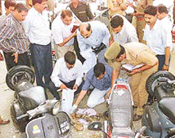
It’s a post that has been floating around in my head for the last 10 days – ever since the Delhi blasts happened. Perhaps the events of that day have already faded from public memory but I think I need to get it out of head anyway.
This is primarily a rant against television news. I don’t know how many of you felt the same irritation I experienced while watching television the following morning.
The reportage of the blasts was muddled, jingoistic and trivial all at once. I got more information out of watching 5 minutes of BBC World than I did out of watching 20 minutes of various Indian channels.
The first complaint is that this expression ‘Dilhi dilwaalo ki’ (loosely translated….Delhi – city with a heart) suddenly caught the fancy of reporters and interviewees alike. But it is so hopelessly out-of-sync with Delhi as we know it that it sounded only superficial - hardly creating a lump in the throat that it was perhaps expected to. Also, faced with such a unique situation, most people do respond humanely. And then the very next morning they go back to fighting with their neighbours over water and parking space. So were we really expected to buy this ‘dilwalo ki’ business?
The other triviality that was covered ad nauseam was the fact that shop-keepers around the blast sites had opened up the very next day for business. Reporters seemed to want us to believe that it was their resilience and their will to fight the terrorists that made them do so. But it sounded extremely insincere. Shoppers were interviewed and many of them said, “life goes on.” Of course, “life does go on”, but such banal philosophy on the morning of the blasts sounds insensitive not resilient.
To me, it seemed like these people were back on the streets simply because they knew that lightning does not strike in the same place twice or because of that old “It-will-not-happen-to-me” attitude. But, armed with heavy shopping bags, these shoppers were projected as some kind of exalted heroes at the forefront of the battle against terrorism.
The problem with 24-hour TV news is that it is an insatiable monster. So anything you feed it, it will eat. I can shrink the entire mornings coverage of the blasts in a few lines.
Shops around the blast sites have re-opened for business. Shop-keepers here say they are not going to be intimidated by the designs of a few terrorists. But it also happens to be one day before Diwali – the best time for business. And sure enough, the shoppers are back. Meanwhile, the death toll from last evenings blasts has gone up to xyz. A little-known group called so-and-so has claimed responsibility for the attacks and the Delhi police is investigating the organizations various other links. Raids have been conducted in 20 locations and x number of people have been arrested and interrogated.
8 lines. But on television somewhere between the barrage of useless, irrelevant un-information, we had to glean this hard kernel of real news.
Sunday, October 23, 2005
A MEETING WITH GERE

You meet the gorgeous man from ‘Pretty Woman’ and one of the first things he does is show you a tear in his trousers. Just as he was sitting down for the interview Richard Gere said to me, “I’m so jet-lagged and tired… look even my trousers are torn.” I just smiled and said, “Welcome to chennai.” (?? D’Oh!!?)
From then on I was determined to be a better conversationalist. The moments while your cameraman is checking the lights and sound are always extremely awkward. The interviewee is sitting right there in front of you and you’ve got to make easy conversation till you can abruptly start when you hear the word, “rolling”. What easy conversation do you make with Richard Gere? Turned out I didn’t have to worry about that. Gere is a seasoned TV interviewee.
He began to fill the space by beginning with, “Have we met before? You looked so familiar sitting there in the press conference.” (I was meeting him in an ante-room after his presser with Kamal Hassan, Parmeshwar Godrej and Kalanidhi Maran) I told him we hadn’t, although I was flattered for some reason. We started talking about this and that and he enquired about Dr. Prannoy Roy. But even as we talked, I began to get a bit fidgety because I was still not getting the green signal from my cameramen. Richard Gere immediately noticed that and wonderful gentleman that he is, asked me if the other people in the room were making me nervous. I assured him they weren’t and a nice woman from ABC news (cant remember her name now but her handshake is memorable… she was very strong), also chipped in with, “Its her cameramen who are making her nervous.”
Anyway, so the interview finally began. My introduction to camera was smooth and I set him talking about his mission of spreading awareness on HIV and AIDS. He has given these interviews many, many times so his sentences flowed like an extension of repeated thought. For an interviewer, that is always disheartening. Its as if your questions are not inspiring your interviewee to think anew about the same things.
However, I felt his body language change a little bit after the third question. I had kept the best questions for later. His reply was more spontaneous and thinking yet clear and concise. But just as I was settling in, his manager warned me that I could ask only one more question. My exclusive time with him had been eaten up by the technical delay.
So I shot my last question to which I think he gave me his most spontaneous answer. I was very pleased but had to wind up, at the point where I thought it was really getting interesting. Imagine my delight when he said, “I wish we had more time.” I could only say, “Me too.”
Incidentally, white hair and torn trousers have never looked more becoming on a man.
Wednesday, October 19, 2005
HELLO-SNARL-GOODBYE
You'd expect the State Human Rights Commission (SHRC) to be an approachable, welcoming body, right? You'd expect it to have people who are benign, learned and kind, right? You'd expect it to be headed by persons who truly believe in an egalitarian society, right? And most of all, you'd expect it to have people willing to listen, right? Wrong.
I called the State Human Rights Commission in Chennai and asked to speak to one of its members - Justice S Thangaraj (former judge of the Madras High Court). When he came on the line, I wished him good afternoon, very politely, and introduced myself. Anyone who doesnt wish you back is strange. And he was. Undeterred I proceeded to ask him the status on a particular complaint and enquired when the investigation would be complete.
But instead of answering my questions, he began to yell at me! He ticked me off for nosing around and said I had no business filing such stories. Also, he made the bizarre allegation that I ought not to be calling him, but coming in person. So, if I was to land up at the SHRC office and find the venerable Justice S Thangaraj out of his seat, thats alright. Afterall, I have no business to try and speak with him on the phone before that!! It took me a moment to understand the ludicrous comment he had just made but when I finally recovered, to defend myself, he hung up on me mid-sentence and didnt pick up that line despite many attempts to call back.
My rationate is very simple - if this is how he treats me, this is probably how he treats people who appear before the Commission with complaints. And people who do are generally very poor, politically voiceless and deeply wronged. Upon such people we have unleashed the likes of Justice S Thangaraj.
I called the State Human Rights Commission in Chennai and asked to speak to one of its members - Justice S Thangaraj (former judge of the Madras High Court). When he came on the line, I wished him good afternoon, very politely, and introduced myself. Anyone who doesnt wish you back is strange. And he was. Undeterred I proceeded to ask him the status on a particular complaint and enquired when the investigation would be complete.
But instead of answering my questions, he began to yell at me! He ticked me off for nosing around and said I had no business filing such stories. Also, he made the bizarre allegation that I ought not to be calling him, but coming in person. So, if I was to land up at the SHRC office and find the venerable Justice S Thangaraj out of his seat, thats alright. Afterall, I have no business to try and speak with him on the phone before that!! It took me a moment to understand the ludicrous comment he had just made but when I finally recovered, to defend myself, he hung up on me mid-sentence and didnt pick up that line despite many attempts to call back.
My rationate is very simple - if this is how he treats me, this is probably how he treats people who appear before the Commission with complaints. And people who do are generally very poor, politically voiceless and deeply wronged. Upon such people we have unleashed the likes of Justice S Thangaraj.
Friday, October 14, 2005
STORY?!
Apologies to those who tuned in. The story must have been dropped at the last minute. Such are the vagaries of television news. Sigh... It did go on air today though. (14th), but guess what, i missed it too.
Thursday, October 13, 2005
IIPM vs BLOGGERS
Okay.. Yet another update. Though i have the sinking feeling very few people will read this on time. The blogger story will go on air NOW. The latest I know is that its going on air on the 8 and 9 'o' clock bulletins on NDTV 24*7 on 13th October. Thats right - tonight.
But if you miss it - take heart. We are planning to do a longer story on blogging pegged around this issue. Do leave your thoughts here on possible angles to such a story.
The last time we did such a story I think there was some confusion on who the target audience should be. Should it be the vast majority who do not blog and thus run the risk of perhaps not getting them interested in the topic or do we talk to bloggers but run the risk of telling them things they already know. I guess like a good general news feature it should interest anyone - So how do you do that? Will be picking my brain over that.
But if you miss it - take heart. We are planning to do a longer story on blogging pegged around this issue. Do leave your thoughts here on possible angles to such a story.
The last time we did such a story I think there was some confusion on who the target audience should be. Should it be the vast majority who do not blog and thus run the risk of perhaps not getting them interested in the topic or do we talk to bloggers but run the risk of telling them things they already know. I guess like a good general news feature it should interest anyone - So how do you do that? Will be picking my brain over that.
Saturday, October 01, 2005
PRESS, POLICE AND PRIVACY

Recently a Tamil newspaper called ‘Dina Malar’ did something despicable to increase their sales. Their photographer, invited to cover a fashion show at a club called ‘Pasha’, trained his lens instead on couples on the dance floor. Close-ups of couples smooching and drinking were then splattered all over the newspaper - an utter and complete violation of journalistic ethic because it was a brazen invasion of privacy.
But before the outrage could even begin, the police stepped in and did something even more ridiculous. They arrested two staff members at the hotel where the pictures were taken! The charges against them were that they were permitting obscene behaviour and operating the bar without a license.
A favourite with Chennaiites - 'Pasha' will have to be on mute for the next three months according to court orders.
The police wants us to believe that the photographs of the smooches was the tip of the ice-berg. But hey…we all party and go clubbing. I have never seen anything that descends into something so obscene that people need to be arrested for it. 'Pasha' was made to appear like a den of vice, which it is not.
The buzz for a while was that the police was looking for the couples who were photographed kissing on the dance floor. Is anyone looking for that photographer?
ERROR IN CONNECTION

I called Airport Enquiry at 11:45 pm on the night following the strike called by Left unions all over the country. All I needed was to find out when the Thai Airways flight from Colombo would land. A gruff sounding man answered the phone. I was at the wrong place, he said, but instead of giving me the correct number he hung up.
Dialing another number led to an ‘error in connection’ message. The third line was not in existence either. The fourth line I tried, a lady picked up the phone. She told me I was calling the wrong number and kindly gave me the right one. But that line didn’t exist as well! I called back the number with the same lady at the end of the line. She tried connecting me to Thai Airways – no reply. I tried the last enquiry number she gave me. Dead again.
Dipanker Mukherjee of the CPI(M) was in the NDTV studio, brandishing a document on their alternative to privatization of airports. They would do well to begin with a damn enquiry number that works.
Its difficult to be sympathetic towards government employees who promise to run your airports efficiently, when they can barely tell you whether a flight has landed.
Sunday, September 04, 2005
THE TRAUMA OF SUICIDE SURVIVAL
The number of young women between the age group of 15 to 25 attempting suicide by consuming acid is on the rise. According to hospital records more than 6000 such patients were admitted to various government hospitals in Chennai city last year. Nearly 5700 survived. But that's the problem. It's where the tragedy actually begins.
Dr. S M Chandramohan, Professor of Gastroenterology at the Government Royapettah Hospital says, "When they consume acid, they think they're going to die. But they dont die. Its a myth."
Emotionally vulnerable women reach for the cheapest, most accessible option available to kill themselves - bathroom cleaners at home that contain acid. While an acid concentrate in a chemistry lab is enough to kill, diluted cleaning acids stop short. They are potent enough to burn up your innards but not enough to kill you. So most people live but end up destroying their lives.
They are unable to eat, talk or even swallow their own saliva! The entire apparatus from the oesophagus to the stomach is rendered useless. Making these patients eat again, is the first priority for doctors. In fact, Dr. Chandramohan has pioneered a new surgical method to enable patients to do so. He says, "The south Indian stomach is an extremely bulky one because we are traditional rice eaters. This has come in handy - we are able to stretch the stomach right upto the mouth and once they are connected patients can eat again."
I found this solution extremely interesting.
Consuming acid has become such a disturbingly common method of suicide that the Health Secretary of Tamil Nadu is now planning to write to the Drug Controller to request that cleaning acids be made available in soap form.
If ever you're in the presence of someone who has just consumed acid, remember NOT to make them throw it up. That will only re-expose their insides to the corrosive liquid. Give them some water (if they can manage to down it) and rush them to a hospital.
Dr. S M Chandramohan, Professor of Gastroenterology at the Government Royapettah Hospital says, "When they consume acid, they think they're going to die. But they dont die. Its a myth."
Emotionally vulnerable women reach for the cheapest, most accessible option available to kill themselves - bathroom cleaners at home that contain acid. While an acid concentrate in a chemistry lab is enough to kill, diluted cleaning acids stop short. They are potent enough to burn up your innards but not enough to kill you. So most people live but end up destroying their lives.
They are unable to eat, talk or even swallow their own saliva! The entire apparatus from the oesophagus to the stomach is rendered useless. Making these patients eat again, is the first priority for doctors. In fact, Dr. Chandramohan has pioneered a new surgical method to enable patients to do so. He says, "The south Indian stomach is an extremely bulky one because we are traditional rice eaters. This has come in handy - we are able to stretch the stomach right upto the mouth and once they are connected patients can eat again."
I found this solution extremely interesting.
Consuming acid has become such a disturbingly common method of suicide that the Health Secretary of Tamil Nadu is now planning to write to the Drug Controller to request that cleaning acids be made available in soap form.
If ever you're in the presence of someone who has just consumed acid, remember NOT to make them throw it up. That will only re-expose their insides to the corrosive liquid. Give them some water (if they can manage to down it) and rush them to a hospital.
Friday, September 02, 2005
THE INSIGHT INTO A STORY

Sometimes an insight into a story comes from unrelated events.
I was in Pudukottai in southern Tamil Nadu, doing a story on a group of Muslim women who have set up an all-womens jamaat. That is a big deal because traditionally the jamaat has been a male bastion. The jamaat is attached to every mosque and plays the role of conscience-keeper and arbitrator, doling out justice for the people who come before it.
But justice is not always done. To begin with, muslim women are not allowed to appear before the all-male jamaat. (Here, im talking only of Pudukottai. Maybe its different in other parts of the world). So if its a divorce, the husband is present to plead his case but the female is represented by a brother or father.
One of the womens jamaat members said, "The woman is involved in the dispute, but when it comes to the final resolution, she is nowhere in the picture!"
The all-womens jamaat was set up to deal with such and various other discriminatory practices. Sharifa Khanam, a bold, brassy woman set it up so that Muslim women would find a voice. She says, "This is not about religion, this is about power. Islam is a fair religion but these men have appropriated power over the years and dont want to give it up now."
I stored away that comment at the back of my mind and went out in search of these "megalomanical" men. I met some professors at the Arabic College in Pudukottai. All of them said that Sharifa and all the others in the jamaat were immoral. One bearded sage said, "They have a baaad character. They dont even wear the purdah...they come out in their nightie!" These men were genuinely of the opinion that a womans rightful place is at home.
Still i thought - old men stuck in their old thinking. So i searched for more men. More views.
I decided to find them outside a mosque after the evening prayer. Gathering a group around me i asked, "What do you think of the womens jamaat?" Most of them were dismissive of them, some even disdainful. The local cleric said, "Women should obey men. Thats the way it is in the shariat."
I began to believe the womens side of the story more - all the talk of oppression. But i was a bit unsatisfied because i felt i was reporting it in a he-said, she-said kind of way. Anyway, i decided to wrap up and shoot my piece-to-cameras or PTCs (where reporter stands before camera and delivers a few lines) and then head back home.
I planned to do a PTC right outside the mosque where I had met all those men. So the following day i was there again. But this time it was different. They were hostile. They didnt want me around. They thought i was being too nosey and that i should take my camera and leave. But they didnt bother being civil about it. Rude, ungentlemanly and arrogant - that's what they became. That's how they told me to bugger off.
I stood my ground and did the PTC right outside the mosque and indeed in quarreling with me, they had done me a favour. I finally got a real insight into how they must talk to their wives and daughters. The way they tried to bully me, I figured that they dont really treat women as equals. And in trying to collar me out, i felt that they were intolerant of too much questioning.
It didnt make a difference to the way i wrote the story. The "facts" of the case remained the same. I had no additional information - just a deeper insight. That's what I was talking about.
Subscribe to:
Posts (Atom)